



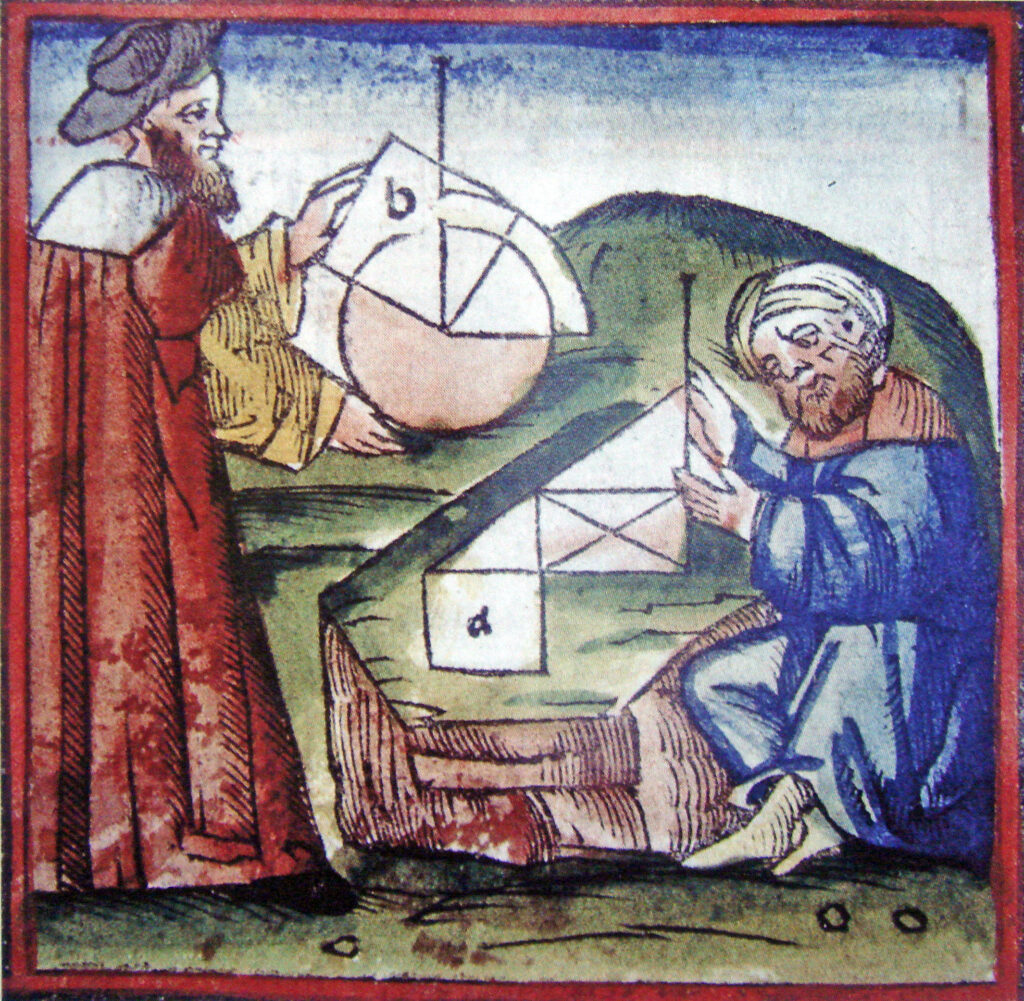
Most adults assume geometry is something you “learn” in school—lines, angles, rules, proofs, and pain.
But what if the brain starts building geometry years before any teacher draws a triangle on the board?
A well-known research paper by Véronique Izard and Elizabeth Spelke tested exactly that idea, using a clever “deviant detection” task across multiple experiments. The results are both reassuring and unsettling: children see some geometric truths early, but remain blind to other shape properties far longer than you’d expect.
The twist: children notice distance and angles early—mirror images, not so much
In their experiments, preschoolers were already good at detecting relationships of distance and angle in shapes. But when the only difference was that a figure was a mirror image of another (what the authors call “sense”), young children largely missed it.
That’s a big deal, because “sense” is what separates left from right, clockwise from counterclockwise, and one orientation from its mirror twin—an ability that sounds basic, yet develops late.
A universal pattern: what’s hard for toddlers stays hard for adults
Here’s the part that hits hardest: the study didn’t just find that kids improve with age. It found that the pattern of what’s easy vs hard is surprisingly stable over development.
In one large sample (ages 3 to 51), the items most difficult for the youngest children were also among the hardest for adults—despite decades of experience and education.
So it’s not just “kids are worse.” It’s that the human visual system seems naturally tuned to some geometric properties more than others.
Geometry competence peaks around 12—before formal geometry class
Another headline result: sensitivity to the tested geometric properties improved through childhood and reached an asymptote around age 12, before most students begin formal axiomatic geometry (typically later in school).
In other words: a large portion of the geometric intuition we rely on may come from everyday experience and core perceptual systems—not from classroom proofs.
The “right angle moment”: when kids start treating 90° as special
The paper also reports something fascinating: between 8 and 10 years old, children begin to give a privileged status to perpendicularity—they start to treat right angles as a “special” kind of relationship.
That’s not just better perception. It hints at a reorganization of geometric understanding—like the brain is upgrading from “rough comparisons” to rule-like structure.
The big conclusion: two sources of geometry in the mind
The authors argue geometric competence emerges from an interplay of:
- early, likely universal intuitions (especially about length and angle)
- later-acquired distinctions (including mirror-image “sense,” and special status for relations like perpendicular/parallel)
This framing matters because it bridges a classic debate: are we born with geometry, or do we build it from experience? The study suggests: both—some foundations are early and robust, but key refinements arrive later.
Why this matters for education (and why students struggle with geometry)
If students hit geometry class already carrying strong intuitions about distance and angle, teaching can build on that. But if “sense” relations and symmetry-like distinctions are naturally harder—and stay harder—then simply “explaining it again” may not work.
The practical implication is uncomfortable:
- Some geometry difficulties are not laziness.
- Some are not “bad teaching.”
- Some are deeply linked to which properties the visual system prioritizes.
That doesn’t mean instruction is powerless. It means instruction should be designed around human biases, not against them.