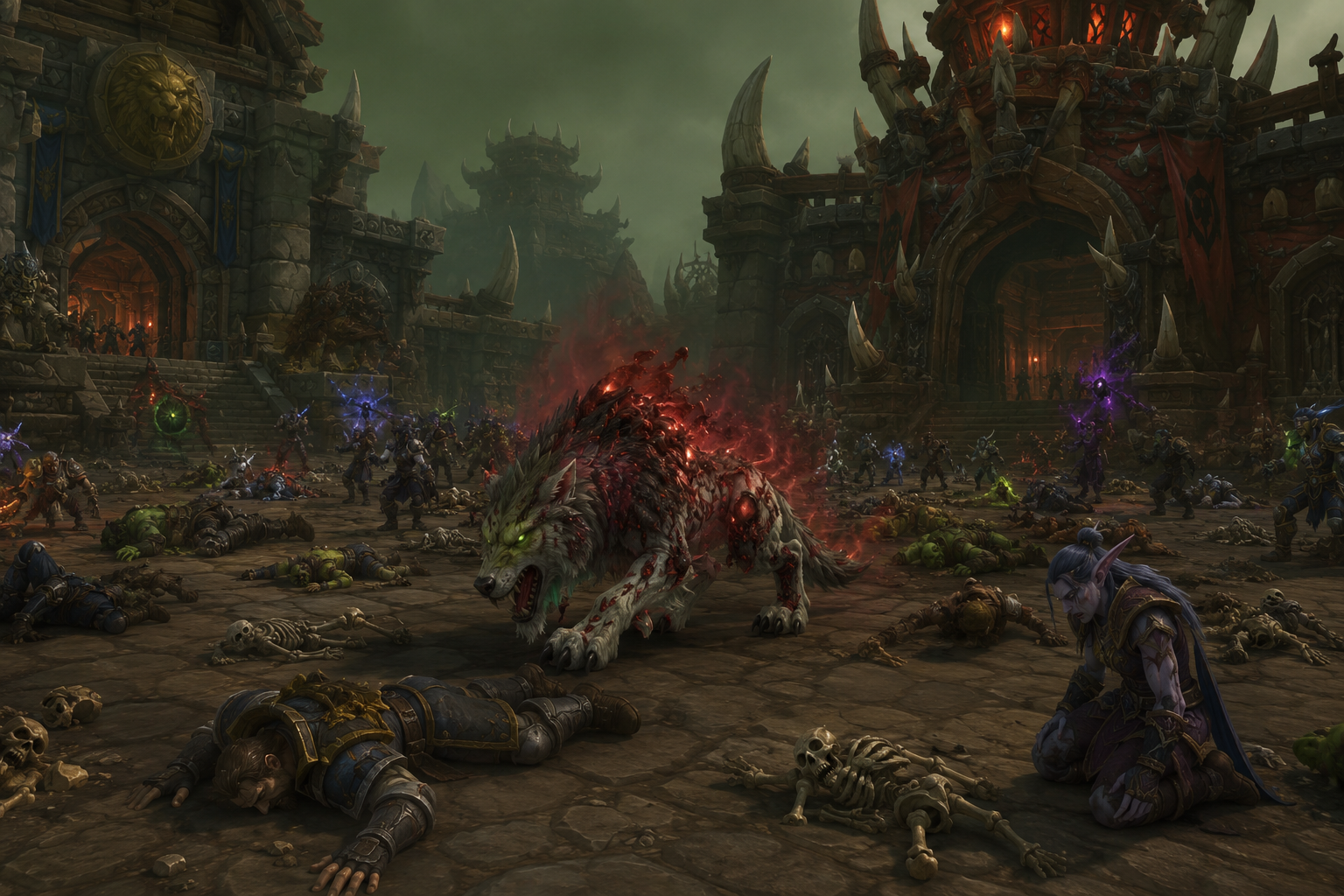




In September 2005, developers at Blizzard Entertainment accidentally unleashed what would become the most devastating and highly studied pandemic in digital history. Long before Covid-19 triggered global lockdowns, a software bug in the MMORPG World of Warcraft (WoW) turned bustling virtual metropolises into ghost towns littered with the skeletons of millions of players.
What began as a localized gameplay mechanic quickly mutated into an uncontrollable outbreak known as the Corrupted Blood Incident. The event was so structurally identical to a real-world biological crisis that it caught the attention of immunologists, behavioral scientists, and counter-terrorism researchers worldwide, fundamentally changing how epidemiologists model human behavior during a pandemic.
The Genesis of the Digital Virus
The outbreak began with the release of Patch 1.7, which introduced a high-level 20-man raid dungeon called Zul’Gurub. The final boss of the raid, Hakkar the Soulflayer, utilized a unique tactical debuff called “Corrupted Blood.”
The mechanics of the debuff were highly aggressive:
- It drained a character’s health rapidly over a short period.
- It was highly contagious, instantly spreading to any nearby players or non-player characters (NPCs).
- High-level characters could survive the damage through healing, but low-level players were obliterated within seconds.
Blizzard’s design intended for the virus to remain strictly confined within the walls of Zul’Gurub. However, the developers overlooked a critical variable in the game’s code regarding specific player classes: Hunters and Warlocks.
If a player’s pet contracted Corrupted Blood during the battle, and the player quickly dismissed (stowed away) the pet before it died, the pet retained the active infection in its data state. When these players traveled to the game’s heavily populated capital cities, like Ironforge and Orgrimmar, and re-summoned their companion animals, Patient Zero was unleashed upon the public.
Below is the step-by-step breakdown of how the transmission chain successfully bypassed the game’s regional barriers:
| Stage | Transmission Vector | Operational Mechanics in Game Code |
| 1. Origin | Hakkar (Raid Boss) | Casts the highly contagious “Corrupted Blood” debuff on raiding players and their minions. |
| 2. Incubation | Player Pet (Infected) | The hunter’s or warlock’s companion pet catches the virus, triggering active health drain. |
| 3. The Glitch | Dismissed Pet | The player stows away the pet. The game code freezes the pet’s active state, keeping the virus alive in data. |
| 4. Transport | Teleport to Capital City | The player teleports to heavily crowded hubs like Orgrimmar or Ironforge, carrying the dormant carrier. |
| 5. Outbreak | Summon Pet | The pet is re-summoned in public, instantly releasing the active virus into the city centers. |
| 6. Pandemic | Rapid Community Spread | The virus jumps from pets to NPCs and other players, initiating exponential cross-species transmission. |
The Anatomy of Chaos: Human Behavior Under Quarantine
As the virus leaked into major hubs, the outbreak expanded exponentially due to an unforeseen factor: Asymptomatic Carriers. Virtual city NPCs (such as merchants and bankers) could contract the virus, but because their code gave them near-infinite health, they did not die. Instead, they became permanent, walking super-spreaders, constantly infecting anyone who approached them to trade.
The behavioral responses of the players mirrored the darkest and most complex elements of human nature during a real-world health crisis, dividing the community into distinct psychological factions:
- Mass Panic and Flight: Upon seeing the streets instantly fill with corpses and skeletons, thousands of players abandoned the cities, fleeing to remote, unpopulated wilderness zones to avoid contact.
- The Apathy of the Unaffected: Some players ignored the warning signs entirely, continuing their daily routines and entering hazardous areas out of denial or a refusal to alter their gaming experience.
- The Curious Inquirer: Driven by morbid curiosity, hundreds of players actively traveled into the infected hot zones just to witness the destruction firsthand, inadvertently catching the virus and carrying it back to uninfected remote villages.
- The Well-Intentioned Blunderer: High-level healers rushed to the city centers to cast protective spells and heal the dying. However, this altruism backfired drastically. By keeping infected players alive longer, the healers unknowingly extended the time those players could transmit the virus to others, compounding the reproduction rate ($R_0$) of the disease.
- Malicious Bio-Terrorism: A subset of griefers and chaotic players actively embraced the role of biological terrorists. They deliberately contracted the disease and utilized teleportation spells to seed the virus into clean, isolated quarantine zones.
Blizzard attempted to enforce voluntary quarantines and establish safe zones, but the measures failed entirely because players refused to comply with the rules. Ultimately, the outbreak became so severe that the game became unplayable. Blizzard was forced to execute a hard reset of the game servers and deploy a hotfix that altered the debuff’s properties, preventing it from existing outside the raid zone.
The Scientific Breakthrough: The “Flawed Human” Factor
Prior to 2005, mathematical models used by organizations like the CDC and the World Health Organization relied strictly on predictable, rational variables—such as vector transmission rates and generic contact statistics. They struggled to quantify irrational human behavior.
The Corrupted Blood Incident changed everything. In 2007, epidemiologists Dr. Nina Fefferman and Dr. Eric Lofgren published a landmark paper in The Lancet Infectious Diseases, analyzing how the WoW outbreak exposed major flaws in traditional predictive modeling.
| Behavioral Category | Virtual World Expression (WoW) | Real-World Equivalent |
| Super-Spreader Vector | Invulnerable City NPCs | Asymptomatic individuals / Essential workers |
| The Curiosity Factor | Traveling to infected capitals to watch | Disobeying travel bans to view crisis zones |
| Altruistic Amplification | Healers keeping infected hosts alive | Crowded triage centers spreading pathogens |
| Active Malice | Intentional teleportation to spread virus | Intentionally coughing on items / breaking quarantine |
Dr. Fefferman emphasized that the most valuable lesson from World of Warcraft was the introduction of the “curiosity factor” and “intentional non-compliance.” Traditional models assumed people would always act to protect their lives; the game proved that human curiosity and a desire to disrupt systems frequently override self-preservation.
Conclusion
The legacy of Hakkar’s plague extends far beyond gaming history. It demonstrated that modern multiplayer environments are not just spaces for entertainment, but complex social laboratories capable of generating highly accurate psychological data. By watching millions of players navigate a digital apocalypse, scientists gained an invaluable mirror into our collective future, proving that when a virus strikes, human behavior is often far more dangerous than the pathogen itself.