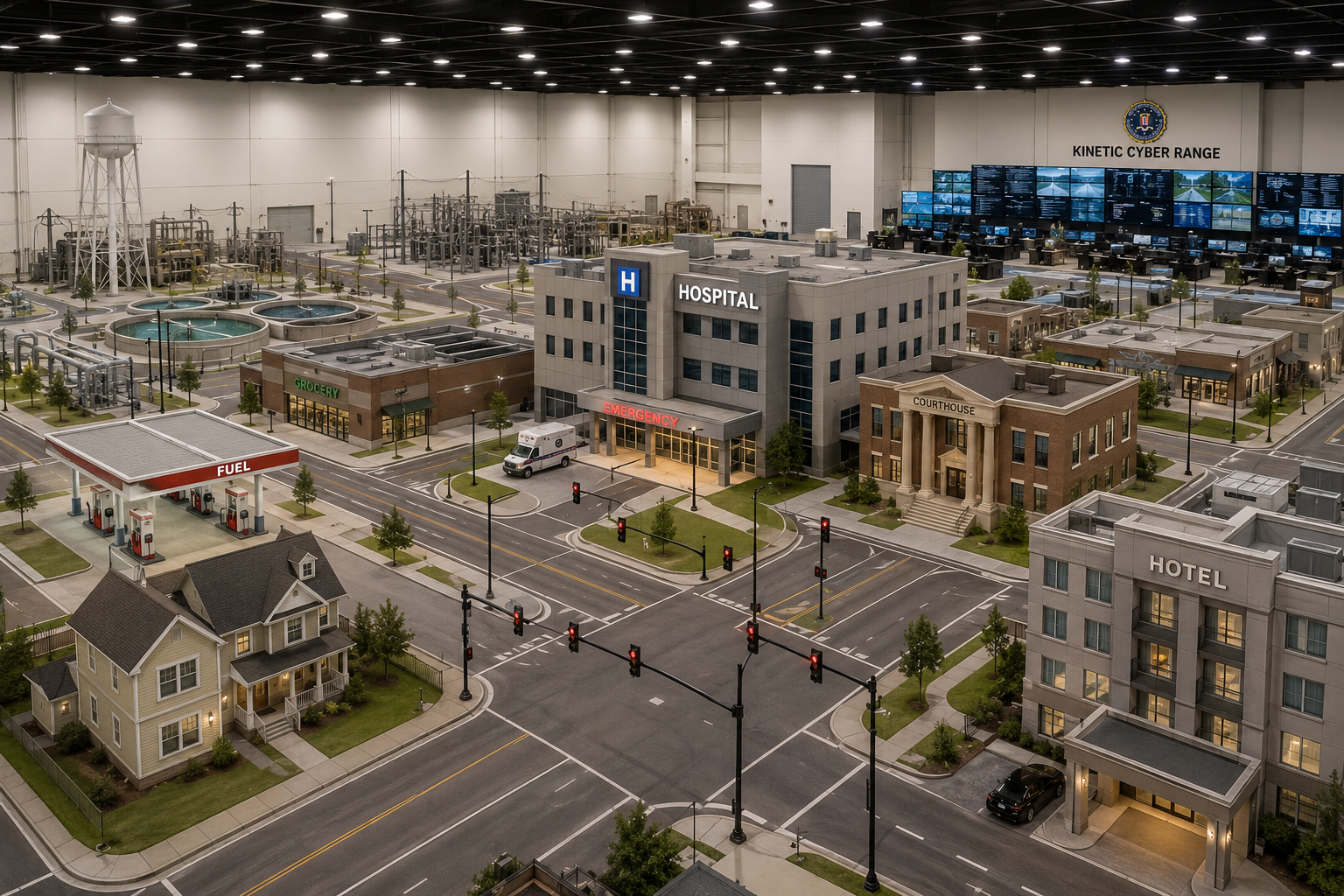





The definition of a “cyberattack” has fundamentally changed. Gone are the days when hacking was confined to defaced websites, stolen credit card numbers, or annoying email viruses. Today, lines of malicious code are being used as kinetic weapons aimed directly at critical infrastructure.
In the modern geopolitical landscape, hospitals, electrical grids, municipal water treatment facilities, and transportation networks are the new front lines.
To confront this terrifying reality, the Federal Bureau of Investigation (FBI) has unveiled its most ambitious counter-measure yet: the Kinetic Cyber Range in Huntsville, Alabama. Spanning over 2,000 square meters (approximately 22,000 square feet), this highly sophisticated facility is a fully operational, scaled replica of a real American town—built entirely for the purpose of being hacked, defended, and rebuilt.
The Blueprint of a Vulnerable Society
The Kinetic Cyber Range is not a mere virtual reality simulation or a software program. It is a tangible, interconnected physical and digital ecosystem designed to mimic the exact vulnerabilities of modern, “smart” municipalities.
Every building inside this miniature metropolis is wired to simulate the real-world consequences of digital warfare:
- 🏥 A Fully Functional Hospital & Courthouse: Featuring mock patient rooms where life-saving medical devices, ventilators, and sensitive legal databases can be digitally compromised.
- ⛽️ The Supply Chain Spine (Gas Stations & Grocery Stores): Designed to simulate fuel pipeline shutdowns or food supply distribution hacks that cause immediate societal panic.
- 🏢 Residential Buildings & A Luxury Hotel: Used to test smart-home vulnerabilities, IoT (Internet of Things) weak points, and hospitality network breaches.
- ⚡️ The Power Utility & Water Plant: The crown jewels of critical infrastructure, where trainers can simulate catastrophic grid failures.
- 🚦 Working Traffic Lights & Roadways: Capable of displaying real-time traffic flow disruptions and gridlock scenarios.
- 🖥 The Brains: Over 200 Physical Servers: Processing massive amounts of operational data, running real industrial control systems (ICS) and SCADA networks identical to those used by actual utility companies.
Ditching the Classroom for the Crucible of Crisis
Historically, cyber detectives, federal agents, and military personnel learned cybersecurity behind a desk. Training consisted of heavy textbooks, theoretical slide decks, and basic sandbox software. While effective for learning the basics of malware analysis, classroom theory collapses under the weight of a live, high-stakes infrastructure crisis.
When a sophisticated foreign adversary or a ruthless ransomware cartel targets a major metropolitan hospital, chaos erupts instantly. Patient monitors go black, electronic health records are encrypted behind a multi-million-dollar extortion screen, and life-support systems are held hostage.
[ Classroom Theory ] ──> Focuses on: "How does the malware work?"
[ Kinetic Range    ] ──> Focuses on: "How do we save lives while under active fire?"
In those critical moments, federal responders do not have hours to debate strategy; they have seconds to make decisions under immense psychological and tactical pressure. The Kinetic Cyber Range acts as a crucible, forcing agents to experience the panic, noise, and urgency of an active digital siege.
Witnessing the Catastrophic “Domino Effect”
One of the primary objectives of the Alabama facility is to teach specialists to recognize and halt the catastrophic “domino effect” of modern cyber warfare. In an interconnected world, no system exists in a vacuum.
During live exercises, trainees can watch a simulated attack unfold in real-time. A breach that begins with a simple phishing email sent to a low-level worker at a municipal water plant can quickly cascade:
- Phase 1: The water plant’s chemical balancing systems are compromised.
- Phase 2: The automated safety sensors trigger a hard shutdown of the facility.
- Phase 3: The sudden spike in emergency power draw causes a localized overload at a nearby electrical substation.
- Phase 4: The power grid fails, immediately knocking out traffic lights, plunging the local hospital into backup generator mode, and freezing financial transactions across the city.
By allowing federal agents, international allies, and private sector infrastructure operators to fail safely within the confines of the range, the FBI can map out hidden vulnerabilities before real-world hackers exploit them.
The Future of Global Defense
The Kinetic Cyber Range represents a paradigm shift in national security. It bridges the gap between the digital realm and physical reality, proving that the best defense against tomorrow’s hackers is hands-on, realistic experience.
As cyber threats continue to grow more sophisticated, the FBI’s fake city stands as a vital shield—ensuring that when the real world faces a digital blackout, the front-line defenders will be ready to keep the lights on.