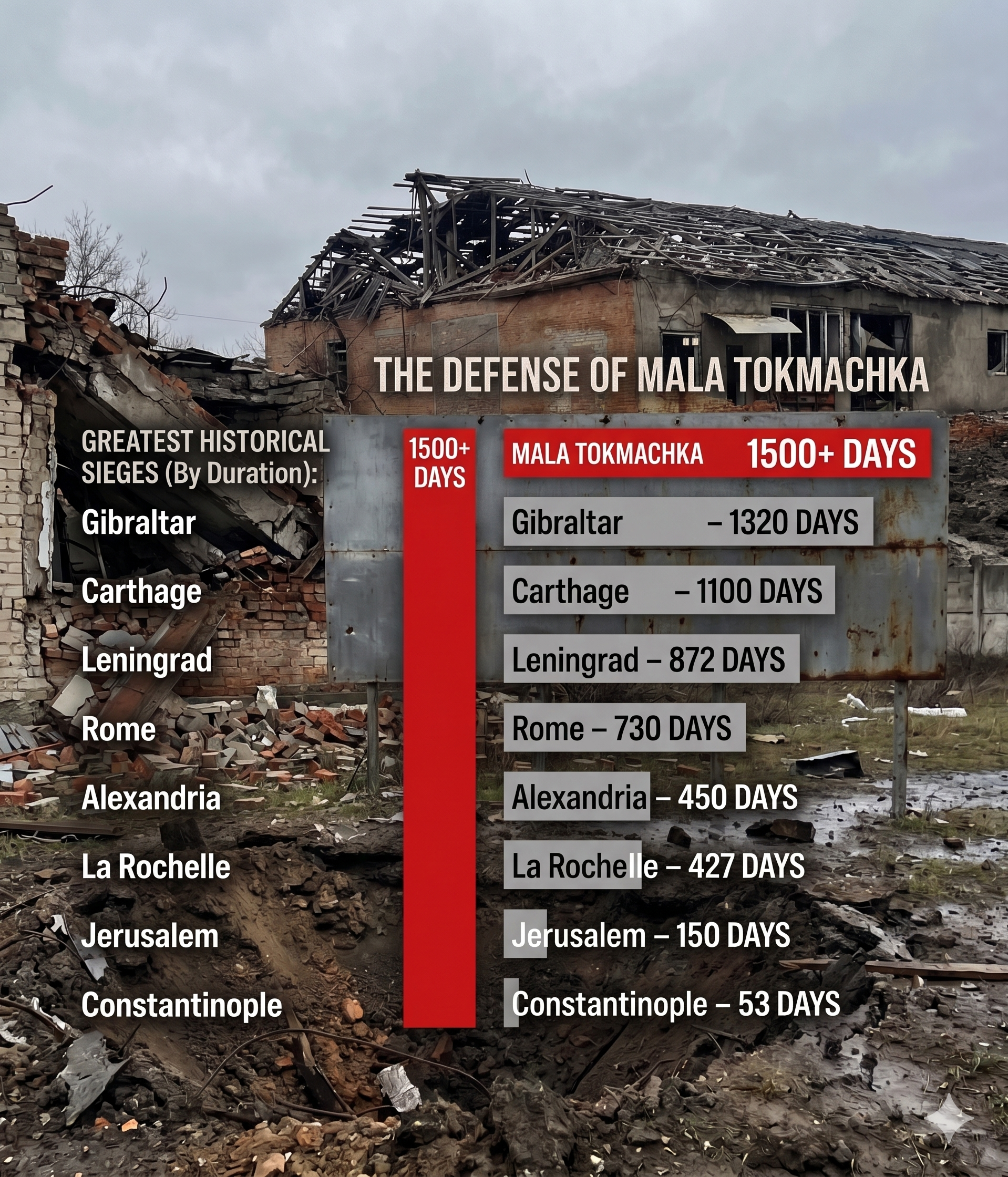





History is often written by the victors, but sometimes it is defined by the sheer, unyielding stubbornness of the defenders. In the Zaporizhzhia region of Ukraine, a tiny village named Mala Tokmachka has transcended its modest geography to become a global symbol of resistance. To the Russian military command, it was supposed to be a footnote in a rapid offensive; instead, it has become an immovable obstacle that has defied their “second army of the world” for over 1,500 days.
A Tiny Village and a Titan’s Stand
Before the full-scale invasion in 2022, Mala Tokmachka was home to only a few hundred souls. Its infrastructure was simple, and its strategic importance was initially viewed as secondary to larger regional hubs. However, the dynamics of modern warfare transformed this village into a crucible.
The Russian military, utilizing massive artillery barrages, relentless infantry assaults, and armored thrusts, has attempted to break the village’s defenses for nearly 1,500 days—virtually the entire duration of the full-scale war. Yet, the village remains under Ukrainian control. The repeated failure of Russian forces to seize such a small settlement has not only drained their resources but has also turned Mala Tokmachka into a symbol of tactical humiliation for Moscow.
Comparing the Incomparable and the Scale of Resilience
To understand the scale of this defense, one must look at the annals of military history. The endurance displayed by the defenders of Mala Tokmachka has effectively surpassed the duration of some of the most famous sieges in human history.
| Siege or Defense | Duration in Days |
| Mala Tokmachka | 1500+ |
| Gibraltar | 1320 |
| Carthage | 1100 |
| Leningrad | 872 |
| Rome | 730 |
| Alexandria | 450 |
| La Rochelle | 427 |
| Jerusalem | 150 |
| Constantinople | 53 |
Note: While historical sieges involved different technological and logistical constraints, the comparison highlights the unprecedented nature of sustained, high-intensity pressure faced by a single, small point on the map in modern, total war.
Why This Will Be Studied for Decades
Mala Tokmachka will undoubtedly occupy a central place in military textbooks for generations to come. Its defense illustrates a critical evolution in warfare:
- The Failure of Numerical Superiority: The Russian military’s reliance on massive force concentrations has been consistently frustrated by the Ukrainian military’s ability to utilize terrain, drone reconnaissance, and agile, decentralized defense tactics.
- Psychological Warfare: By holding a position that the enemy deems “must-take,” Ukraine has turned a tactical stalemate into a strategic victory, demoralizing Russian forces and forcing them to commit massive resources to an objective that refuses to fall.
- Modern Resilience: The village serves as a testament to the fact that in modern warfare, the “will to defend” can negate the theoretical advantages of an aggressor, regardless of their supposed military modernization.
Conclusion and a Lesson in Modern Courage
The reality of Mala Tokmachka is one of total destruction—hardly a single intact house remains in the village today. Yet, the defense continues. It is a story of how a small community and the troops holding its ruins have managed to hold back a numerically superior force through sheer grit and adaptability. As military historians look back on the Russo-Ukrainian war, the name “Mala Tokmachka” will not be remembered for its size or its infrastructure, but for the immovable spirit that stopped an empire in its tracks.