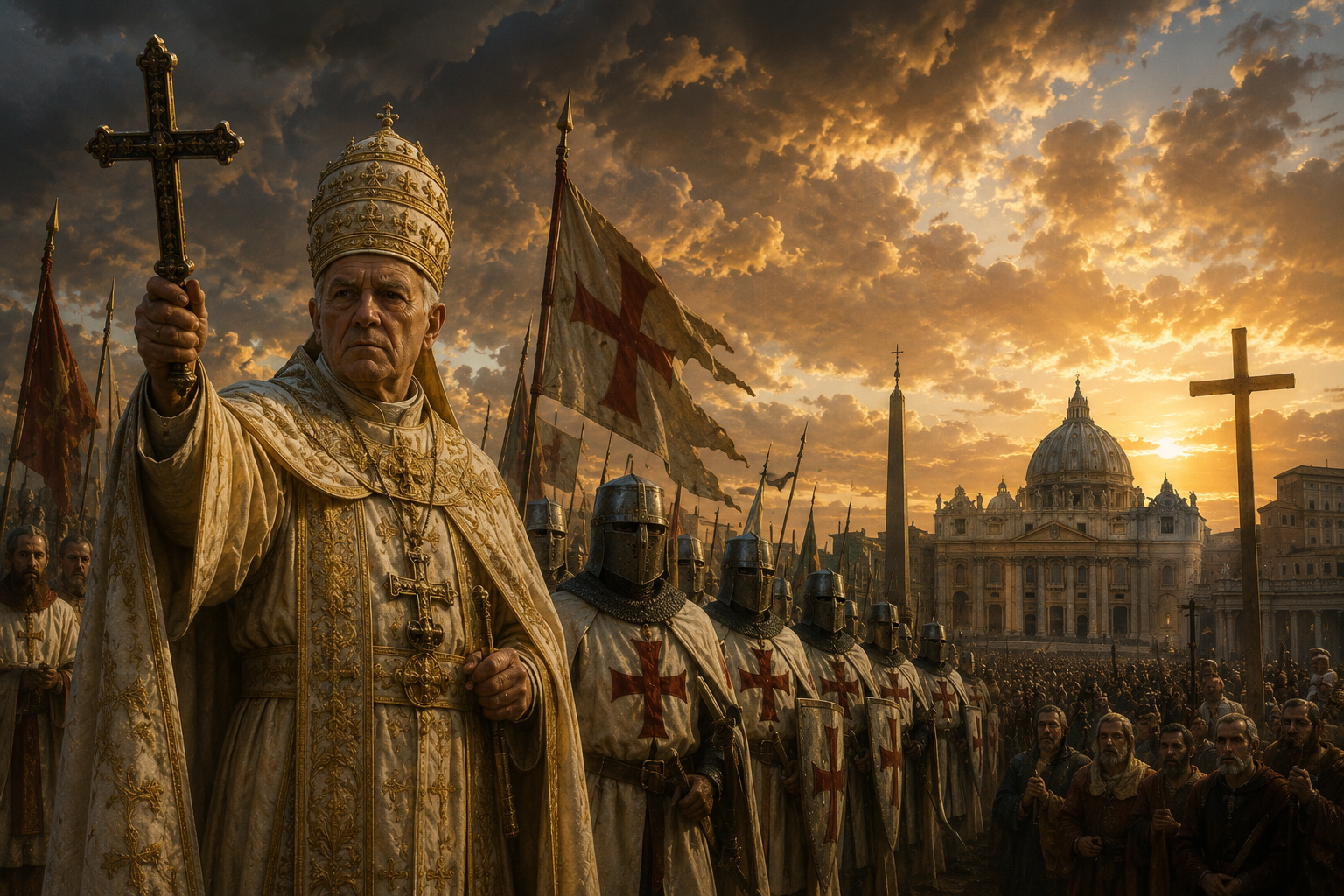




The European continent stands at a civilizational crossroads. For centuries, the identity of Europe was inseparable from the Cross, forged in the fires of shared faith and the defensive will to protect its borders. Today, that identity is fraying. Faced with unprecedented migration crises, the silencing of domestic terror through political correctness, and a profound paralysis in leadership, many are looking back to history. They see a time when the Papacy was not merely a diplomatic office, but a beacon of strength—led by Popes who, like a modern Joshua, led their people with the sword of faith to preserve their way of life.
The Papal Lion and the Chronology of the Crusades
The Crusades were not merely wars of aggression; they were conceived as defensive acts of reclamation and protection for the Christian world. During this era, the Papacy acted as the supreme unifying force of the West.
In 1095, the First Crusade was triggered by Pope Urban II at the Council of Clermont. His cry of “Deus vult!” (God wills it!) unified a fractured Europe against the expansion of the Seljuk Turks, eventually resulting in the liberation of Jerusalem in 1099.
Nearly a century later, the Third Crusade (1189–1192) was orchestrated by Pope Gregory VIII following the fall of Jerusalem to Saladin. This era saw the rise of legendary leaders like Richard the Lionheart, all driven by the Papal call to restore Christian honor.
Under Pope Innocent III, the concept of the Crusade expanded further through the Albigensian and Northern Crusades. During this time, it was no longer just about the Holy Land, but about purifying the internal and northern borders of Europe from perceived spiritual and physical threats to the faith.
The Twilight of the Sword and the Final Crusade
The historical era of the Crusades reached its traditional end with the Ninth Crusade (1271–1272), led by Prince Edward of England and supported by Pope Gregory X.
This campaign was a desperate attempt to save the remaining Crusader strongholds in the Levant. While Edward achieved several military victories, the lack of unified support from a weary Europe prevented a total restoration of the Kingdom of Jerusalem.
The consequence was profound. The fall of Acre in 1291 marked the final loss of the Crusader states in the East. This began a slow retreat of Christian influence in the Mediterranean, eventually leading to the fall of Constantinople in 1453—a trauma that reshaped the map of Europe and left the continent vulnerable to centuries of subsequent conflict.
The Modern Crisis of Migration Terror and Silence
In 2026, the threats to Europe are no longer just external armies, but internal erosion. The indigenous peoples of Europe face a demographic and cultural shift that borders on existential.
The influx of populations with values often diametrically opposed to the Enlightenment and Christian tradition has created “no-go zones” and social fragmentation. Furthermore, the silencing of radicalism under the guise of tolerance has left the European citizen undefended in their own home. Many now feel that the current Papacy has traded the “Sword of Joshua” for the language of universalism, neglecting the specific duty to protect the Christian heritage of the European continent.
Conclusion and the Call for Europe to Wake Up
The history of the Crusades teaches us that when Europe is united under a clear spiritual objective, it is invincible. Today, Europe does not necessarily need a war of steel, but it desperately needs a Crusade of the Will.
It is time for the indigenous peoples of Europe to reclaim their cultural sovereignty. The Pope must once again take the initiative, moving beyond mere rhetoric to become a true guardian of the faith on the continent. The preservation of Christianity in its ancestral home is not “intolerance”—it is an act of survival. Europe must wake up and remember that its peace was bought with the courage of those who were unafraid to stand for the Cross.