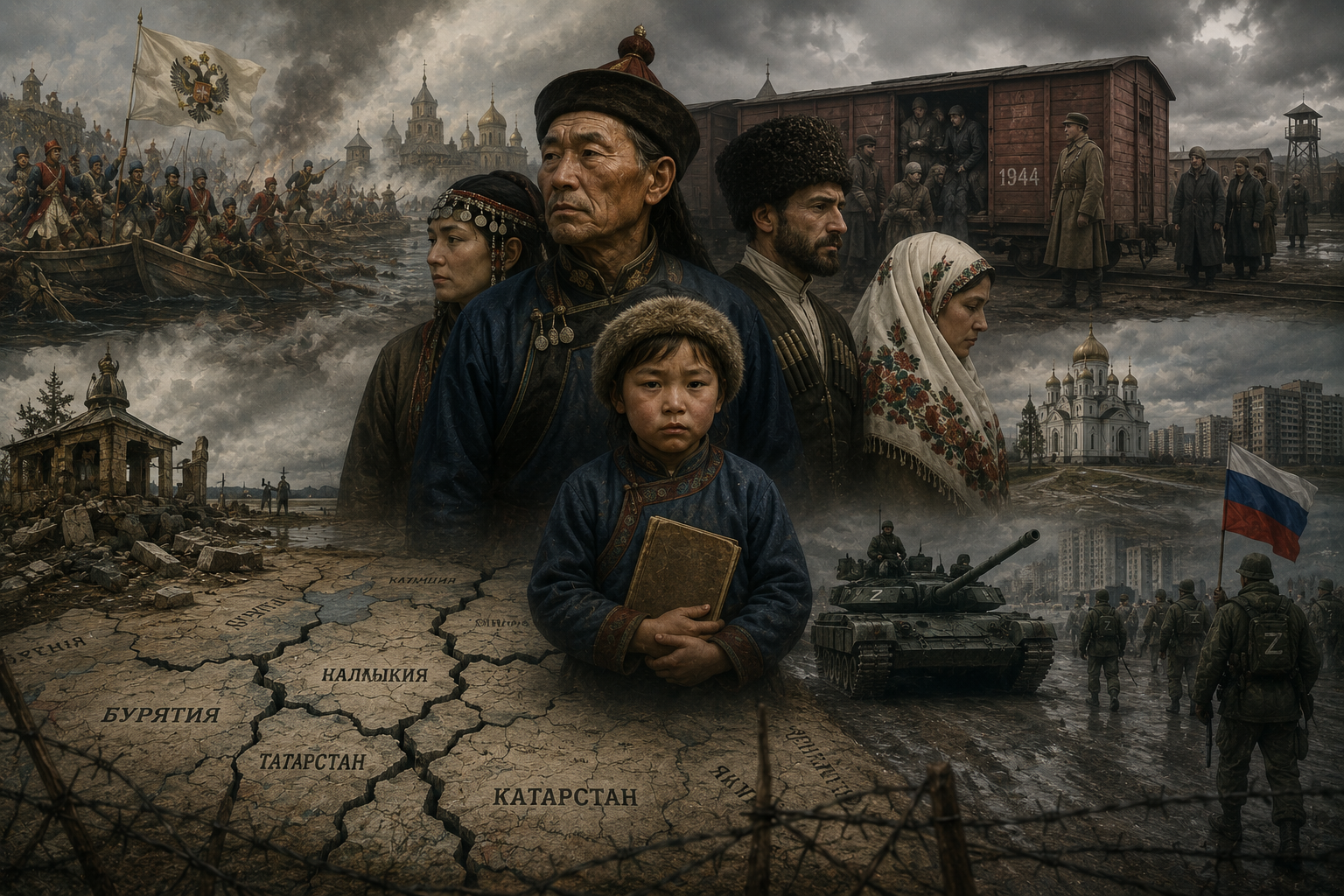



The modern Russian Federation presents itself as a voluntary union of diverse cultures, yet historical records tell a far darker story. For centuries, the Russian state—whether under the Tsars, the Soviets, or the current administration—has expanded through a consistent pattern: brutal military conquest followed by the systematic erasure of the indigenous identity. This “colonization from within” has turned dozens of independent nations into demographic reservoirs for the empire’s ambitions.
The Buryats: From Steppe Nomads to Imperial Frontiers
The incorporation of Buryatia into the Russian Empire began in the mid-17th century during the Russian conquest of Siberia. The Buryats, a Mongolic people with a rich Buddhist and Shamanic heritage, initially resisted the expansion of Russian forts (ostrogs).
- The Subjugation (1620s–1689): Through a series of bloody skirmishes and the Treaty of Nerchinsk, Russia secured the Buryat lands.
- The Loss of Identity: The Russian administration utilized the “divide and rule” tactic, splitting Buryat tribes into administrative units that disrupted their nomadic life. In the Soviet era, the alphabet was changed from the vertical Mongol script to Cyrillic, effectively cutting the people off from their historical literature and Buddhist roots. Today, Buryatia is one of the most economically depressed regions, with its youth disproportionately mobilized for the empire’s modern wars, a grim evolution of their “integration.”
The Chechens: Two Centuries of Resistance and Deportation
The North Caucasus has historically been the most volatile frontier for Russian imperialism. Unlike the Siberian tribes, the Chechens maintained a highly organized resistance centered on their Islamic faith and clan-based social structure (teips).
- The Subjugation (1785–1859): The Caucasian War lasted nearly 75 years. It took the scorched-earth tactics of General Aleksey Yermolov to finally “pacify” the region.
- The Erasure: In 1944, the ultimate act of imperial control occurred: Operation Lentil. Under Stalin, the entire Chechen and Ingush populations were deported to Central Asia in cattle cars. Thousands died. While they eventually returned, their “integration” involved the installation of Moscow-loyalist regimes that enforce Russian political culture while eroding the traditional democratic structures of the teip system.
The Kalmyks: The Tragic Migration and Forced Loyalty
The Kalmyks, the only Buddhist nation in Europe, migrated to the Volga region in the early 17th century. Initially allies of the Tsar, they soon found themselves trapped in the empire’s tightening grip.
- The Subjugation (1771): Frustrated by Russian encroachment on their pastures and interference in Buddhist affairs, the majority of Kalmyks attempted to flee back to China. Those who remained were stripped of their autonomy by Catherine the Great.
- The Erasure: Like the Chechens, the Kalmyks were deported in 1943. Their temples (huruls) were destroyed, and their language was suppressed. Decades of forced settlement and the influx of ethnic Russian settlers have led to a critical level of linguistic assimilation, where many Kalmyks now speak Russian as their primary or only language.
The Tatars: A Century-Long Campaign of Erasure
The Tatars represent one of the most resilient yet persecuted groups within the Russian imperial structure. Their story is divided into two distinct tragic arcs: the fall of the Kazan Khanate and the ongoing tragedy of the Crimean Tatars.
The Fall of Kazan (1552)
The conquest of the Kazan Khanate by Ivan the Terrible was a turning point in Russian history, marking the transition from a grand duchy to an empire.
- The Subjugation: After a brutal siege, the city of Kazan was razed. Local elites were executed or forced to convert to Christianity.
- The Erasure: The Russian state implemented a policy of “Russification” by settling ethnic Russians on Tatar lands and restricting the construction of mosques. Over centuries, the Tatar language was pushed out of the administrative sphere, forcing the population into a dual identity where “success” was only possible through the Russian language.
The Crimean Tatars and the “Emptying” of the Peninsula (1783–1944)
The annexation of Crimea by Catherine the Great began a long-term strategy of demographic engineering.
- The Subjugation: Once a powerful independent Khanate, Crimea was annexed in 1783. This was followed by waves of forced emigration to the Ottoman Empire.
- The Genocidal Deportation (1944): The most devastating blow came in May 1944. Accused of “mass collaboration,” the entire Crimean Tatar population was deported to Central Asia in three days. Their homes, names, and even the graves of their ancestors were “Russified.” It wasn’t until the late 1980s that they were allowed to return, only to find their homeland transformed into a military fortress for the Russian Black Sea Fleet.
Further Examples of Systematic Subjugation
Russia’s expansion into the Arctic and the Far East followed a similar blueprint of resource extraction and cultural marginalization.
| Nation | Region | Key Event of Subjugation | Method of Assimilation |
| Circassians | North Caucasus | Circassian Genocide (1864) | Massive ethnic cleansing; 90% of the population was killed or expelled to Turkey. |
| Sakha (Yakuts) | Eastern Siberia | 17th Century Conquest | Forced to pay yasak (fur tribute). Modern assimilation through the destruction of the permafrost by mining industries. |
| Mari People | Volga Region | Cheremis Wars (1550-1580s) | Brutal suppression of their unique Pagan-Animist faith and forced Christianization. |
| Karelians | Northwest Russia | Soviet Era (1920-1940s) | Massive displacement and the flooding of the region with Russian settlers, making the native language nearly extinct. |
The Concept of the “Internal Colony”
In the Russian model, these nations are treated as internal colonies. Unlike British or French colonialism, where colonies were overseas, Russian colonialism happened across contiguous land. This allowed the state to mask its imperialism as “nation-building.”
- Administrative Dismantling: Ethnic borders were often drawn to include large Russian populations, ensuring that indigenous voices remained a minority in their own “autonomous” republics.
- Educational Genocide: Since the 2018 Russian language laws, native languages have been relegated to “optional” status in schools. This ensures that the next generation of Tatars, Bashkirs, and Sakha will be functionally Russian, possessing the blood of their ancestors but the mind of the Kremlin.
The Irony of Modern Mobilization
In 2026, the tragic climax of this assimilation is evident on the front lines of Russia’s external conflicts. The regions with the highest casualty rates are disproportionately ethnic minority republics. By utilizing the “colonized” to expand the empire’s borders, Moscow achieves a dual goal: expanding territory while thinning the population of ethnic minorities who might one day demand independence.
Mechanisms of Imperial Assimilation
Russia’s success in “integrating” these nations relies on a specific toolkit of imperial management:
| Mechanism | Method | Impact on Indigenous Peoples |
| Linguistic Hegemony | Making Russian the only language of “success” and administration. | Native languages become “domestic,” then eventually obsolete. |
| Spiritual Erasure | Replacing or controlling local faiths (Buddhism, Islam) with state-approved versions. | Loss of the moral and cultural framework that resists central authority. |
| Economic Dependency | Deliberately preventing industrial growth in ethnic regions. | Forces local populations to join the military or move to Moscow for survival. |
| Historical Revisionism | Teaching that conquest was a “civilizing mission” or “voluntary joining.” | Younger generations lose the memory of their ancestors’ resistance. |
The Price of Empire
The “integration” Russia speaks of is, in reality, a process of asymmetry. The empire takes the resources (diamonds from Sakha, oil from Tatarstan, soldiers from Buryatia) and gives back a standardized, Cyrillic-based identity that serves the state’s survival.
The tragic irony of 2026 is that the very nations Russia once enslaved are now the primary workforce for its external expansions. By erasing the identity of the Buryat, the Chechen, and the Kalmyk, the Russian system has created a “new person”—one who fights for the borders of an empire that once destroyed his own.