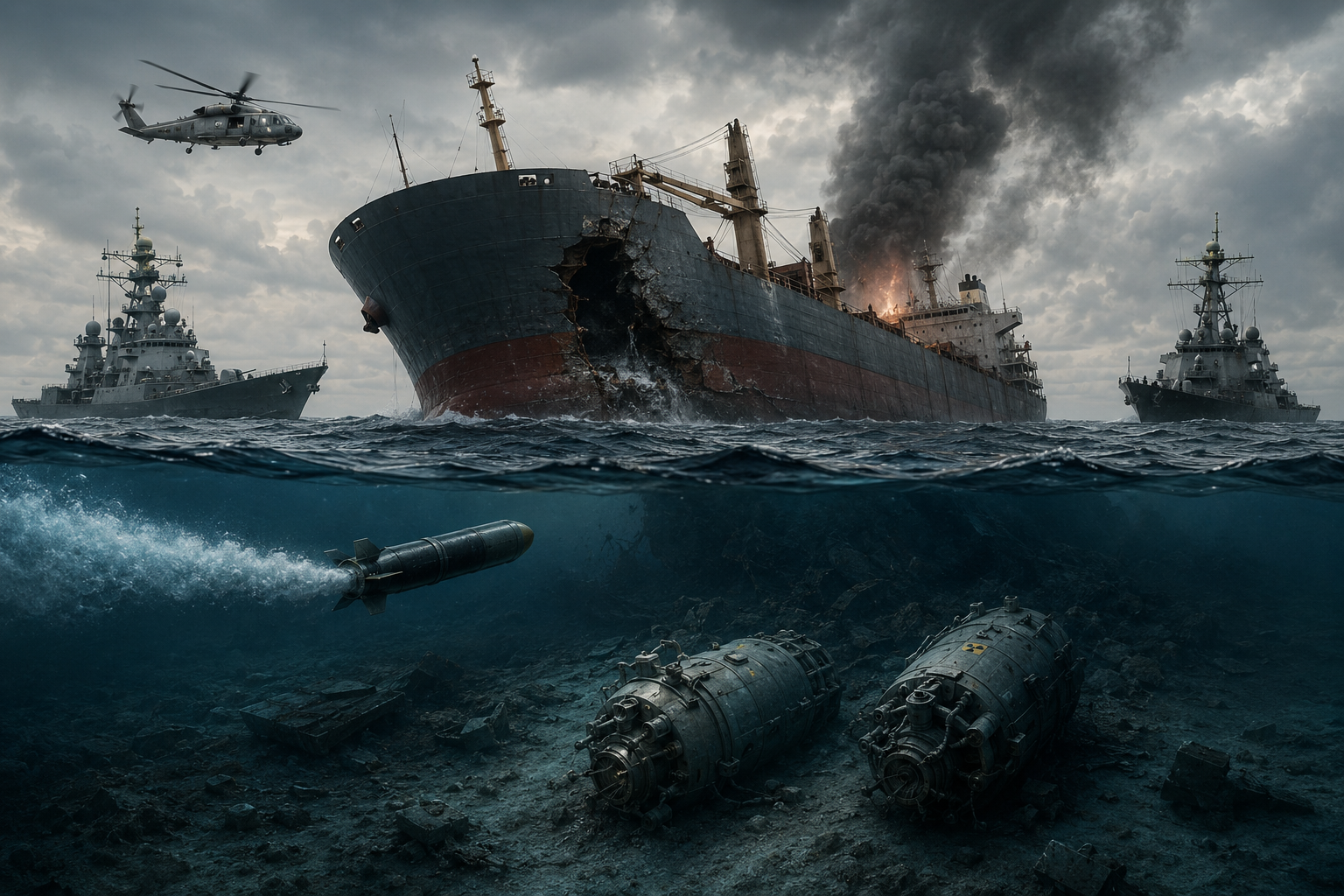





In the shadows of global maritime monitoring, a quiet but potentially epoch-making event took place late in 2024. While the world’s attention was fixed on conventional frontlines, a Russian cargo ship met a sudden, violent end in the Mediterranean. This incident raises a haunting question: Has NATO already crossed the “red line” of direct kinetic engagement with Russia, and if so, why has the Kremlin remained silent?
The Sinking of the Ursa Major
On December 23, 2024, the Russian-flagged freighter Ursa Major issued a distress signal off the coast of Cartagena, Spain. The vessel was not alone; it was traveling under the heavy protection of two Russian warships. Intelligence reports suggest the cargo was of strategic importance: two nuclear reactors destined for North Korea to power their burgeoning nuclear submarine program.
Shortly after the distress call, the vessel disappeared from radar. Recent underwater surveys have reportedly discovered a massive breach in the hull. Experts suggest the damage is consistent with a high-velocity, heavyweight torpedo—specifically a model currently exclusive to the United States and a select few NATO allies.
Nuclear Reactors on the Ocean Floor
The aftermath of the sinking is as chilling as the event itself. The two nuclear reactors now lie on the floor of the Mediterranean. Despite the environmental risks and the blatant loss of high-value military technology, the international response has been characterized by an eerie, coordinated silence.
There were no emergency sessions at the UN, no activation of NATO Article 5, and, most surprisingly, no “decisive response” or nuclear threats from Moscow. The reactors were lost, the ship was destroyed, and yet, the gears of the global diplomatic machine barely turned.
Naval Power Disparity Between NATO and Russia
The silence from the Kremlin following the loss of the Ursa Major may be explained by the sheer reality of the naval balance of power. While Russia utilizes nuclear blackmail to deter intervention on land, at sea, the technological and numerical gap is staggering.
Below is a comparison of the active naval assets illustrating why a direct maritime confrontation remains Russia’s greatest fear:
| Asset Category | NATO Alliance (Total) | Russian Federation |
| Aircraft Carriers | 17 | 0 (Non-operational) |
| Nuclear Submarines | 140+ | ~30 |
| Destroyers / Cruisers | 160+ | ~12 |
| Frigates | 200+ | ~15 |
| Total Personnel | ~1,000,000+ | ~150,000 |
| Technological Edge | Aegis System, MK-48 Torpedoes | Aging Soviet-era hulls |
This table highlights that in a “blue water” conflict—like the one near Cartagena—Russia simply lacks the hulls and the technology to match a NATO response. The sinking of a single freighter, even one carrying nuclear reactors, is a loss Russia must swallow because the alternative is the total annihilation of their remaining fleet.
The Myth of the Red Line
This incident challenges the prevailing narrative of Western hesitation. For years, the primary argument against providing Ukraine with long-range weapons or enforcing no-fly zones has been the fear of Russian nuclear escalation. However, if a Russian vessel under military escort was indeed targeted and sunk by NATO technology, the “red line” has not just been touched—it has been obliterated.
The lack of a Russian reaction suggests a startling reality:
- The Bluff is Called: When faced with a direct, localized, and devastating loss, the Kremlin chose silence over suicide.
- Strategic Deniability: Both sides benefit from the silence. NATO avoids the political fallout of an unprovoked strike, and Russia avoids admitting it could not protect its most sensitive military exports.
Conclusion and the Lessons of Cartagena
The Ursa Major incident serves as a stark lesson in the realities of 21st-century power dynamics. The “empty threats” of nuclear blackmail often crumble when met with precise, overwhelming force that leaves the aggressor with no viable way to escalate without total self-destruction.
As we move forward, the silent depths of the Mediterranean hold the proof that the boundaries of this conflict are much more fluid than the public is led to believe. The question is no longer “Will NATO act?” but rather “How much of the current stalemate is based on a fear of a ghost?”