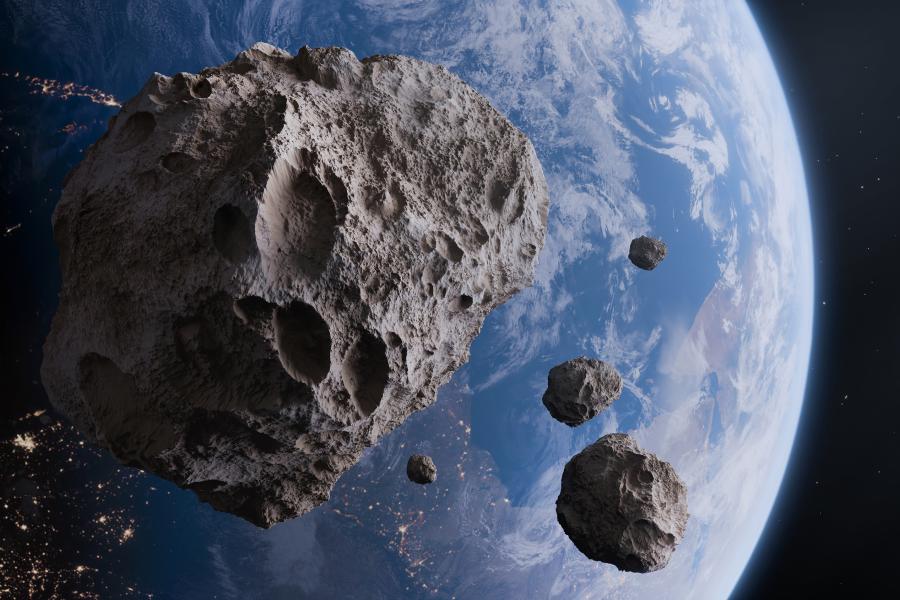




The headlines appear with increasing frequency: “Potentially Hazardous Asteroid the Size of a Football Field Approaches Earth.” For the average reader, these alerts trigger a mix of curiosity and existential dread. However, while the language is sensational, the reality is a mix of precise orbital mechanics, ancient history, and the ongoing quest to protect our planet from the “cosmic roulette” of near-Earth objects (NEOs).
Why the “Potentially Hazardous” Label?
Astronomers use the term Potentially Hazardous Asteroid (PHA) not because an impact is imminent, but because of the object’s physical characteristics and orbital proximity. By definition, an asteroid is classified as a PHA if it meets two strict criteria:
- Size: It must be large enough to cause significant regional damage (typically over 140 meters in diameter).
- Distance: Its minimum orbit intersection distance (MOID) with Earth must be less than 7.5 million kilometers (approximately 0.05 astronomical units).
These classifications are meant to prioritize observation, not to incite panic. They allow international space agencies, such as NASA’s Planetary Defense Coordination Office, to track these objects with high precision to rule out any future collisions.
The Torino Scale of Hazard
Scientists use the Torino Scale to categorize the risk of impact, ranging from 0 to 10.
| Level | Designation | Meaning |
| 0 | No Hazard | Collision is impossible or highly unlikely. |
| 1 | Normal | Object is a routine discovery with no unusual risk. |
| 2-4 | Meriting Concern | Requires careful monitoring but low probability of impact. |
| 5-7 | Threatening | Serious risk; requires international planning and observation. |
| 8-10 | Certain Collision | Guaranteed to cause regional or global catastrophe. |
Simulation: The Impact of a “Football Field” Asteroid
If an asteroid roughly 100–140 meters in size (the scale of a football field) were to strike Earth, the outcome would depend heavily on its composition—whether it is rocky or metallic—and where it lands.
- Atmospheric Entry: Such an object would likely survive the journey through the atmosphere.
- Energy Release: It would strike with the force of multiple megatons of TNT, roughly equivalent to a large thermonuclear weapon.
- The Aftermath: If it struck a city, the area of total destruction would span several dozen kilometers. If it struck the ocean, it could trigger a localized tsunami, though it would likely not cause a global extinction event. It would be a regional disaster of unprecedented scale, leaving a crater roughly 1 to 2 kilometers wide.
Shielding Earth: Can We Actually Destroy Them?
We are no longer defenseless. The recent success of the DART (Double Asteroid Redirection Test) mission proved that we possess the technology to alter an asteroid’s path.
The most effective method is Kinetic Impaction—crashing a high-speed spacecraft into an asteroid to slightly nudge its trajectory. Because these objects are tracked years or decades in advance, a “nudge” performed early enough ensures that the asteroid will miss Earth by thousands of kilometers by the time its path crosses ours. While “destroying” an asteroid (blowing it up) is a last-resort option that risks creating a shower of radioactive or dangerous debris, redirection is the preferred strategy of planetary defense.
The Moon as Our Shield: Why Earth Has Fewer Craters
A common question is: “If the Moon is covered in thousands of visible craters, why does the Earth look relatively pristine?”
- Atmospheric Shielding: Earth has a thick atmosphere that incinerates smaller space rocks. The Moon has no atmosphere; even a tiny pebble impacts the surface at thousands of kilometers per hour, leaving a mark.
- Geological Activity: Earth is a geologically “alive” planet. Plate tectonics, volcanic activity, and mountain building constantly reshape the crust, “erasing” old impact sites. Furthermore, wind, rain, and water erosion act like a planetary eraser, smoothing out ancient impact basins over millions of years.
- Water Coverage: Seventy percent of the Earth is covered by oceans. Many historical impacts simply occurred in the water, leaving no permanent crater on the continents we inhabit.
The Moon acts as a historical record-keeper for the inner solar system, whereas Earth is a dynamic system that constantly hides its scars. As we advance our observational technology, we are learning to track the “missing” threats before they reach our doorstep, turning the threat of cosmic impact from an unpredictable gamble into a manageable scientific challenge.
Known Asteroid Impact Sites on Earth
While the Moon serves as a static museum of cosmic impacts, Earth’s surface—though frequently reshaped by erosion and tectonics—still bears the marks of several high-energy collisions. These “astroblemes” (star-wounds) provide critical data for scientists attempting to understand the frequency and severity of asteroid strikes throughout our planet’s history.
Famous Impact Craters
- Barringer Crater (Meteor Crater), USA: Located in Arizona, this is perhaps the most famous and well-preserved impact site on Earth. Created approximately 50,000 years ago by an iron-nickel meteorite about 50 meters across, the crater is nearly 1.2 kilometers wide and 170 meters deep. It serves as the primary reference point for studying smaller-scale impacts.
- Chicxulub Crater, Mexico: Buried beneath the Yucatán Peninsula and the Gulf of Mexico, this is the site of the most significant impact in Earth’s recent geological history. Approximately 66 million years ago, a 10-to-15-kilometer-wide asteroid struck the planet, triggering the K-Pg extinction event that wiped out the non-avian dinosaurs. The crater itself is over 150 kilometers in diameter.
- Vredefort Crater, South Africa: This site holds the title for the oldest and largest verified impact crater on Earth. Formed roughly 2 billion years ago, the original structure is estimated to have been up to 300 kilometers wide. Over eons, erosion has obscured the outer rings, but the central uplift—a “dome” of ancient rock—remains visible.
- Manicouagan Crater, Canada: Often called the “Eye of Quebec,” this is one of the oldest visible impact craters. Formed about 214 million years ago, the crater is now partially filled by a ring-shaped reservoir. It remains a striking example of how large impacts can fundamentally alter the geography of a region.
Why Are These Still Visible?
The reason we can see these specific craters while others have vanished is a combination of size and environment. The Chicxulub impact was so violent that it fractured the Earth’s crust on a continental scale, while the Barringer Crater’s location in the arid, high-desert climate of Arizona significantly slowed the rate of erosional wear.
Understanding these historical events is the backbone of modern planetary defense. By studying the geological remains of past impacts, scientists can better calibrate their models for the energy release of future near-Earth objects. Earth may be a dynamic, self-healing system, but these craters remain as permanent reminders that our planet exists within a volatile cosmic neighborhood.