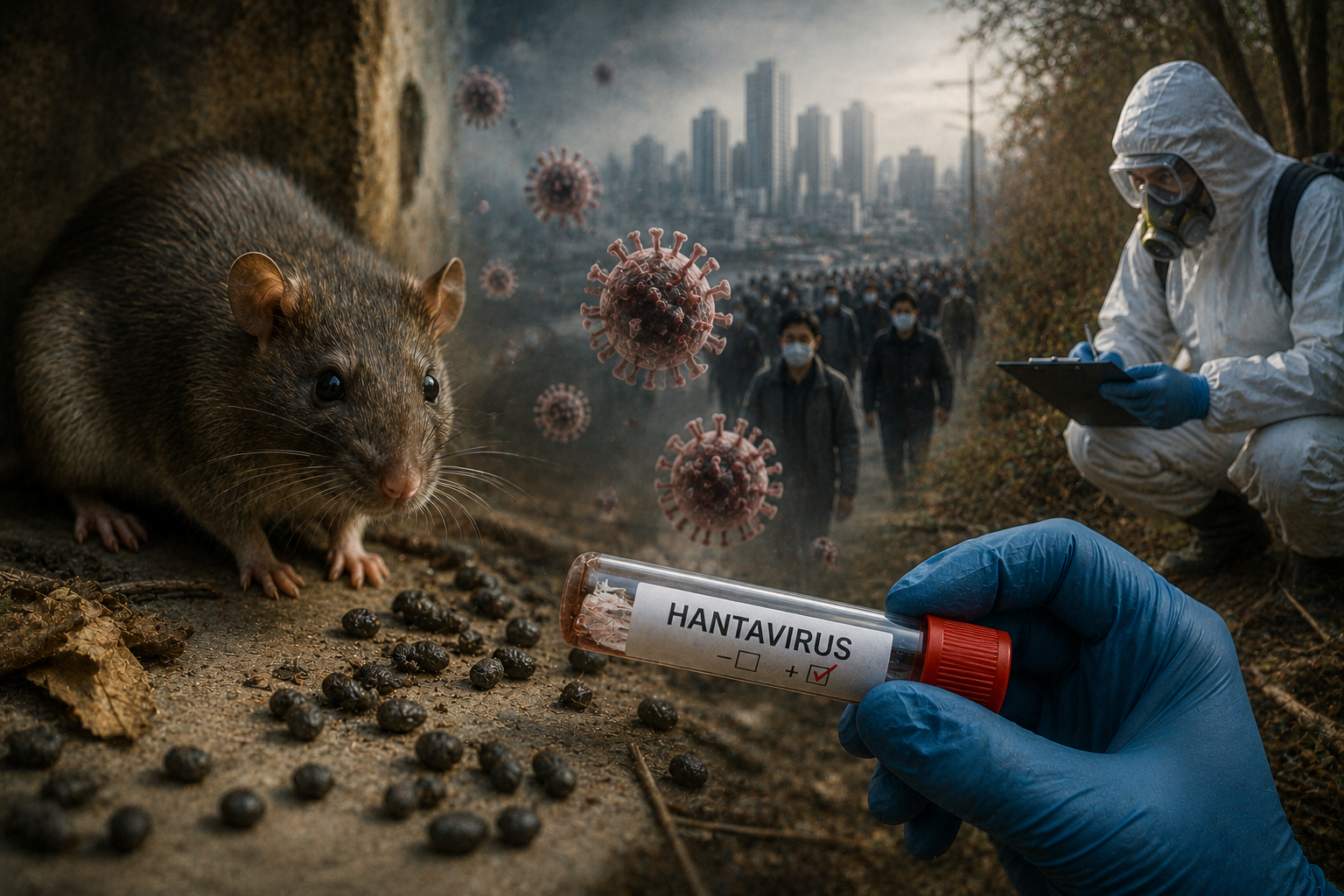





As the world continues to recover from recent respiratory pandemics, the scientific community is turning its gaze toward zoonotic reservoirs that harbor “sleeper” pathogens. Among the most concerning is the Hantavirus, a family of viruses traditionally associated with rodents but possessing the biological machinery to cause devastating systemic failure in humans. While it has not yet reached the level of a global pandemic, the rapid acceleration of viral evolution suggests that we cannot afford complacency.
Etymology and Biological Architecture
The term “Hantavirus” is derived from the Hantan River area in South Korea, where the virus was first isolated by Dr. Ho Wang Lee in 1976 during an outbreak among soldiers. Etymologically, it belongs to the Hantaviridae family within the order Bunyavirales.
Unlike many other respiratory viruses, Hantaviruses are enveloped, single-stranded RNA viruses with a negative-sense genome. Their structure consists of three segments: Large (L), Medium (M), and Small (S), which encode the viral polymerase, surface glycoproteins (Gn and Gp), and the nucleocapsid protein, respectively. This segmented architecture is crucial; it allows the virus to undergo “reassortment”—a process where different strains swap genetic segments, potentially creating a new, more lethal variant. This mechanism is part of what makes viruses the invisible architects of global regulation, driving rapid evolution that often outpaces human intervention.
Pathogenesis: How Hantavirus Attacks the Body
Hantavirus does not affect everyone the same way. Depending on the strain, it primarily targets two major systems, leading to two distinct clinical syndromes:
- Hantavirus Pulmonary Syndrome (HPS): Predominant in the Americas, this strain attacks the lungs. It increases vascular permeability, causing the capillaries to leak fluid into the lungs, effectively drowning the patient from the inside.
- Hemorrhagic Fever with Renal Syndrome (HFRS): Common in Europe and Asia, this version targets the kidneys, causing acute renal failure and internal hemorrhaging.
The primary mode of transmission is zoonotic spillover. Humans contract the virus through the inhalation of aerosolized droppings, urine, or saliva from infected rodents. While human-to-human transmission is currently extremely rare (noted only in the Andes strain), the risk of mutation is ever-present. This cross-species jump is a phenomenon we are seeing more frequently, as discussed in our previous analysis of how marine viruses are crossing the species barrier through the food chain.
Overpopulation and the Acceleration of Mutation
The probability of a Hantavirus epidemic is directly tied to the current state of our planet. As of 2026, the human population continues to push into previously wild territories, increasing the frequency of encounters between humans and viral reservoirs.
In virology, every transmission is a “lottery ticket” for a mutation. Overpopulation creates a high-density environment that acts as a laboratory for viral adaptation. The more times a virus passes from a host to a recipient, the more opportunities it has to refine its genetic code. Each replication cycle can produce a new strain that might be better at evading the human immune system or, more dangerously, easier to transmit through the air between humans.
The Race Between Modification and Vaccination
The most sobering reality for global health authorities is the asymmetry of time. Developing a vaccine is a rigorous, multi-stage process involving:
- Genetic sequencing and candidate selection.
- Pre-clinical animal trials.
- Three phases of human clinical trials for safety and efficacy.
- Regulatory approval, mass production, and distribution.
This process, even when accelerated, takes months or years. Conversely, viral modification happens in real-time. A virus can mutate within a single host in a matter of days. By the time a vaccine is tested and approved, the dominant strain in the population may have already shifted, rendering the vaccine less effective or entirely obsolete.
Is a Hantavirus Pandemic Possible?
Currently, Hantavirus lacks the efficient human-to-human transmission required for a global pandemic. However, the ingredients are there: a high mortality rate (up to 38% for HPS), a segmented genome capable of reassortment, and a human population providing endless opportunities for “spillover” events.
If the Hantavirus evolves to spread via simple respiratory droplets—much like the flu or COVID-19—the world would face a pathogen far more lethal than anything we have seen in recent history. The “silent threat” is no longer just in our environment; it is a byproduct of our own global growth and the rapid, unrelenting pace of viral evolution.