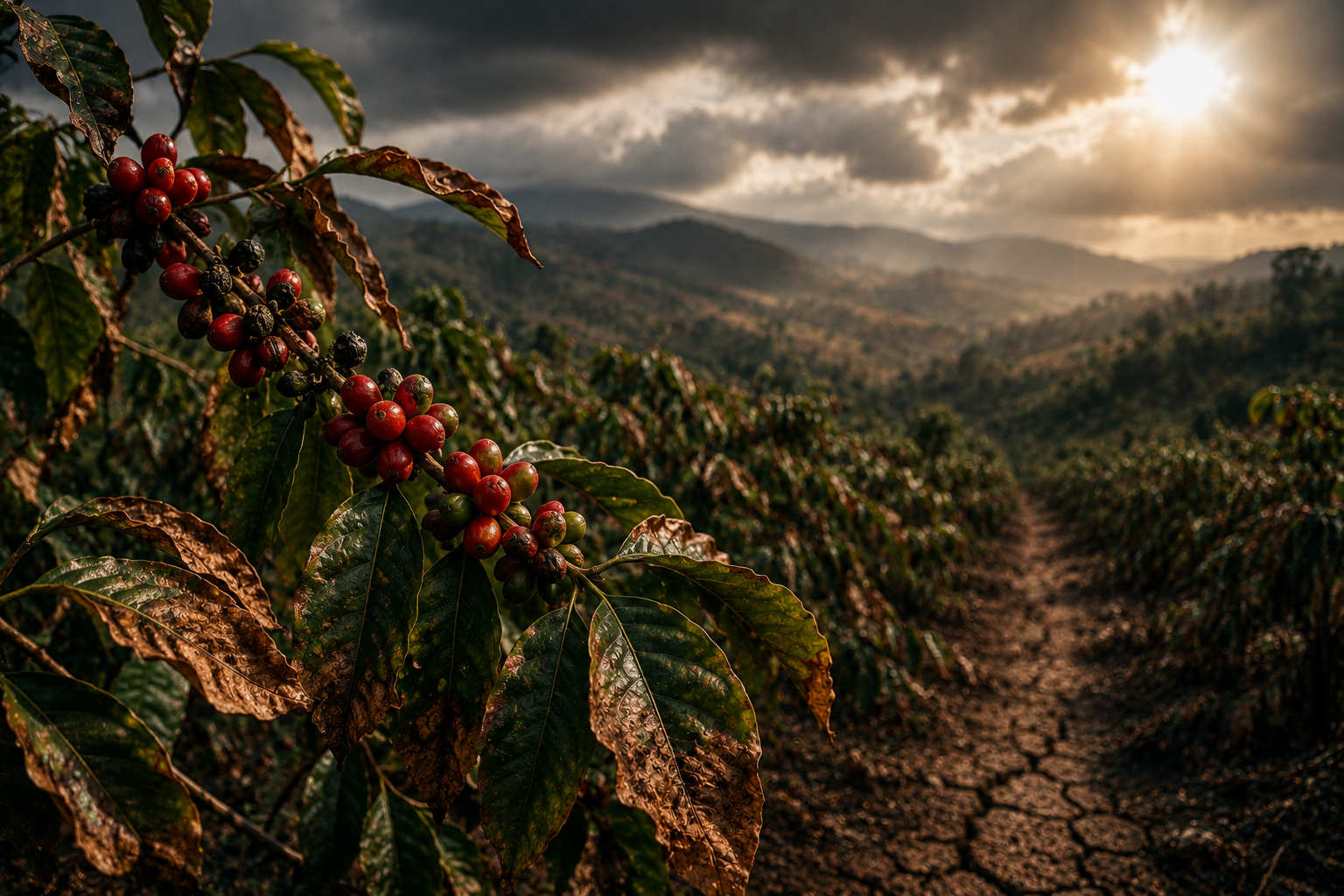




The morning ritual for billions of people is under imminent threat. Coffea arabica, the species responsible for approximately 60% of global coffee production, is spiraling toward extinction. Scientists and agronomists now warn that at the current rate of environmental degradation, we may lose viable wild Arabica populations within the next five years, forcing a radical shift in global consumption habits.
The Vulnerability of a Perfectionist Plant
Arabica is a notoriously “fussy” plant. Unlike its hardier cousin, Robusta, Arabica requires very specific climatic conditions to thrive. It evolved in the cool, high-altitude tropical forests of Ethiopia and South Sudan. For an Arabica tree to produce high-quality beans, it needs an average annual temperature between 18°C and 22°C.
Even a slight deviation in these parameters triggers physiological stress:
- Thermal Scorch: High temperatures accelerate the ripening of coffee cherries, leading to a loss in flavor complexity and acidity.
- Pest Proliferation: Increased humidity and erratic rainfall have fueled the spread of Hemileia vastatrix (coffee leaf rust) and the coffee berry borer, which thrive in warmer climates.
- Photosynthesis Inhibition: Extreme heat causes the plant to shut down its energy production to conserve water, leading to “leaf scorch” and eventual death.
Yield Dynamics and the Five-Year Countdown
The decline in productivity is no longer a projection—it is a measurable reality. Over the last three years, traditional “coffee belt” regions have faced unprecedented challenges, from frost in Brazil to prolonged droughts in Central America.
| Year | Global Arabica Production (Million Bags) | Status / Forecast |
| 2023 | 98.2 | Historical Average |
| 2024 | 91.5 | Impact of Regional Frosts |
| 2025 | 84.8 | Severe Drought Disruption |
| 2026 (Est.) | 76.2 | Projected Global Shortage |
| 2028 (Proj.) | 52.0 | Critical Supply Failure |
| 2031 (Proj.) | < 15.0 | Commercial Unviability |
The Failure of Industrial Breeding
A common question is: why can’t we simply breed a “climate-proof” Arabica? The problem lies in the species’ genetic makeup. Coffea arabica is an autogamous (self-pollinating) plant with extremely low genetic diversity. This lack of a “genetic library” means that industrial Arabica plants do not have the inherent traits needed to adapt quickly to rapid thermal shifts.
Wild Arabica, which holds the genetic diversity necessary for resilience, is disappearing as its forest habitats are cleared. Without these wild ancestors, scientists have no “raw material” to cross-breed for heat resistance. We are essentially trying to upgrade a computer’s software when the hardware itself is melting.
Direct Climatic Factors and Environmental Stress
The direct climatic factors impacting Arabica are twofold:
- The “Thermal Ceiling”: Rising minimum night temperatures prevent the plant from resting and recovering, leading to metabolic exhaustion.
- Rainfall Asynchrony: Unpredictable rain disrupts the flowering cycle. Instead of one uniform harvest, the plant produces fruit at irregular intervals, making industrial harvesting impossible and lowering overall fruit quality.
A Universal Survival Plan
The loss of Arabica would not just be a culinary tragedy; it is a canary in the coal mine for global agriculture. As we look for alternatives—such as Coffea stenophylla or Coffea liberica—we must recognize that substitution is only a temporary fix.
Ecologists and global leaders must move beyond small-scale conservation and form a Comprehensive Global Preservation Plan. This strategy must protect not only Coffea arabica but all industrially significant plants—from cocoa to wheat—that are essential for human civilization. We are approaching a tipping point where the shift of climates and the loss of biodiversity are merging into a singular threat to global food security.