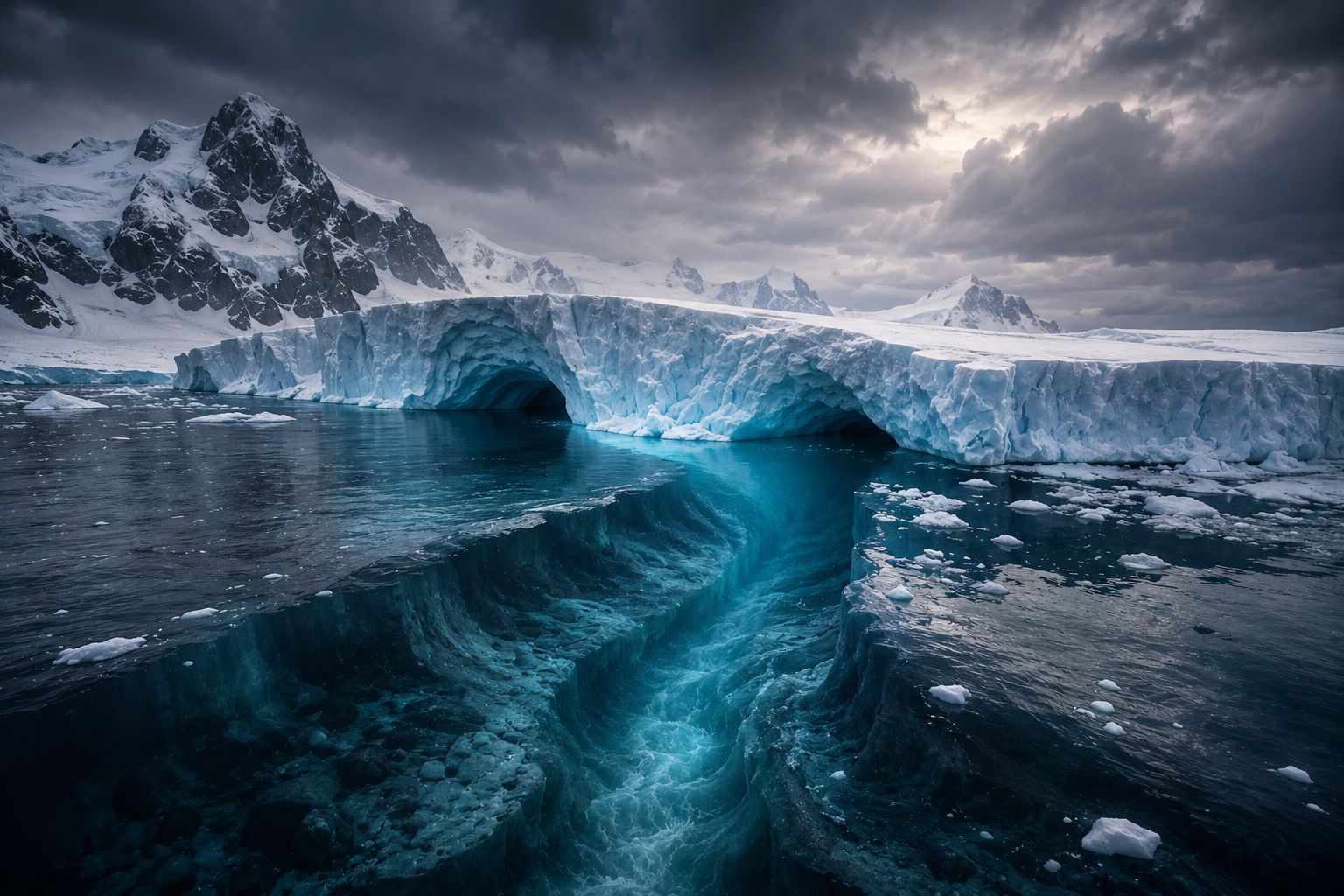



The timeline for global climate stability is being drastically recalibrated. According to recent research highlighted by ScienceDaily, Antarctica’s ice shelves are melting from below at a rate far exceeding previous scientific models. This “bottom-up” erosion is not just a distant environmental concern; it is a catalyst for a chain reaction that could reshape the geography and climate of our civilization within decades.
The Discovery of Sub-Glacial Channels
Oceanographers and glaciologists have identified a hidden mechanism accelerating the destruction of the Antarctic ice sheet. Long, deep channels have formed beneath the floating ice shelves, acting as conduits for warm ocean water. These channels trap heat against the “grounding line,” causing the ice to thin from the inside out.
Because this melting occurs out of sight of traditional satellite monitoring, the structural compromise was underestimated. As these foundations weaken, massive glaciers risk sliding into the ocean at an uncontrollable velocity.
Global Ocean Dynamics: Sea Level Rise and Desalination
The influx of meltwater is causing two simultaneous crises: the physical rise of water levels and the chemical dilution of the ocean’s salinity. The following table illustrates the accelerating trend recorded over the last few years and the projected shifts leading into the next decade.
| Year | Average Sea Level Rise (Cumulative vs 2000) | North Atlantic Salinity (PSU Index) | Impact Observations |
| 2010 | +35 mm | 35.1 | Stable current flow |
| 2020 | +78 mm | 34.8 | Measurable AMOC slowing |
| 2024 | +102 mm | 34.5 | Sub-glacial channels detected |
| 2026 (Est.) | +118 mm | 34.2 | Record storm surges in Europe |
| 2030 (Proj.) | +155 mm | 33.7 | High risk of AMOC tipping point |
| 2040 (Proj.) | +240 mm | 32.9 | Significant coastal displacement |
Note: PSU (Practical Salinity Unit) represents the salt content. A drop below 33.5 in key North Atlantic corridors is considered critical for the “conveyor belt” of global currents.
Saltwater Species on the Brink of Extinction
The rapid desalination of the oceans is not only a physical threat to climate currents but a lethal biological challenge for marine life. Most saltwater organisms are stenohaline, meaning they can only survive within a very narrow range of salinity. As the infusion of fresh Antarctic meltwater dilutes their habitat, the osmotic balance of these species is disrupted, leading to systemic cellular failure and mass mortality.
Marine ecosystems that have remained stable for millennia are now facing a “freshwater shock.” This disruption ripples up the food chain, affecting everything from microscopic plankton to apex predators. When the water becomes too fresh, the shells of mollusks and crustaceans fail to form properly, and the metabolic processes of saltwater fish become exhausted as they struggle to maintain the salt levels required for their survival.
Declining Marine Populations in Desalinating Zones
The following table tracks the alarming decline in populations of key species sensitive to salinity changes in the North Atlantic and Southern Ocean corridors.
| Species Group | Role in Ecosystem | Population Change (2020–2026) | Critical Salinity Threshold |
| Phytoplankton (Diatoms) | Primary Producer / Oxygen | -22% | High sensitivity to ion balance |
| Atlantic Bluefin Tuna | Apex Predator | -15% | Affects larval development |
| Cold-Water Corals | Habitat Architect | -30% | Osmotic stress & acidification |
| Atlantic Cod | Commercial Keystone | -18% | Disrupts spawning migration |
| Oceanic Pteropods | Base of Southern Food Web | -28% | Shell dissolution in low salinity |
Examples of Species at the Tipping Point
- Oceanic Pteropods (Sea Butterflies): These tiny marine snails are the “canaries in the coal mine” for the Southern Ocean. They are a primary food source for fish and whales. Low salinity levels, combined with rising acidity, prevent them from calcifying their shells, leading to a collapse of the base of the Antarctic food web.
- Atlantic Bluefin Tuna: While highly mobile, the spawning grounds of the Bluefin are specifically tied to high-salinity currents. As fresh water “plumes” expand, these predators are forced into unfamiliar, resource-poor territories, leading to lower reproductive success.
- Deep-Sea Sponges and Corals: These stationary organisms cannot migrate away from the freshening water. In the North Atlantic, entire reefs are being “suffocated” as the chemical composition of the water shifts, leading to a loss of biodiversity that supports thousands of other marine species.
The extinction of these saltwater-dependent populations signifies more than just a loss of biodiversity; it represents the dismantling of the global blue economy and the primary protein source for billions of humans. If the oceans lose their salt, they lose their life.
The AMOC Collapse and the End of Climate Predictability
Perhaps the most terrifying aspect of the Antarctic melt is its impact on the Atlantic Meridional Overturning Circulation (AMOC). As massive quantities of fresh meltwater pour into the Atlantic, they dilute the salt concentration.
Ocean currents rely on the “thermohaline” pump—the sinking of cold, salty water that drives global circulation. When the water becomes too fresh, it ceases to sink, potentially leading to a total collapse of the AMOC. The consequences would be world-altering:
- Extreme European Winters: Without the warm currents from the Gulf Stream, Europe could face Siberian-style winters.
- Agricultural Failure: The shifting of rain belts would cause traditional “breadbaskets” to face permanent drought.
- Super-Storms: The temperature disparity between the cooling North and warming South would fuel more frequent “mega-storms.”
A Race Against the Current
The news from Antarctica is a stark reminder that the Earth’s systems are interconnected. The melting of the southern ice is the first domino in a series of collapses that threaten the very predictability of the seasons.
Ecologists and global policymakers must treat the stabilization of the AMOC and the protection of coastal infrastructure as a unified existential priority. The window for adaptation is closing faster than the ice is thinning.