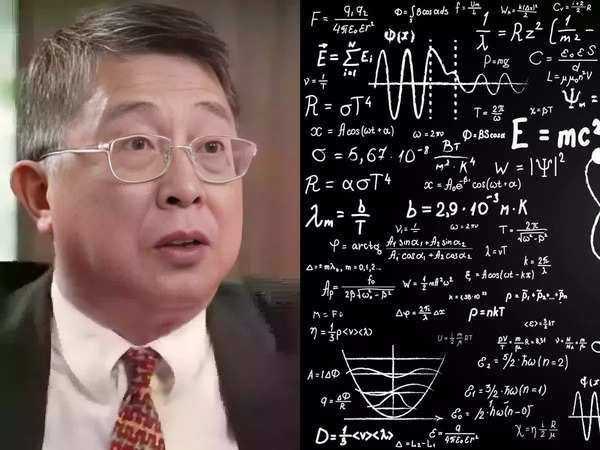




The centuries-old debate between science and theology has taken an unexpected turn. Dr. Willie Soon, an astrophysicist and aerospace engineer affiliated with the Harvard-Smithsonian Center for Astrophysics, has sparked widespread discussion by asserting that the existence of a higher power can be demonstrated through mathematical precision.
Appearing on the Tucker Carlson Network, Dr. Soon argued that the fundamental equations governing our universe are not the result of cosmic coincidences, but rather the highly calibrated blueprints of a divine creator. By consolidating physical constants into a singular mathematical framework, he posits that the probability of our universe existing purely by chance is virtually zero.
Cosmic Fine Tuning and Mathematical Improbability
At the foundation of Dr. Soon’s thesis is the fine-tuning argument—the scientific observation that the fundamental physical constants of nature are perfectly set to the exact values required to permit life.
Our universe is governed by precise numeric values, including the speed of light, the gravitational constant, and the strengths of the strong and weak nuclear forces. If any of these constants were altered by even an infinitesimal fraction, the structural stability of reality would collapse. Galaxies would never have aggregated, stars would fail to ignite, and the chemical bonds necessary for organic life could not form.
To Dr. Soon, this flawless calibration is mathematically impossible to attribute to random luck. Instead, he argues that the equations themselves serve as an intentional formula for creation.
The Asymmetry of Matter and Antimatter
One of the most compelling pieces of cosmic evidence cited by Dr. Soon dates back to the immediate aftermath of the Big Bang. According to the standard laws of physics, the birth of the universe should have generated matter and antimatter in perfectly equal quantities.
However, this symmetry presents a fatal paradox:

If matter and antimatter had been created equally, they would have instantly annihilated one another upon contact, leaving behind nothing but a featureless void of pure radiation. Yet, a mysterious asymmetry occurred—a slight excess of matter survived the cataclysmic dawn of time. This remaining matter went on to form gas clouds, stars, planets, and ultimately, human beings.
Dr. Soon views this fundamental imbalance not as a random anomaly, but as a deliberate deviation from standard physics—a signature of intentional design specifically orchestrated to allow life to take hold.
Divine Architecture of Physical Laws
To contextualize his findings, Dr. Soon revived the philosophies of legendary Nobel Prize-winning theoretical physicist Paul Dirac. In 1963, Dirac famously observed that the fundamental features of nature are best described through mathematical theories of immense beauty and power. Dirac concluded that “God is a mathematician of a very high order, and He used very advanced mathematics in constructing the universe.”
Dr. Soon builds directly upon this legacy, expanding on complex geometric concepts such as closed curvature in spacetime without gravity. He emphasizes that abstract mathematical principles often predict physical realities long before humans can physically observe them—just as Dirac mathematically predicted the existence of antimatter years before it was experimentally discovered.
| Scientific Phenomenon | Naturalist Interpretation | Dr. Willie Soon’s Interpretation |
| Cosmic Fine-Tuning | A lucky coincidence or a byproduct of a broader multiverse. | Intentional design by a supreme mathematician. |
| Matter-Antimatter Asymmetry | An unexplained flaw in early thermodynamic expansion. | A deliberate intervention designed to prevent total annihilation. |
| Mathematical Beauty | A human tool invented to map patterns in nature. | The literal “fingerprints” of a Creator left behind in the laws of physics. |
The Boundary Between Proof and Faith
Unsurprisingly, Dr. Soon’s claims have reignited a fierce ideological divide within the global scientific community. Critics and secular physicists argue that utilizing mathematics to demonstrate intelligent design conflates description with causation. Legendary cosmologist Stephen Hawking famously noted that the laws of physics can explain how the universe behaves, but attributing those laws to God is a matter of personal definition rather than empirical proof. Skeptics also favor the Multiverse Hypothesis, which suggests that if an infinite number of universes exist, ours simply happens to be the one with the winning numerical lottery ticket for life.
Dr. Soon, however, remains resolute. He maintains that when humanity looks deeply into the governing equations of the cosmos, it is not looking at chaos, but at absolute order.
Conclusion
The mathematical models presented by Dr. Soon challenge the traditional boundary that separates rational science from spiritual faith. Whether the precision of cosmic constants is viewed as the ultimate mathematical fluke or the conscious intent of a divine creator remains a deeply personal conclusion. However, as science continues to peel back the layers of the cosmos, the staggering harmony of the universe ensures that the question of a Grand Architect will remain at the forefront of human inquiry.