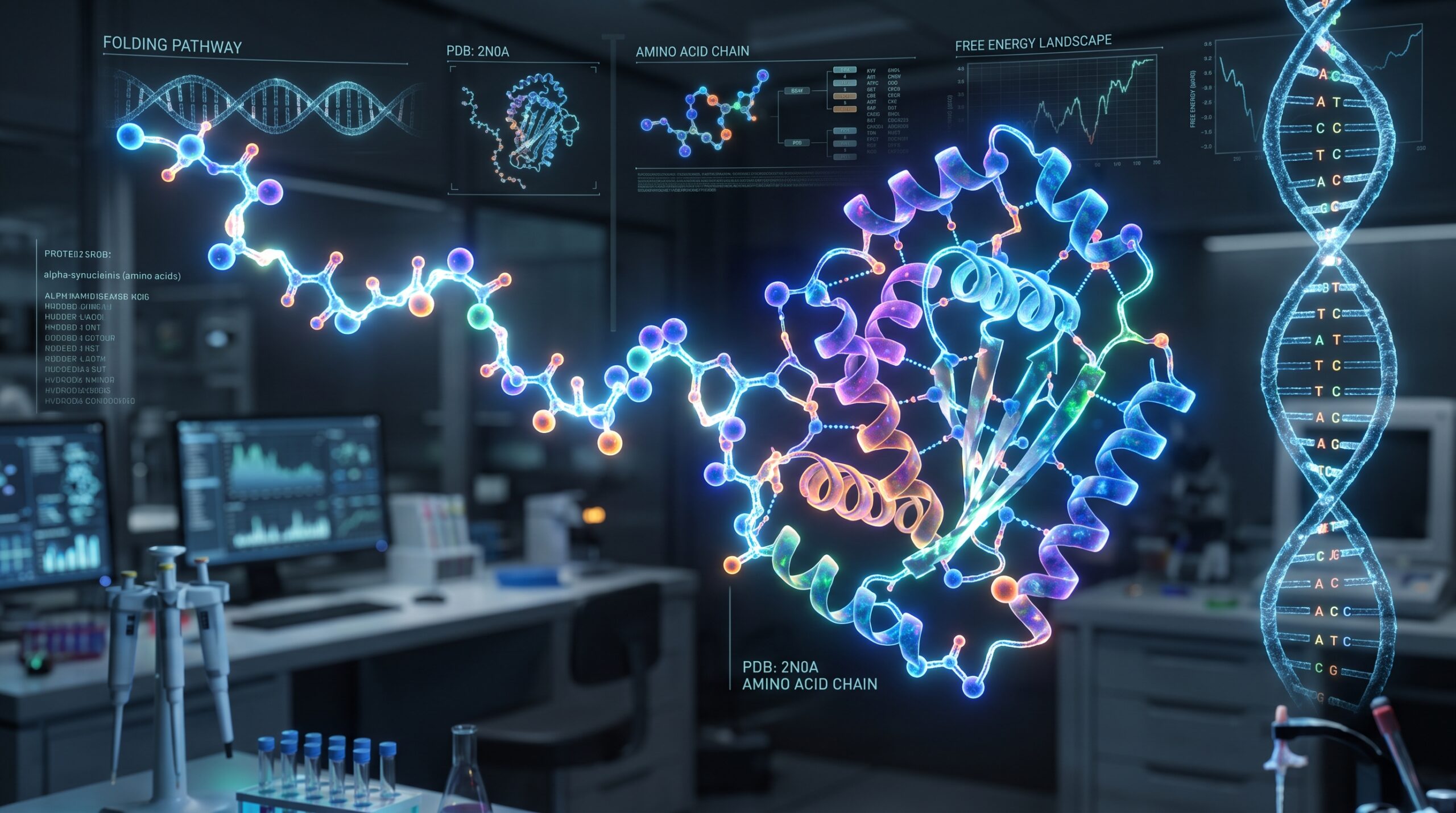


Proteins serve as the primary functional, structural, and catalytic machinery of living organisms, driving cellular metabolism, signaling pathways, structural architecture, and immune responses. Understanding how a simple chain of amino acids folds into a complex, functionally active three-dimensional macromolecule remains a cornerstone of biochemistry, structural biology, and bioinformatics.
To comprehend how biological function emerges at the molecular level, scientists analyze what is an amino acid sequence and investigate how the physical arrangement of chemical building blocks governs spatial geometry, biological reactivity, and evolutionary lineage.
The Chemical Transition from Amino Acids to Proteins
A foundational question frequently explored in biological sciences is is amino acid a protein. Individual amino acids function as the chemical building blocks (monomers) of proteins, composed of a central alpha-carbon atom, an amino group, a carboxyl group, a hydrogen atom, and a variable side-chain (R-group) that determines unique chemical behavior.
The biological condensation of amino acids to proteins proceeds through a highly regulated polymerization mechanism:
- Peptide Bond Formation: The carboxyl group of one monomer reacts with the amino group of an adjacent monomer, releasing a water molecule in a dehydration synthesis reaction.
- Polypeptide Chain Extension: As subsequent covalent bonds form, a continuous string of amino acids emerges, featuring an invariant backbone with distinct chemical polarity running from the N-terminus to the C-terminus.
- Higher-Order Folding Trajectory: The unique linear sequence of amino acids drives local secondary interactions (alpha-helices and beta-pleated sheets) and long-range tertiary folding into stable 3D architectures.
What Determines the Sequence of Amino Acids and Genetic Expression
The specific order of monomers within a protein amino acid sequence is not random. It is strictly dictated by the organism’s genomic blueprint.
When investigating what determines the order of amino acids in a protein, the process follows the central dogma of molecular biology:
- Genomic Transcription: Nuclear enzymes transcribe double-stranded DNA into single-stranded messenger RNA (mRNA).
- Codon Translation: Cytoplasmic or membrane-bound ribosomes decode the mRNA sequence in triplet units called codons. Each triplet codon specifies a unique amino acid transferred by specialized tRNA molecules.
- Sequence Expression and Modifications: Translation ensures that the primary protein sequence reflects exact genetic instructions. Following ribosome assembly, post-translational modifications (such as phosphorylation, glycosylation, and proteolytic cleavage) can further modify sequence function.
Evolutionary Homology, Sequence Alignments, and Functional Conservation
In modern structural biology and comparative genomics, the sequence of amino acids in a protein serves as a direct record of evolutionary relationships. Because proteins carrying essential catalytic functions experience selective pressure, key amino acid residues remain conserved across divergent species over millions of years.
Bioinformaticians analyze these patterns using specialized analytical frameworks:
- Sequence Homology and Alignments: By comparing the amino acid sequence of a protein across different organisms using local and global alignment algorithms (such as BLAST and Needle-Wunsch), researchers identify conserved motifs essential for enzyme active sites.
- Structural and Functional Prediction: Conserved residues within an amino acid chain indicate critical positions for structural stability or ligand binding, allowing scientists to infer protein function in newly discovered organisms without immediate empirical testing.
- Mutational Tolerance and Disease Mapping: Analyzing variance within a linear sequence of amino acids helps distinguish benign genetic variants from pathogenic mutations that cause protein misfolding and cellular dysfunction.
Analytical Methodologies in Protein Sequencing and Mass Spectrometry
Accurately determining the primary amino acid sequence structure is crucial for drug discovery, proteomics, and biopharmaceutical development.
Researchers exploring how to find amino acid sequence details rely on advanced analytical pipelines:
Direct Chemical Identification and Edman Degradation
Classic amino acid sequencing relied on Edman degradation, which selectively labels, cleaves, and identifies the N-terminal residue of a peptide chain in iterative cycles. While extremely precise for short peptides, it is limited by chain length.
Mass Spectrometry and High-Throughput Proteomics
Modern protein sequencing predominantly uses liquid chromatography combined with tandem mass spectrometry (LC-MS/MS). Proteins are enzymatically digested into smaller peptides, ionized, and fragmented in gas phase. The resulting mass-to-charge spectra reveal the exact amino sequence with high speed and sensitivity.
Genomic Translation and Bioinformatic Decoding
When assessing how to read amino acid sequence information from high-throughput nucleic acid sequencing, computational tools automatically convert open reading frames (ORFs) into corresponding polypeptide chains using standardized genetic code tables.
Comparative Hierarchy of Protein Structural Organization
The primary sequence of amino acids serves as the master template dictating all subsequent levels of spatial organization:
| Structural Hierarchy | Primary Bonding & Forces | Functional Impact & Biological Role |
| Primary Structure | Covalent peptide bonds | The exact sequence of amino acids in a protein encoded by DNA |
| Secondary Structure | Backbone hydrogen bonding | Localized repeating patterns such as alpha-helices and beta-sheets |
| Tertiary Structure | Hydrophobic packing, disulfide bridges, ionic bonds | Complete three-dimensional monomeric fold defining active sites and binding pockets |
| Quaternary Structure | Non-covalent subunit interactions | Multi-polypeptide complex assembly necessary for allosteric regulation and structural integrity |
Frequently Asked Questions
What does the sequence of amino acids determine in a protein?
The sequence of amino acids determines the specific 3D tertiary fold, thermodynamic stability, catalytic activity, and functional binding specificity of the protein.
What is an amino acid sequence example?
A classic amino acid sequence example is human insulin, which consists of two interconnected polypeptide chains: Chain A (21 amino acids) and Chain B (30 amino acids) held together by interchain disulfide bonds.
Why is primary sequence conservation important in evolutionary biology?
Conserved positions within a chain of amino acids reveal functional domains that cannot mutate without disrupting protein stability or catalytic activity, serving as molecular evidence for shared evolutionary ancestry.