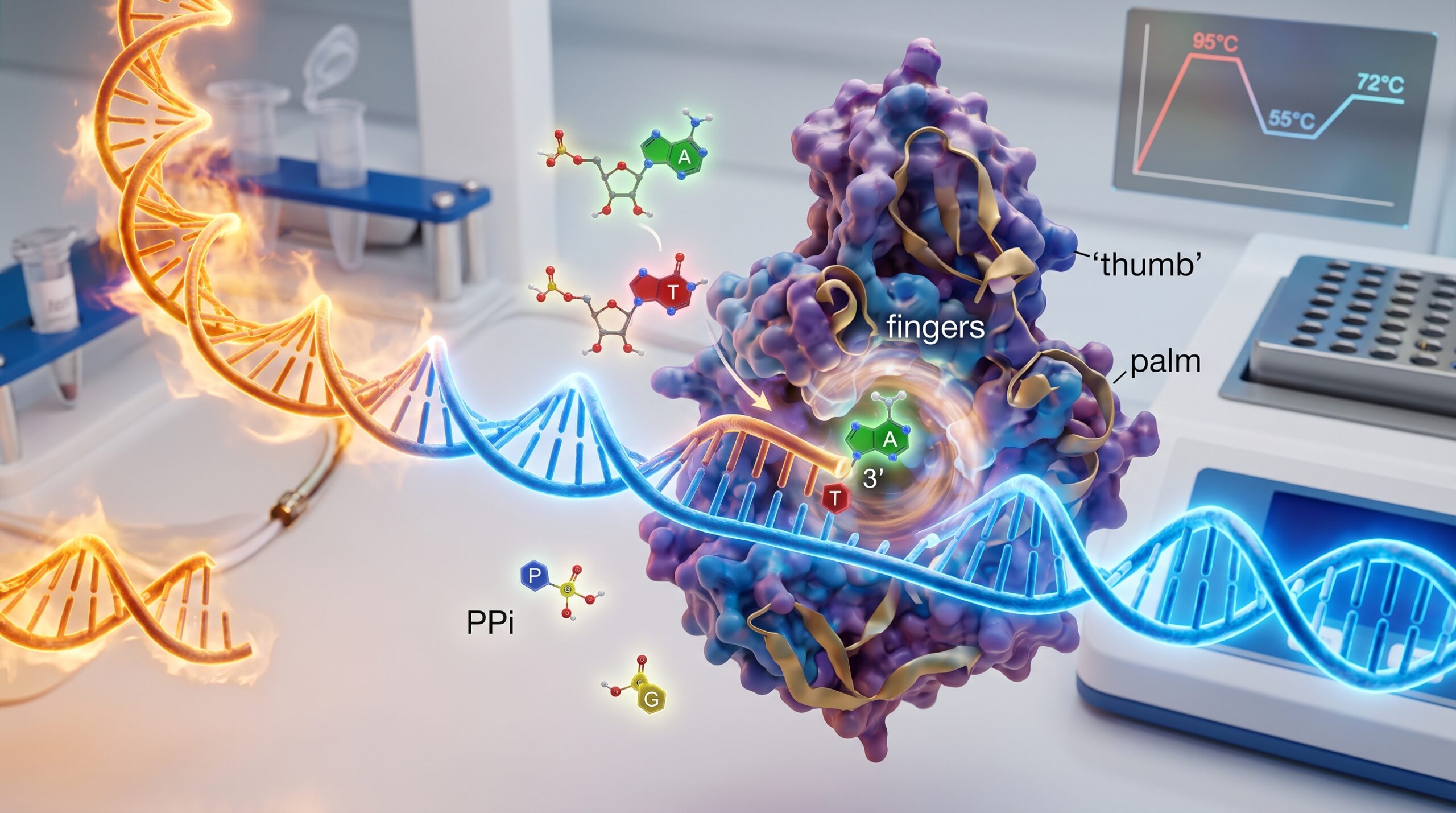
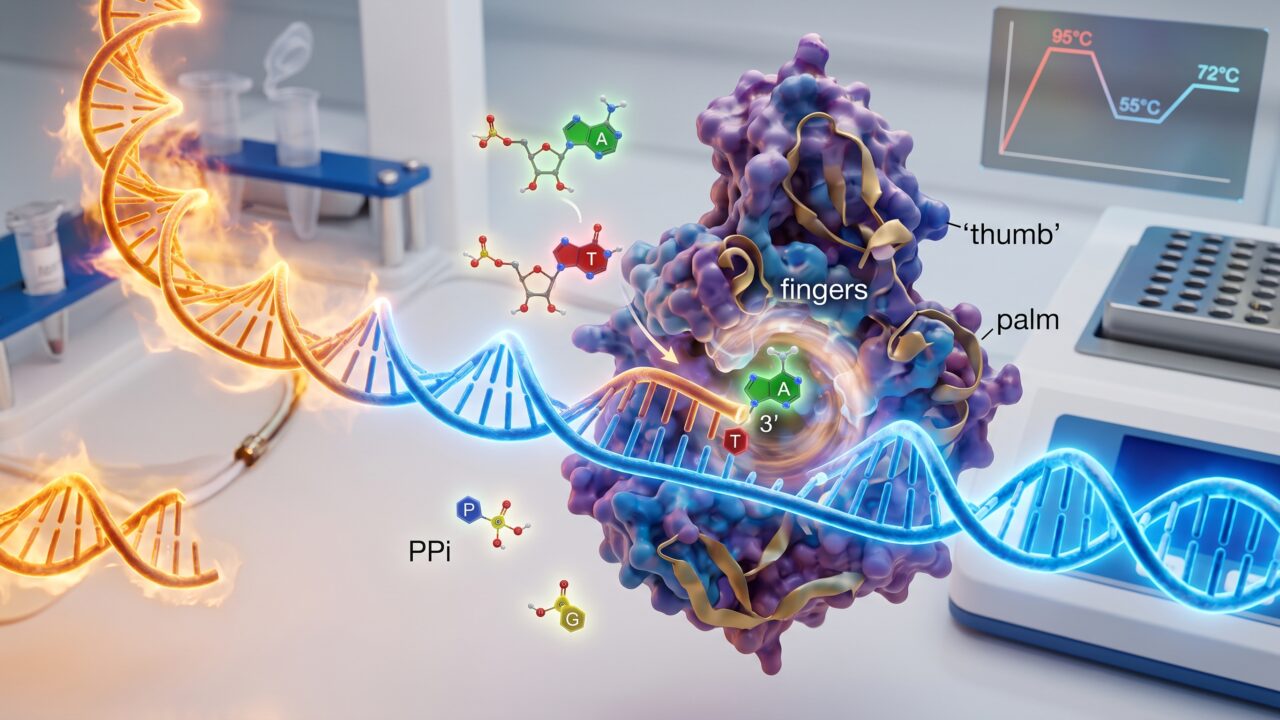




In contemporary molecular genetics and biotechnology, targeted nucleic acid amplification serves as an indispensable tool for clinical diagnostics, forensic identification, and academic research. Students and researchers frequently explore what is taq polymerase and investigate how thermostable catalysts transformed gene amplification from a tedious manual chore into a routine automated laboratory workflow.
Understanding what is taq dna polymerase requires analyzing how specialized thermal enzymes preserve structural stability across repeated denaturation cycles without losing biological activity.
Discovery and Natural Origin of Thermus Aquaticus
When investigating where does taq polymerase come from, the history of biotechnology points to the extreme thermal environments of Yellowstone National Park. In the late 1960s, microbiologist Thomas D. Brock discovered a thermophilic bacterium thriving in hydrothermal vents at temperatures exceeding 70°C.
This organism was named thermus aquaticus, giving rise to the formal taq definition and the common scientific abbreviation taq. Understanding the taq meaning revolves around its bacterial source (T. aq.), from which scientists isolated a single-polypeptide chain enzyme with a molecular weight of approximately 94 kDa capable of retaining catalytic activity even after exposure to near-boiling water.
Enzymatic Mechanics, Co-Factors, and Kinetic Properties
To understand the specific taq dna polymerase function, it is useful to evaluate standard cellular replication mechanisms. Like all polymerase enzymes, this protein synthesizes complementary DNA strands by adding deoxynucleotide triphosphates (dNTPs) to a growing 3′ hydroxyl end in the 5′ to 3′ direction.
For a deeper analysis of cellular DNA replication, exploring dna polymerase function provides important foundational context. While standard cellular enzymes denature at high temperatures, the primary taq polymerase function centers on maintaining rapid extension rates at an optimal working temperature between 75°C and 80°C.
Key biochemical properties of taq dna polymerase include:
- Thermal Half-Life: Demonstrates a half-life of approximately 40 to 45 minutes at 95°C, ensuring high catalytic integrity through dozens of thermo-cycling phases.
- Divalent Cation Dependency: Requires magnesium ions (Mg2+) as an essential co-factor. The concentration of MgCl2 directly influences enzyme activity, fidelity, and primer annealing specificity.
- Exonuclease Profile: Possesses intrinsic 5′ to 3′ exonuclease activity, which is utilized in TaqMan probe cleavage assays, but lacks 3′ to 5′ exonuclease proofreading capability.
- Terminal Transferase Activity: Frequently adds a single nontemplated 3′ adenosine (A) overhang to amplified double-stranded fragments, facilitating downstream TA cloning vector integration.
The Indispensable Role of Taq Polymerase in PCR Workflows
Understanding why is taq polymerase used in pcr highlights the difference between early manual methods and modern automated thermo-cycling. Before the integration of thermostable taq polymerases, scientists had to manually add fresh enzyme after every single heating cycle, as conventional enzymes denatured during strand separation.
When evaluating what does taq polymerase do in pcr, its main function unfolds across three recurring temperature phases:
| PCR Cycle Phase | Operating Temperature | Role of Taq Polymerase in PCR |
|---|---|---|
| 1. Denaturation | 94°C – 96°C | Survives extreme thermal exposure while double-stranded target DNA separates into single strands. |
| 2. Annealing | 50°C – 65°C | Remains stable while synthetic oligonucleotide primers bind to complementary target sequences. |
| 3. Extension | 72°C | Binds to primed sites and rapidly synthesizes new complementary DNA strands at up to 1,000 base pairs per minute. |
This continuous operation explains what is the function of taq polymerase in pcr and demonstrates why the purpose of taq polymerase in pcr remains vital for automated genetic analysis, diagnostic testing, and genomic research.
Optimizing Reaction Conditions for Polymerase Efficiency
Achieving maximum yield and specificity during taq polymerase pcr requires fine-tuning reaction parameters:
- Magnesium Optimization: Standard reactions utilize 1.5 mM to 2.5 mM MgCl2. Insufficient Mg2+ reduces yield, while excessive Mg2+ leads to non-specific amplification and misincorporation.
- pH and Salt Buffers: Optimal activity occurs in a buffer around pH 8.3 to 8.8 (at 25°C) containing potassium chloride (KCl) and non-ionic detergents to stabilize enzyme conformation.
- dNTP Balance: Equimolar concentrations of dATP, dCTP, dGTP, and dTTP (typically 200 µM each) prevent premature termination and balance elongation rates.
Frequently Asked Questions
What is taq polymerase used for in pcr?
The primary taq polymerase purpose is to automate the enzymatic synthesis of new DNA strands over multiple thermal cycles, allowing researchers to amplify specific DNA fragments exponentially.
Is taq polymerase an enzyme with proofreading activity?
Standard taq lacks 3′ to 5′ exonuclease proofreading activity, giving it an average error rate of approximately 1 × 10⁻⁵ errors per base pair. For high-fidelity applications requiring absolute sequence accuracy, proofreading enzymes with 3′ to 5′ exonuclease capability (such as Pfu) are preferred.
What is the origin of tac polymerase?
The term tac polymerase is a common misspelling of taq polymerase, which refers directly to the thermostable DNA polymerase isolated from the hot-spring bacterium Thermus aquaticus.