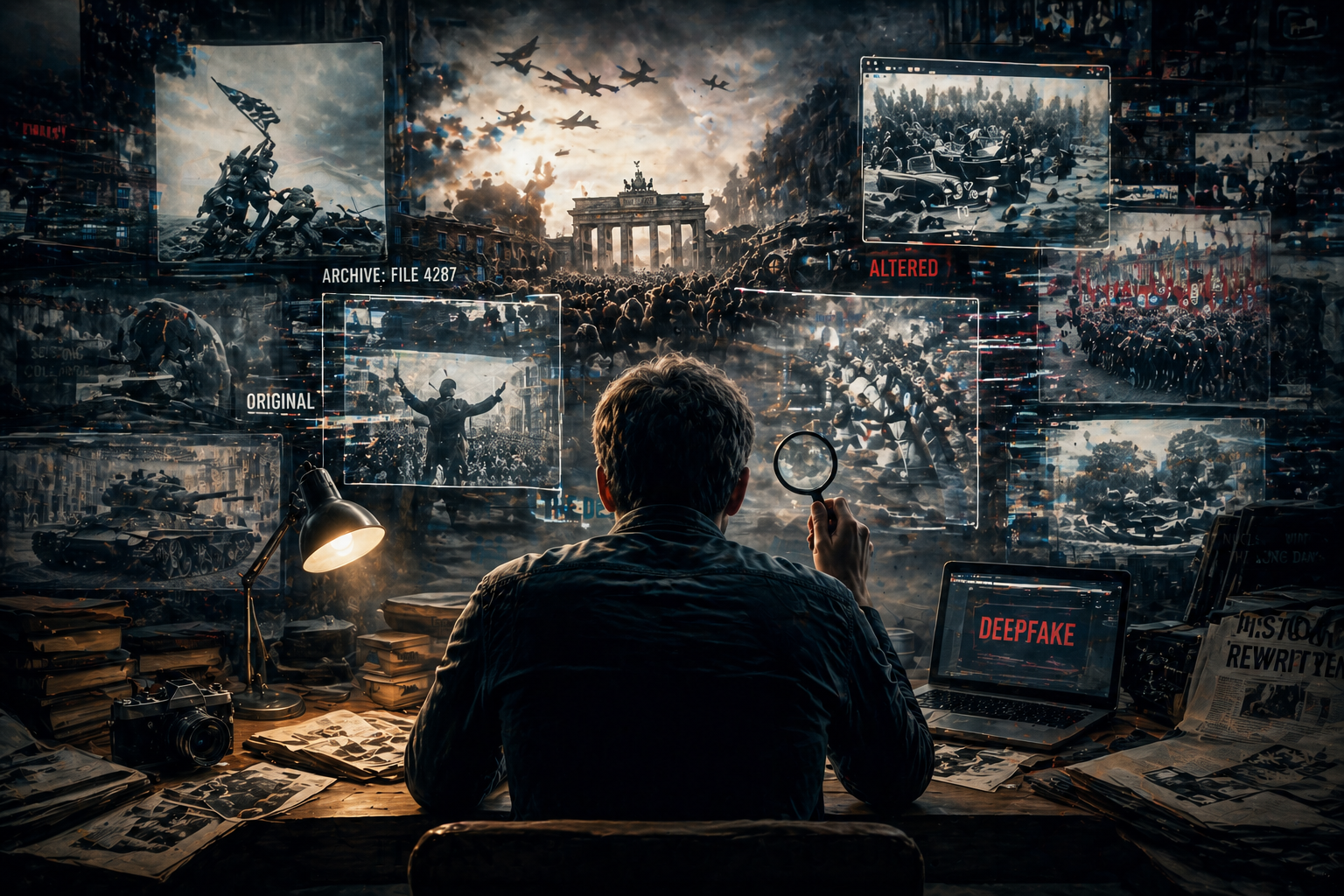




The battlefield of history has shifted. For decades, “memory wars” were defined by states rewriting textbooks, censoring archives, or suppressing inconvenient narratives. These were battles of omission and narrative framing. Today, however, we have entered a far more volatile phase: the era of rewritable visual history. In 2026, information conflict is no longer just about deciding which version of the past to teach; it is about actively fabricating the past itself. History has transformed from a static record into a dynamic, shifting environment where truth no longer possesses a stable form.
The New Frontiers of Information Conflict
The current landscape of memory warfare uses advanced generative tools to create synthetic historical events that never occurred, designed to trigger nationalistic fervor or justify geopolitical agendas. Malicious actors now flood digital spaces with manipulated documents and deepfake archival footage. Because these materials are engineered to look aged and authentic, they bypass our natural skepticism. By drowning the public in a sea of contradictory evidence, these actors aim to induce a state of epistemic exhaustion. When everything could be fake, people stop looking for the truth and start believing whichever version confirms their existing biases.
The Paradox of Digital Transparency
We currently live in the most transparent historical era in human existence, yet this unprecedented accessibility has created a dangerous paradox. The easier it is to access history, the easier it is to manipulate it. Transparency was supposed to be the ultimate safeguard of truth, but in a world of high-fidelity simulations, it provides the perfect cover for high-level deception. When history is just a digital dataset, it becomes as hackable as any other software.
The Crisis of Authority
In an environment where any photograph, video, or government record can be convincingly mimicked, truth ceases to be an inherent property of the source. It becomes a variable of trust. If we can no longer rely on the document, we are forced to rely on the institution, the platform, or the algorithm. This creates a crisis of authority. Future efforts to safeguard history will likely shift toward cryptographic verification, using digital signatures and blockchain-based ledgers to ensure records cannot be retrospectively altered. Yet, technology alone cannot fix the fundamental human flaw: people do not always gravitate toward what is true; they gravitate toward what is convincing.
The End of Naive History
The year 2026 marks the end of our naive belief in history. We can no longer afford to view the past as a fixed, objective foundation. We must now perceive it as a fluid environment—a digital medium that is constantly being edited by technology, political interests, and human bias. The transition from “history as a record” to “history as a simulation” is complete. The essential skill for the future is no longer just knowing history in the traditional sense; it is the ability to discern where authentic history ends and its simulation begins. Historical literacy will now be defined by one’s ability to navigate a world where the past itself has become a customizable narrative, requiring us to verify every step before we accept that reality as our own.you must verify every footstep, or risk walking into a reality that was designed for you to believe.