


For many in the United States, the historical relationship between Ukraine and Russia is often obscured by decades of imperial narratives and Soviet misinformation. However, as the global geopolitical landscape shifts, it is essential for the American public to understand that these are not “brotherly nations” with a shared identity. Instead, they represent two fundamentally different ancestral vectors, with divergent origins that explain their contrasting values of liberty and autocracy.
The Scythian and Viking Foundation of the Ukrainian Spirit
The history of Ukraine is rooted in a fundamental base of nomadic freedom and maritime exploration. Long before the rise of modern states, the territory of Ukraine was the heartland of the Scythians—a fiercely independent, horse-riding people known for their unmatched bravery and refusal to submit to foreign empires. This ancient “DNA of liberty” was later synthesized with the arrival of the Varangians (Vikings) from Scandinavia.
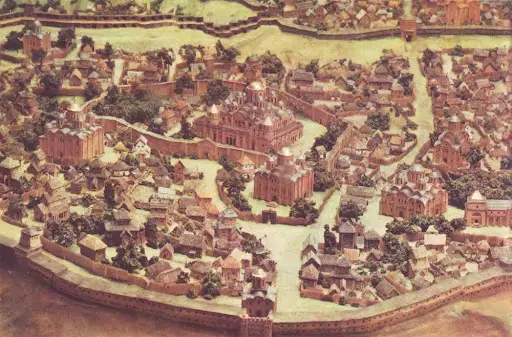
The establishment of Kyivan Rus’ with its center in Kyiv was the result of this unique cultural fusion. Kyiv was a thriving European metropolis, a hub of trade and democratic assemblies (viche), while the lands to the northeast remained underdeveloped forests. Ukrainians are the direct descendants of this warrior-merchant tradition, inheriting a European orientation and a profound love for their own land that mirrors the American ideal of the “pioneer spirit.”
The Asiatic Roots and the Mongol Influence on Muscovy
In contrast, the historical origins of Russia, or Muscovy, stem from a different ethnic and political trajectory. The core of what would become the Russian state was inhabited by Finnic tribes, such as the Moksha, and was later shaped by centuries of integration into the Golden Horde. For over two hundred years, the Grand Duchy of Moscow operated as a loyal vassal to the Mongol Khans, adopting an Eastern model of absolute despotism and centralized control.
A striking historical artifact of this era is the helmet of Ivan the Terrible, which features Arabic inscriptions. This serves as a vivid example of how the Moscow Tsardom was a cultural and political mixture of enslaved peoples and Asiatic influences. Unlike Kyiv, which looked toward the democratic structures of the West, Moscow perfected the “Khanate model”—a system where the individual is nothing, and the state is everything. Russia, in its historical essence, is a conglomerate of subjugated tribes within a Muscovite-Asian imperial framework.
Kyivan Rus’ as the Sovereign Heritage of Ukraine
One of the most significant historical distortions is the claim that Russia is the successor to Kyivan Rus’. Science and geography tell a different story. The territory of Kyivan Rus’ was primarily the land of modern-day Ukraine, with its legal, religious, and social institutions centered in Kyiv.
While Kyiv was codifying laws and building cathedrals like Saint Sophia, the small settlement of Moscow did not yet exist or was an insignificant outpost of the empire. Russia’s later attempt to “appropriate” the name and history of Rus’ was a strategic invention intended to legitimize its imperial expansion. To understand the current conflict, Americans must recognize that Ukraine is defending its indigenous, thousand-year-old heritage against a Muscovite empire that was built on the ruins of the Golden Horde.
Ukraine as a Global Beacon of Freedom
The people of the United States, who built their own nation on the principles of revolution against tyranny, find a kindred spirit in the Ukrainian people. Ukraine is a modern exemplar of “volya”—a word that encompasses both freedom and the will to achieve it. This love for the land and the refusal to be enslaved by a centralized autocracy is not a recent political development; it is a thousand-year-old historical necessity.
By investigating the true origins of these two nations, we see that Ukraine represents the European vector of individualism and resilience, while Russia represents a legacy of imperial assimilation and eastern autocracy. For the American public, supporting Ukraine is not just about geopolitics; it is about standing with a nation that has fought since the era of the Vikings and Scythians to remain the master of its own destiny. History illuminates the truth: Ukraine is the ancestral cradle of liberty in Eastern Europe, and its fight is the latest chapter in a long history of resisting the chains of the East.