




For decades, the multiple-choice question (MCQ) has been the undisputed king of standardized testing and university admissions. From the SATs in the United States to the NMT in Ukraine, these tests are praised for their efficiency, objectivity, and ease of grading. However, a growing chorus of educators and neurobiologists argues that these tests do not measure real knowledge. Instead, they measure a student’s ability to navigate a game of probabilities, intuition, and strategic elimination.
A Game of Probabilities and Strategic Guessing
The fundamental flaw of the multiple-choice format is that it transforms a demonstration of knowledge into a recognition task. In a real-world scenario, a professional must retrieve information from their memory and apply it to a unique problem. In an MCQ exam, the answer is already on the page; the student simply needs to find it.
This leads to the mastery of “test-taking strategies” rather than subject mastery:
- The Method of Elimination: Students are taught to identify and discard the “least likely” distractors. By narrowing four options down to two, a student has a 50% chance of being “correct” without actually knowing the underlying principle.
- Linguistic Intuition: Often, the correct answer is phrased more formally or is longer than the distractors. Experienced test-takers can “feel” the right answer based on the syntax of the question rather than the data.
- Analogy and Pattern Recognition: Many tests reward students who are good at spotting patterns or making logical leaps, skills that are valuable but distinct from the specific knowledge (like historical dates or chemical formulas) being tested.
Knowledge vs Application The Gap in Critical Thinking
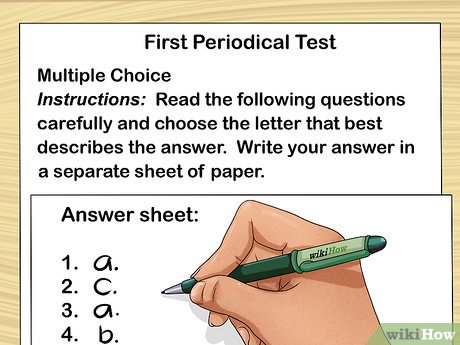
True knowledge is not binary; it is nuanced. Multiple-choice tests struggle to evaluate “high-order thinking”—the ability to synthesize disparate facts into a cohesive argument. When a student chooses “Option B,” the examiner has no idea why they chose it. Did they arrive there through rigorous calculation, or was it a lucky guess based on a half-remembered keyword?
Furthermore, MCQs punish “outside-the-box” thinkers. A student who sees a complex nuance in a question that makes none of the provided answers strictly true is often penalized, while the student who memorized a simplified, perhaps even flawed, textbook definition is rewarded. This encourages a culture of rote memorization rather than deep, inquisitive learning.
The Case for Open-Ended Evaluation and Self-Expression
To truly assess a student’s readiness for university or professional life, we must return to open-ended questions and long-form responses. This shift is essential for several reasons:
- Demonstrating the Process: An open-ended question requires the student to show their work. Whether it is a mathematical proof or a literary analysis, the “how” is often more important than the “what.”
- Application of Skills: Requiring a student to write an original essay or solve a multi-step problem ensures they can apply their knowledge in a vacuum, without the “safety net” of provided options.
- Critical Reflection: Open-ended tasks force students to engage in self-expression. They must formulate a thesis, defend it with evidence, and consider counter-arguments—the exact skills required for scientific research and high-level management.
Restoring the Value of Education
Standardized testing has turned education into a “hacking” exercise where students study for the test rather than for the subject. By shifting the focus back to written exams, oral defenses, and creative applications of knowledge, we move away from “probability games” and back toward genuine intellectual growth.
A student who can argue a point, write a coherent analysis, and explain the “why” behind a fact is far better prepared for the complexities of the 21st century than a student who has simply perfected the art of filling in the correct bubble.