




History is rarely a static record of the past; it is an active mirror reflecting the anxieties, values, and ambitions of the present. May 2026 has arrived alongside a cluster of major, round historical anniversaries that have ignited intense dialogue across global academic, architectural, and scientific circles.
From the shifting ethno-historical narratives of colonial America to the celebration of high-industrial architectural engineering and the foundational steps of early space travel, these milestones are forcing society to re-examine where it came from. In a world deeply preoccupied with decolonization, infrastructural resilience, and a multi-nation race back to the Moon, the anniversaries of 1626, 1931, and 1961 offer a timely blueprint for understanding the contemporary landscape.
Dismantling the 24 Dollar Myth: 400 Years of Manhattan’s Complex Legacy
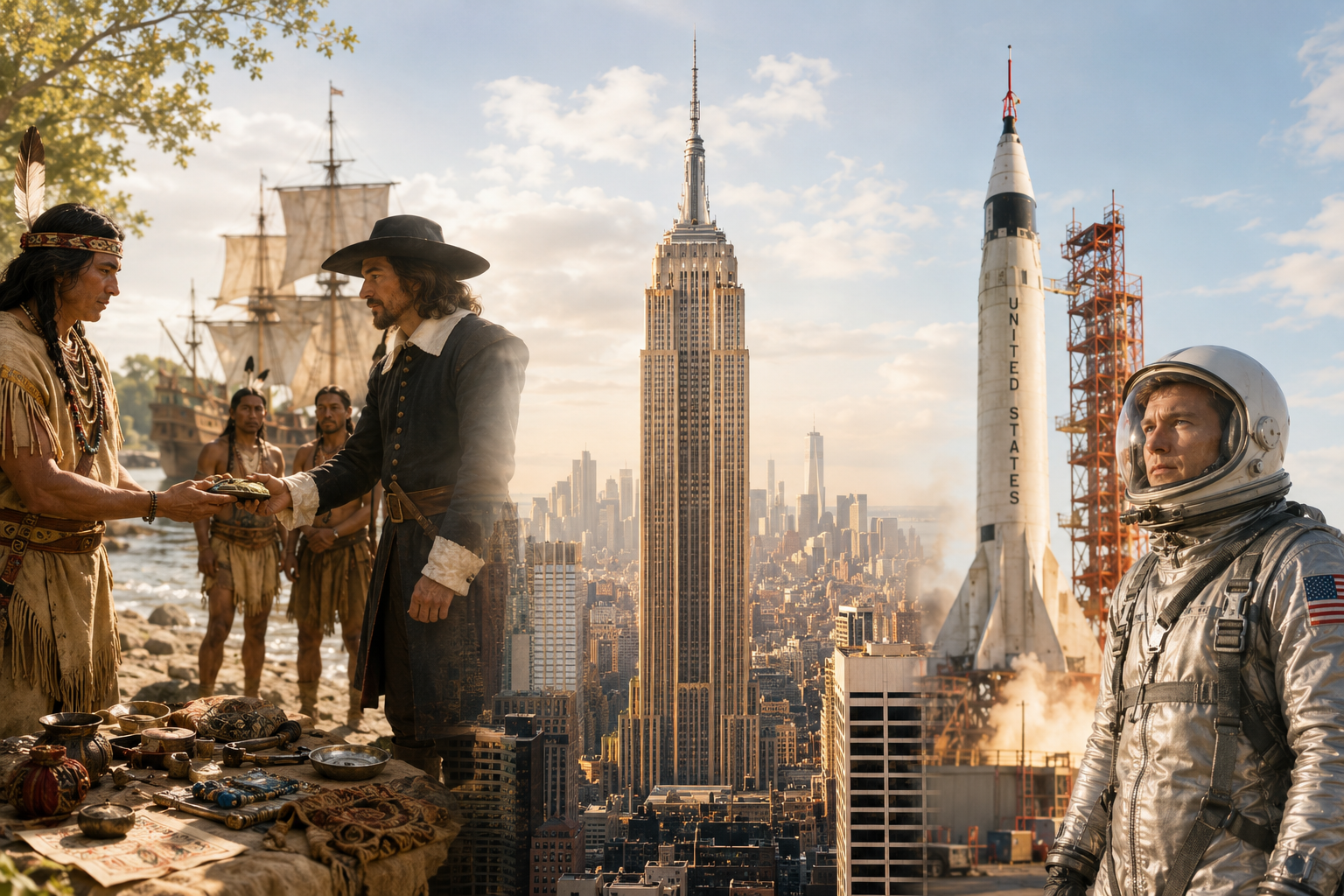
Perhaps the most culturally sensitive milestone of the month is the quadricentennial of the legendary “purchase” of Manhattan Island in May 1626. For generations, Western history textbooks summarized this event through a simplistic, Eurocentric lens: Peter Minuit, representing the Dutch West India Company, allegedly bought the entire island from the local indigenous population for glass beads and trinkets valued at approximately twenty-four dollars.
| Historical Narrative | The Traditional Colonial Myth | The Modern Decolonial Reality |
| Transaction Nature | A definitive, capitalist real estate sale. | A diplomatic alliance and shared land-use agreement. |
| The Currency | Cheap, worthless glass beads and trinkets. | High-value trade goods, iron tools, and cloth. |
| Cultural Concept | Indigenous tribes willingly traded away sovereign land. | The Lenape lacked any concept of permanent property ownership. |
In May 2026, historians and decolonial scholars are thoroughly dismantling this narrative. The consensus within indigenous studies reveals that the Lenape people had absolutely no concept of permanent, exclusive land ownership.
To the Lenape, the transaction was understood as a diplomatic treaty granting shared hunting rights and an alliance, not a permanent eviction. Furthermore, archival research shows that the “trinkets” were actually essential trade commodities—including iron kettles, axes, and high-quality textiles—which held substantial practical value. Re-evaluating 1626 through a modern lens challenges the centuries-old myths of colonial superiority, framing the interaction instead as a story of profound cultural miscommunication and systemic displacement.
Defying the Depressions: 95 Years of the Empire State Building
On May 1, 1931, President Herbert Hoover pressed a button from Washington, D.C., officially illuminating the Empire State Building in New York City for the very first time. Standing at 1,454 feet to its tip, it immediately became the tallest structure on Earth, a title it proudly held for nearly four decades.
Ninety-five years later, this art deco masterpiece has found a massive second life across architectural digital media and engineering channels. Content creators are focusing heavily on the staggering logistics of its construction:
- Unprecedented Speed: The entire skyscraper was erected in just 13 months and 45 days, a vertical construction rate that remains completely unmatched by modern bureaucratic and engineering standards.
- Economic Resilience: Built during the darkest depths of the Great Depression, the project provided critical employment for over 3,400 daily workers, predominantly European immigrants and Mohawk ironworkers.
In 2026, as modern cities struggle with escalating infrastructure costs and delayed project timelines, the Empire State Building is celebrated not just as an aesthetic marvel, but as an enduring symbol of industrial willpower and economic defiance.
The Birth of American Cosmic Ambition: 65 Years of Freedom 7
On May 5, 1961, astronaut Alan Shepard squeezed into the cramped Freedom 7 capsule atop a Redstone rocket, blasting into a suborbital trajectory that made him the first American in space. Coming just weeks after the Soviet Union shocked the world with Yuri Gagarin’s orbital flight, Shepard’s 15-minute mission was a critical, high-stakes victory for the United States.
The 65th anniversary of this flight lands at a moment of intense geopolitical symmetry. The evolution of the global lunar race has shifted from a strict bilateral competition into a multi-polar environment:
| Era | Primary Actors | Mission Milestone & Core Vector | Ultimate Strategic Focus |
| 1961 | United States vs. Soviet Union | Alan Shepard’s 15-minute suborbital flight on Freedom 7. | Building the technological foundations for the Cold War Project Apollo. |
| 2026 | US, China, India, and Private Aerospace Conglomerates | NASA’s Artemis program paired with commercial infrastructure development. | A multi-polar race to establish permanent operations at the lunar south pole. |
Today, the contemporary space race is no longer a simple race to plant a flag. It is a complex race to establish permanent infrastructure and secure resource rights on the lunar south pole, involving multiple nations and independent private space conglomerates. Looking back at Shepard’s pioneering 15 minutes reminds the scientific community of the raw, mechanical vulnerability that started it all, contextualizing the immense technological leaps required to sustain human life beyond orbit today.
The Interconnected Fabric of Time
The convergence of these three round dates in May 2026 highlights the cyclical nature of human development. The questions of territory and human equity raised by the 400th anniversary of Manhattan are the very same ethical debates surrounding the colonization of space and lunar resource rights today. Meanwhile, the industrial ambition that drove the creation of the Empire State Building serves as an inspiration for the aerospace engineers currently designing the launchpads of tomorrow. By understanding these milestones not as isolated museum pieces, but as active chapters of an ongoing human journey, society is better equipped to navigate the complex frontiers ahead.