



A breakthrough study published by the International Consortium for Cognitive Research has unveiled a major leap forward in educational technology and neuroscience. By utilizing lightweight, artificial intelligence-powered neural headbands during learning sessions, researchers have successfully demonstrated how real-time cognitive monitoring can radically accelerate the human brain’s ability to absorb new information.
The study confirms that tracking a student’s mental state in real time and modifying the lesson accordingly can increase the speed of learning by up to 45%. This methodology shows the most significant promise in complex subjects, such as foreign languages and exact sciences.
Real Time Mental Monitoring in the Classroom
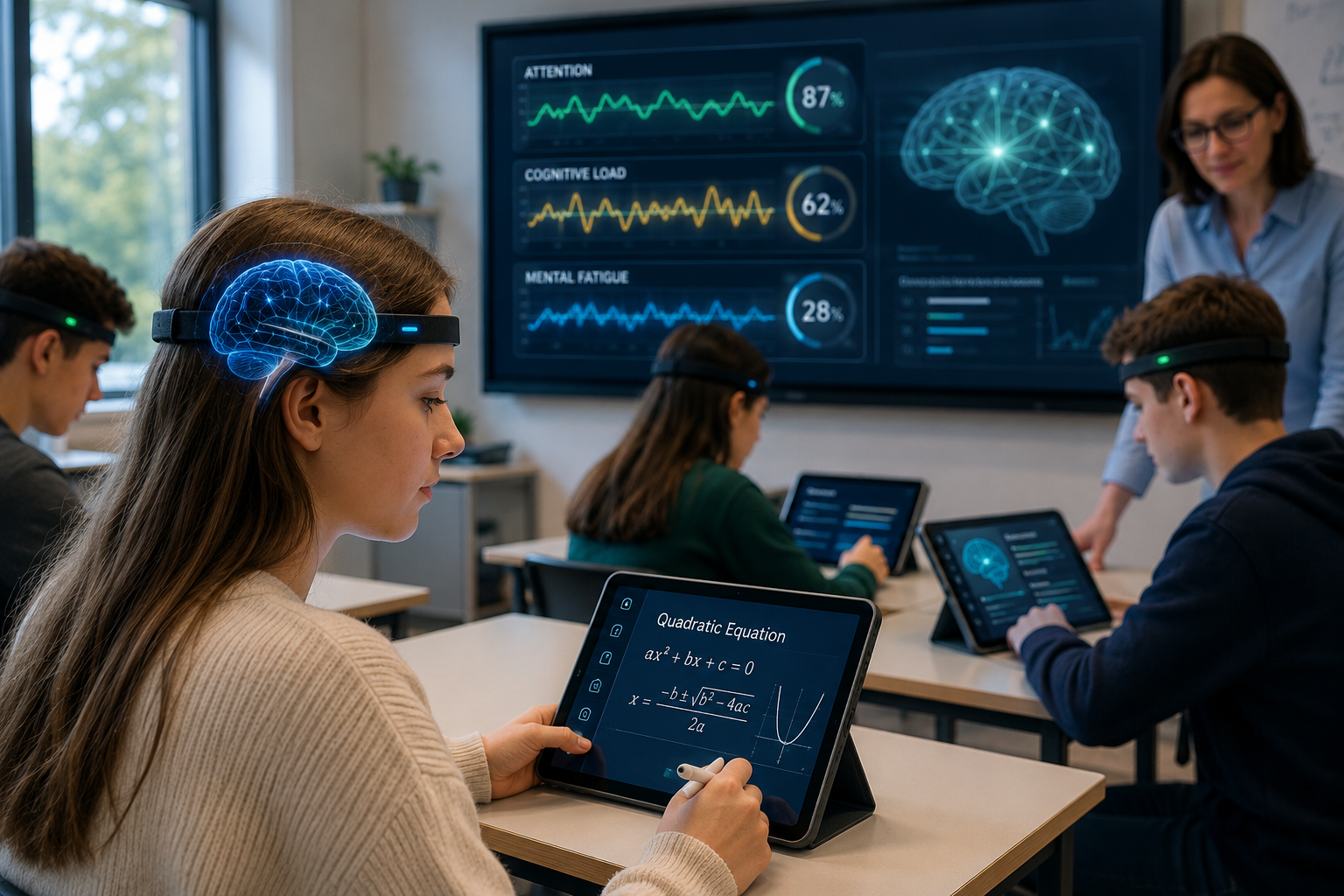
The experiment involved thousands of students wearing specialized, non-invasive neuro-headbands equipped with advanced EEG sensors. These devices actively monitor brainwave patterns to assess two critical metrics in real time:
- Concentration Levels: Tracking how deeply engaged the student is with the material.
- Mental Fatigue: Detecting the precise moment the brain experiences cognitive overload and stops processing data efficiently.
Powered by a specialized AI backend, the system instantly interprets these neural signals, allowing the educational software to understand the exact mental state of the learner without requiring any manual input or feedback.
The Power of Adaptive Learning Delivery
The core discovery of the study lies in the implementation of “adaptive delivery.” Instead of forcing a student through a rigid, predetermined curriculum, the AI-driven learning platform shifts its approach based on the student’s real-time brain activity.
Preventing Cognitive Overload
When the neural interface detects that a student’s brain is becoming overwhelmed or experiencing high cognitive load, the system automatically adjusts. It may insert a brief, calculated pause, introduce a gamified review session, or alter the presentation style of the material—such as breaking down a complex math equation into simpler visual steps.
Exploiting Peak Focus
Conversely, when the system detects peak focus and high cognitive receptivity, it accelerates the introduction of new concepts. This ensures that the brain is being challenged precisely when it is most capable of forming new neural pathways.
The results of this dynamic pacing were undeniable. Students utilizing the adaptive neural system absorbed difficult concepts 45% faster than those following traditional, time-blocked learning structures.
Paving the Way for Universal Education Systems
The traditional educational model operates on a one-size-fits-all approach, assuming every student processes information at an identical speed. Neuroscience, however, has long proven that cognitive thresholds vary wildly depending on the time of day, individual stress levels, and personal learning styles.
The data gathered by the International Consortium for Cognitive Research offers a roadmap to solving this structural flaw. By integrating lightweight, affordable neural interfaces into everyday learning, educators can establish highly universal, accessible, and inclusive educational frameworks.
While still in the optimization phase for mass commercial production, this technology marks the beginning of a shift from standardized schooling to truly personalized, neuro-adaptive education.