



Long before the era of colonial empires, a group of seafaring Norse explorers established the fundamental base of European presence in the New World. This historical vector was driven by the Warrior Spirit and a desperate search for sustainable resources as the Greenland colonies struggled against a harsh, cooling climate. The story of these first outposts in Canada is a saga of immense bravery, environmental challenges, and the inevitable friction between two vastly different cultures.
The Visionary Expedition of Leif Erikson
The central figure of this trans-Atlantic expansion was Leif Erikson, an explorer of Greenlandic origin and the son of the legendary Erik the Red. Around the year 1000 CE, Erikson acted on reports from earlier sailors like Bjarni Herjólfsson, who had sighted land to the west but never went ashore. Seeking timber and grapes—both scarce in Greenland—Erikson set sail with a crew of thirty-five men to investigate these unknown territories.
According to the Saga of the Greenlanders, Erikson navigated through three distinct regions. First was Helluland, identified by modern historians as Baffin Island, which he described as a barren land of flat stones. Moving south, he reached Markland, likely the heavily forested shores of Labrador, providing the Norse with much-needed wood. Finally, he established a camp in Vinland, named for the wild grapes and fertile pastures found there. This region is now definitively linked to the northern tip of Newfoundland.
The Archaeological Reality of L’Anse aux Meadows
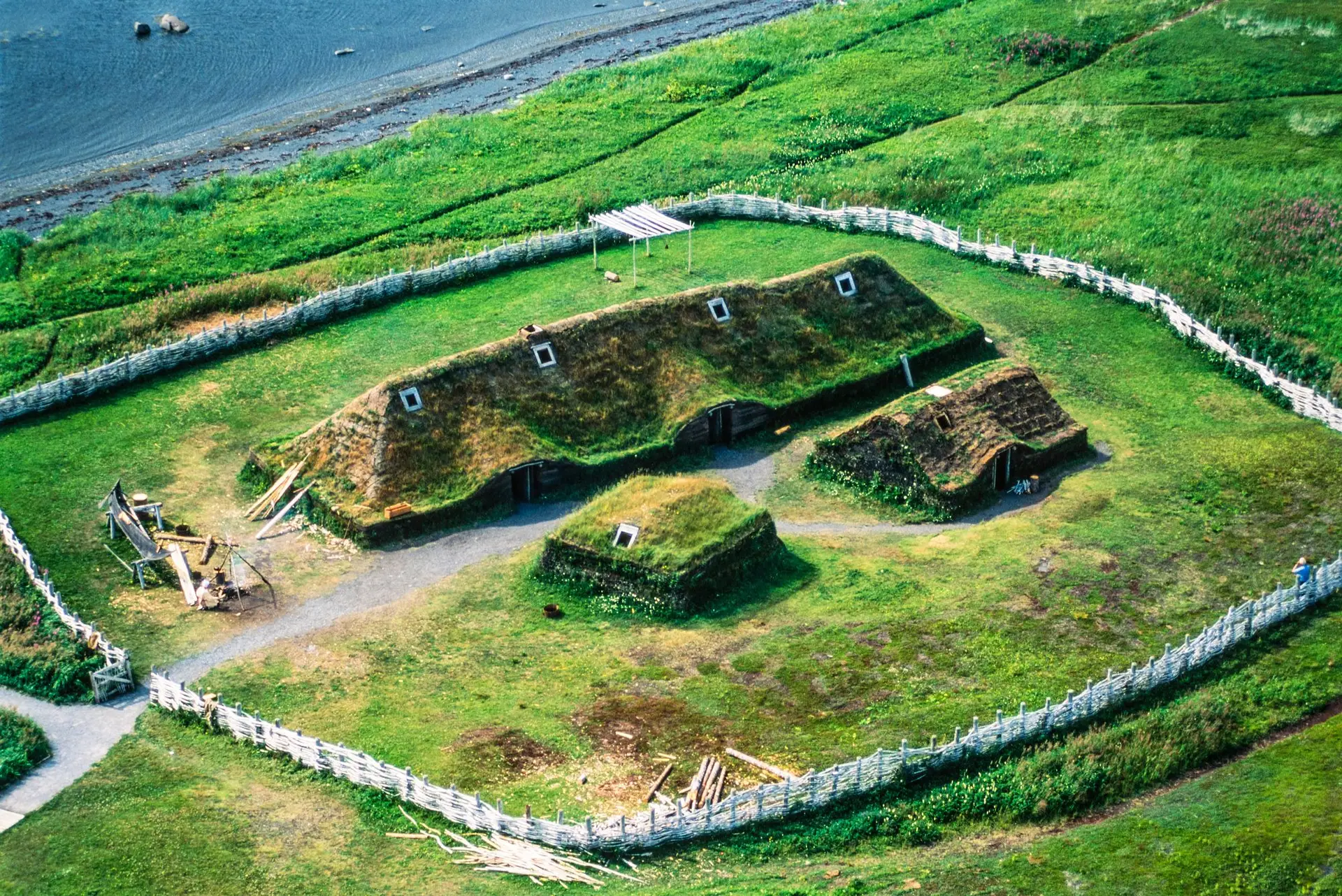
For centuries, these accounts were dismissed as mere folklore until the “scientific base” was established in 1960. Norwegian explorers Helge and Anne Stine Ingstad discovered the site of L’Anse aux Meadows in Newfoundland. This remains the only confirmed Norse settlement in North America and provides visceral documentation of their daily lives.
The excavations revealed eight sod-and-timber buildings constructed in the same architectural style as those found in Viking-age Greenland and Iceland. Beyond simple housing, the site contained a sophisticated iron forge. This is a critical historical marker, as it proves the Vikings were the first people to smelt iron in the New World, utilizing local bog iron to produce nails for ship repair. The presence of artifacts such as a bronze ring-headed pin, a stone oil lamp, and even knitting needles indicates that this was not merely a military camp, but a settlement intended for long-term habitation involving both men and women.
“Skraelings” and the Culture of Conflict
The Norse did not arrive in an empty land; they encountered the indigenous peoples of the region, whom the sagas refer to as Skraelings. These were likely ancestors of the Beothuk or the Dorset culture. The initial interactions were a mix of curiosity and commerce, with the Norse trading milk and red cloth for high-quality furs.
However, a “scientific skew” in communication led to tragedy. The sagas recount that a skirmish broke out after a Norse bull escaped and terrified the local people, who had never seen such a beast. The resulting violence was swift and brutal. Thorvald Erikson, Leif’s brother, was killed by an arrow during one of these coastal clashes. While the Vikings possessed superior iron weaponry, they were vastly outnumbered and lacked the deep knowledge of the terrain held by the local tribes. This constant state of hostility created a psychological “catastrophe” for the small, isolated Norse community, making it impossible to establish the peaceful agricultural base they required.
The Logistics of Isolation and the Failure to Stay
Despite the natural riches of Vinland—including salmon larger than any seen in Europe and frost-free winters—the Norse presence lasted only about a decade. The failure to sustain the settlement was largely a matter of demographic deficit. The parent colony in Greenland was small, numbering perhaps only 2,500 people. They simply did not have the “human capital” to support a distant outpost while simultaneously battling indigenous resistance and internal social strife.
Historical records suggest that internal disputes over resources and social hierarchy further weakened the community. With supply lines stretching over a thousand miles of treacherous North Atlantic waters, even a single failed harvest or a lost ship meant certain death. By approximately 1013 CE, the last of the Norse departed, leaving the structures of L’Anse aux Meadows to be reclaimed by the forest.
Immortalizing the Explorer: Leif Erikson’s Canadian Legacy
Leif Erikson is now celebrated as a symbol of the ancient lineage of liberty and exploration in Canada. His legacy was officially recognized in 1978 when L’Anse aux Meadows became a UNESCO World Heritage site, serving as a global museum of Norse history. In the town of St. Anthony, Newfoundland, a prominent bronze statue of Erikson stands as a permanent tribute, gazing out toward the Atlantic he once conquered.
Today, we look back at these ruins not as a failure, but as proof of a remarkable human-caused phenomenon: the first meeting of Europe and North America. Leif Erikson’s voyage proved that the Atlantic was not an impassable barrier but a hallway between worlds. His footprints in the soil of Newfoundland remain a testament to a time when the horizon was limited only by the courage of the person willing to sail toward it.