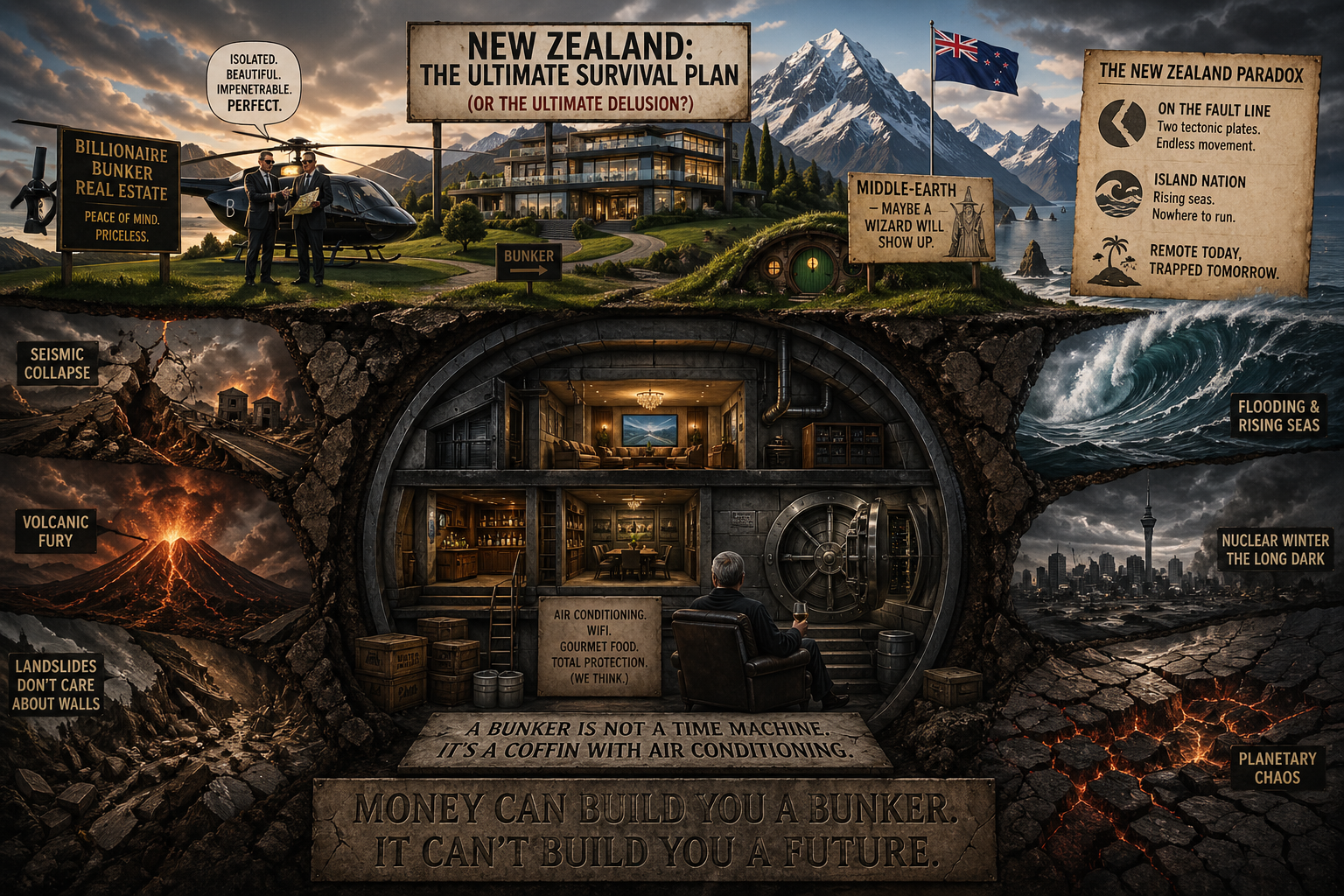



Across the elite circles of Silicon Valley and global finance, a peculiar form of “prepping” has taken hold. Multi-millionaires and billionaires are quietly scouring New Zealand for properties that come pre-equipped with high-end, reinforced bunkers—or, failing that, commissioning custom-built underground fortresses at a staggering cost. From the rolling hills of the Waikato to the remote landscapes of the South Island, these modern-day “survival sanctuaries” are being marketed as the ultimate insurance policy against the collapse of civilization.
But as the wealthy pour billions into these subterranean steel-and-concrete tombs, a fundamental question arises: is this a calculated survival strategy, or simply the most expensive delusion in human history?
The “Hobbit” Theory – Cinematic Obsession?
We have to ask: why New Zealand? Aside from the isolation, one cannot help but notice a rather humorous pattern. Could it be that our billionaire class are simply massive Lord of the Rings fans? It is, after all, the land of Middle-earth. Perhaps they are not preparing for the apocalypse at all, but rather hoping that if they dig deep enough into the hills of Matamata, they’ll find a cozy hobbit-hole lifestyle—minus the hairy feet and the lack of Wi-Fi. Honestly, short of them being die-hard Tolkien enthusiasts waiting for a wizard to show up, we are struggling to find a more logical explanation for this specific geographic preference.
The Illusion of Total Protection
The marketing for these luxury bunkers promises safety from the “end of the world.” However, a closer look at the science of a true, catastrophic apocalypse reveals that a bunker is, at best, a temporary shield against very specific, isolated threats.
A bunker might provide a fleeting chance of survival against a localized blast wave or a temporary surge from a tsunami. But a true “apocalypse”—the kind the wealthy are terrified of—is rarely a single, isolated event. It is a cascading, multi-front war waged by nature.
If global systems truly collapsed under the weight of a systemic catastrophe, the scenario would not be a clean, contained nuclear detonation. It would be a complex, apocalyptic convergence:
- Seismic and Volcanic Activity: Unrelenting tectonic shifts and magma eruptions that ignore the structural integrity of even the deepest reinforced steel.
- Geological Instability: Massive landslides and crustal deformations that can crush or bury underground structures, turning a “sanctuary” into a permanent grave.
- Flooding and Rising Seas: The inevitable inundation of coastal and low-lying land as oceanic dynamics are disrupted.
- The Eternal Winter: Following a global event, the atmosphere would be choked with ash and debris, triggering a nuclear winter that would render the surface world uninhabitable for years.
A bunker is essentially a coffin with air conditioning. It offers no protection against the geological upheaval of a planet in turmoil.
The New Zealand Paradox
The choice of New Zealand as the preferred location for these billionaire “lifeboats” is perhaps the most ironic aspect of this phenomenon. New Zealand sits directly on the boundary of two tectonic plates. It is a nation of intense seismic activity, prone to earthquakes that can reshape the landscape in minutes.
Furthermore, it is an island nation. In a true “end-of-days” scenario, where global weather patterns and sea levels go haywire, the very idea of relying on an island—an isolated piece of land subject to rising tides and unpredictable seismic shifts—seems like a strategic blunder. If the planet is undergoing a profound geological shift, the isolation that makes New Zealand attractive today could easily turn it into a trap tomorrow.
A Monument to Hubris
There is a profound disconnect between the billions being spent on these bunkers and the reality of surviving a planetary-scale collapse. By investing in these steel shelters, the wealthy are trying to use financial capital to solve a problem that is fundamentally existential.
They are treating the apocalypse as a luxury real estate problem that can be managed with better materials and more robust locks. But you cannot buy your way out of a tectonic plate movement. Ultimately, these bunkers in the heart of New Zealand’s seismic zones represent the ultimate scientific and philosophical hubris. They are monuments to the belief that with enough money, one can stand apart from nature, rather than being part of it. When the dust finally settles, these billionaires may find that their multi-million dollar investments are not gateways to a new world, but merely the most expensive, deepest graves ever dug by human hands.