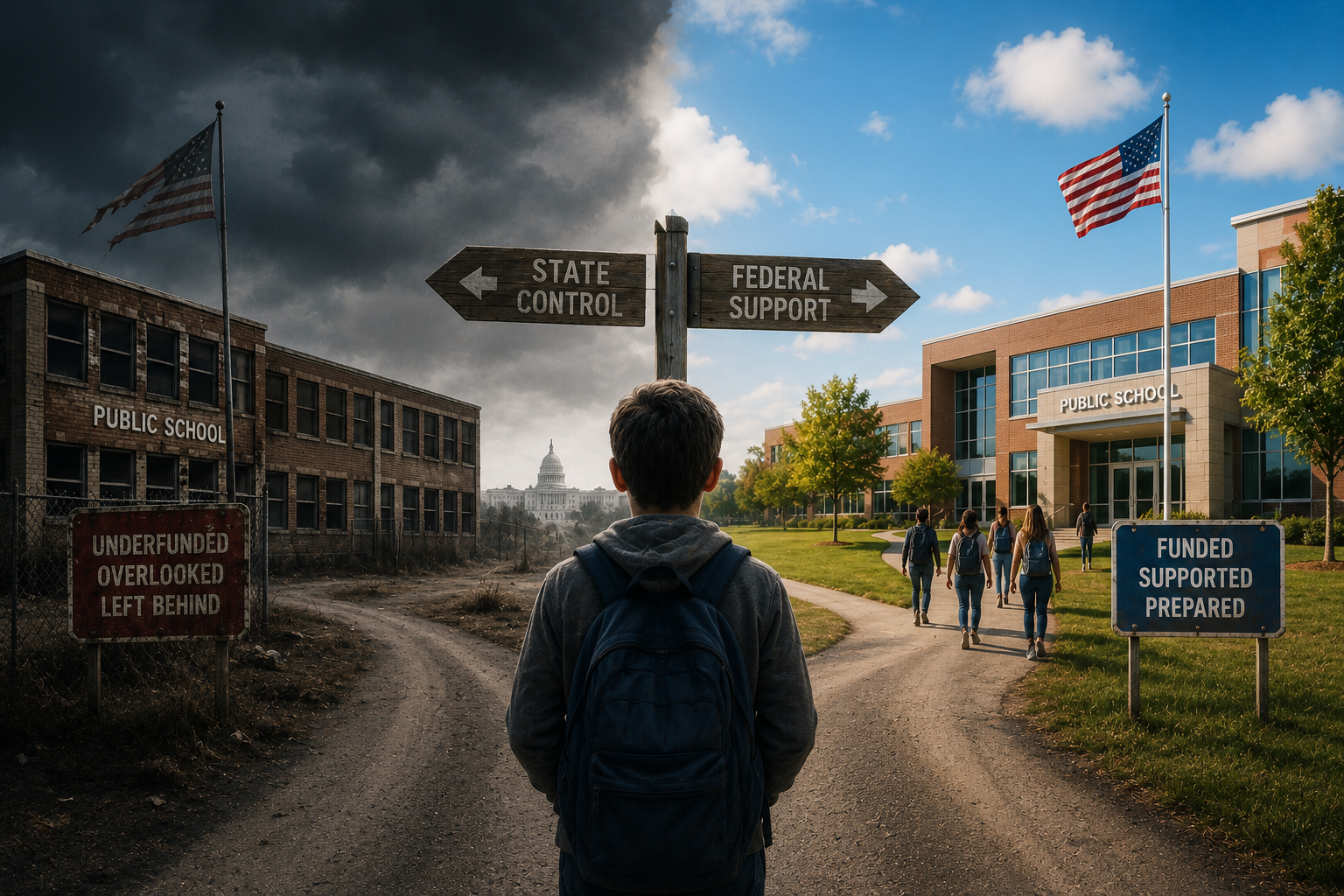





The return of Donald Trump to the White House in 2025 has ushered in one of the most turbulent periods in the history of American education. Driven by a mandate to decentralize power and slash federal spending, the administration has moved swiftly to dismantle long-standing bureaucratic structures. This shift is not merely administrative; it represents a fundamental redefining of how the United States educates its citizens.
The Dismantling of Federal Influence
At the heart of the administration’s agenda is the radical reduction—and potential total abolition—of the U.S. Department of Education. For decades, the department has served as a central hub for civil rights enforcement, federal funding distribution, and standardized data collection. Today, that influence is evaporating as the White House seeks to return “educational sovereignty” to the states.
The Rise of Educational Divergence
As federal oversight wanes, the gap between “Red” and “Blue” states has widened into a chasm. Without federal guidelines to act as a floor, state-level curricula have become deeply politicized. Republican-led states are doubling down on “patriotic education,” expanding school choice vouchers, and removing DEI (Diversity, Equity, and Inclusion) programs. Conversely, Democratic-led states are codifying protections for LGBTQ+ students and increasing state-level funding to offset federal cuts. This has created a patchwork system where the quality and content of a child’s education depend entirely on their geographic location.
The DOGE Effect and Federal Downsizing
The most significant shock to the system has come from the newly established Department of Government Efficiency (DOGE). Tasked with identifying waste and streamlining the federal footprint, the department has targeted the education sector with surgical precision.
Mass Layoffs and Bureaucratic Cuts
The administration has initiated a wave of mass layoffs of federal employees within the education sector. Thousands of career civil servants who previously managed student loan portfolios and federal grants have been let go. The White House argues that these functions are better handled by private contractors or individual states, but critics warn of a “brain drain” that could leave the government unable to manage complex educational financial systems.
The Research and Grant Crisis
The DOGE initiative has also turned its sights on federal research grants. Funding for social science research, environmental education, and certain scientific programs has been frozen or eliminated entirely. This has sparked a firestorm in academia, as universities that rely on federal research dollars face sudden, massive budget shortfalls. Many researchers have begun looking abroad for funding, leading to concerns that the U.S. is yielding its competitive edge in innovation and global academic standing.
Resonating Effects on the Future Workforce
The instability of the current transition period has left local school boards and university administrators in a state of constant pivot. While proponents of the administration’s plan celebrate the end of “federal overreach,” the immediate reality is a climate of intense uncertainty.
The transition from a centralized federal model to a state-centric, efficiency-focused system is perhaps the largest experiment in American domestic policy in a century. As federal grants dry up and curricula diverge, the true cost—or benefit—of this turbulence will likely be measured by the readiness of the next generation of American workers to compete in a global economy.
Do you think the transfer of power to the states will foster local innovation, or will it ultimately lead to an unbridgeable inequality in American education?