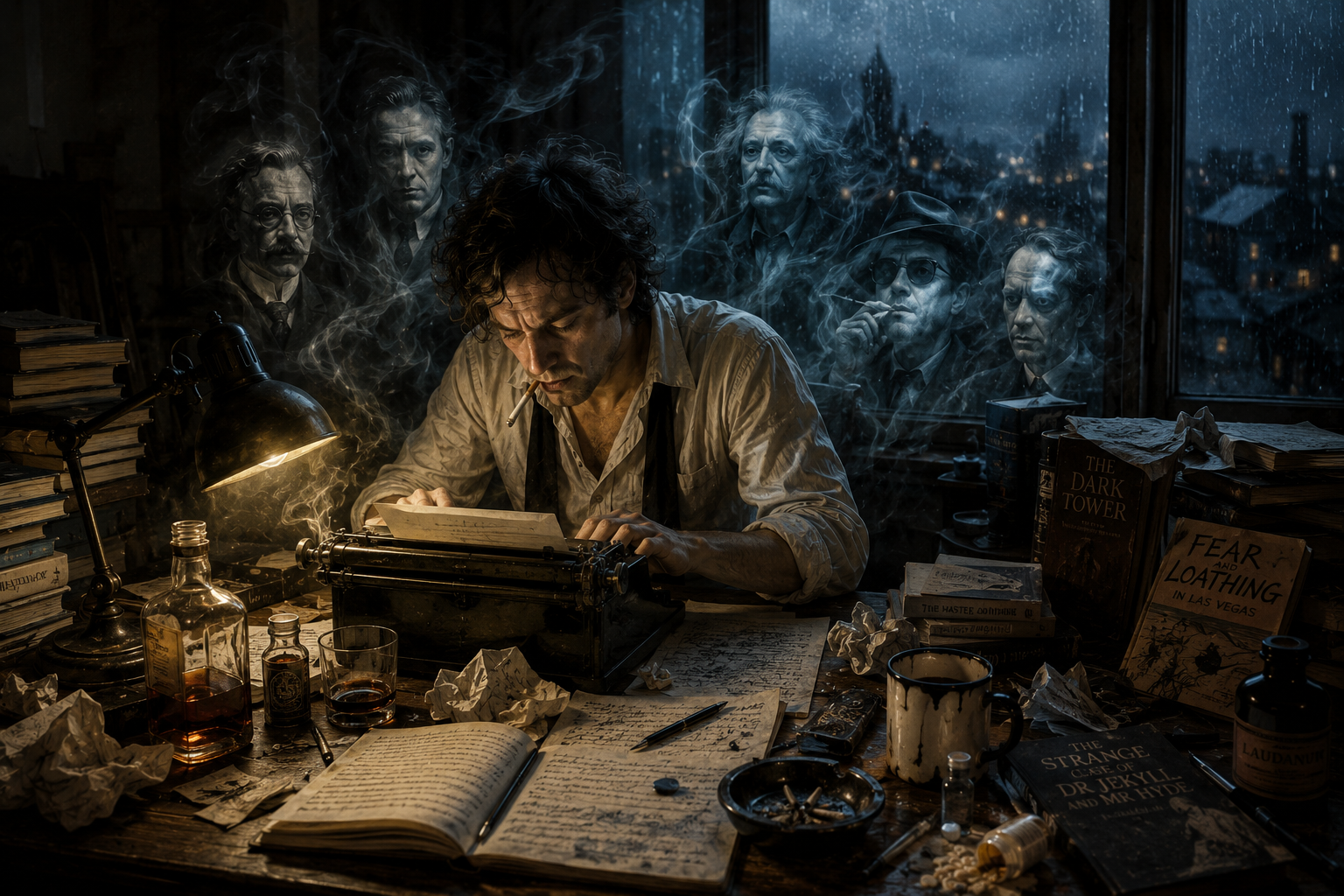



The history of world literature is often written in ink, but sometimes that ink was mixed with spirits, laudanum, or synthetic stimulants. From the gothic horrors of the 19th century to the gritty realism of the 20th, many of the world’s most celebrated authors produced their definitive works under the influence of mind-altering substances. This phenomenon raises a haunting question: is the masterpiece a product of the genius, or the substance that unlocked their inhibitions?
The Hall of Intoxicated Giants
While many writers have struggled with addiction, the following masters stand out for the direct, documented link between their substance use and their creative output:
- Stephen King: The horror icon has been candid about his decade of addiction in the 1980s. He admitted that he barely remembers writing Cujo, and his epic The Dark Tower series, as well as It, were fueled by a mix of cocaine, Xanax, and alcohol.
- Mikhail Bulgakov: Before writing The Master and Margarita, Bulgakov was a doctor who became addicted to morphine while treating himself for an allergic reaction. His early work, Morphine, is a semi-autobiographical account of the drug’s power and its blurring of reality and fantasy.
- Robert Louis Stevenson: Legend says he wrote the 60,000-word draft of The Strange Case of Dr. Jekyll and Mr. Hyde in just six days while fueled by medicinal cocaine (ergot). The theme of a split personality mirrored his own chemical experience.
- Philip K. Dick: The visionary sci-fi author behind Blade Runner and The Man in the High Castle relied heavily on amphetamines to see “multiple realities” at once, which shaped his mind-bending narratives.
- Hunter S. Thompson: He pioneered “Gonzo” journalism through a massive intake of LSD, mescaline, and alcohol, where the substances became the very chaos that made his prose so visceral and legendary.
- Aldous Huxley: Unlike those struggling with addiction, Huxley experimented with mescaline to “cleanse the doors of perception,” fundamentally shaping the philosophical landscape of the counter-culture movement.
The Mechanism of the Inverted Consciousness
Scientifically, many stimulants and hallucinogens work by inhibiting the brain’s “editor”—the prefrontal cortex. This is the part of the brain responsible for logic, social norms, and self-criticism. When this “filter” is removed, the writer experiences a flood of associations, metaphors, and ideas that would normally be dismissed as nonsensical. This “inverted consciousness” allows for hyper-focus, where amphetamines can lock a writer into a task for 20 hours straight, or synesthesia, where hallucinogens cause a blending of senses that leads to vivid, alien descriptions. Additionally, alcohol and opiates can dampen the fear of failure, allowing a writer to take massive creative risks that a sober mind might shy away from.
Could They Have Written Without the Doping?
This is the ultimate debate. Critics often argue that the drugs were merely a tool, like a typewriter. However, the evidence suggests a more complex relationship. Without the manic drive of cocaine, Stevenson might have taken years to write Jekyll and Hyde, losing the feverish intensity that makes the book great. Without morphine, Bulgakov might not have developed the specific, haunting “otherworldliness” of his prose.
However, the cost is always high. Most of these writers reached a point where the substance began to destroy the very brain it was “enhancing.” Stephen King eventually got sober, noting that while he feared he would lose his “spark,” his later work became more structurally sound and emotionally resonant, even if it lacked the raw, jagged edges of his addicted years.
Musicians, Actors, and the Performance Trap
The “dope culture” isn’t limited to writers; it is arguably more prevalent among musicians and actors. This occurs largely due to the performance ceiling, where artists use substances to overcome stage fright or reach emotional depths that are exhausting to achieve naturally night after night. Furthermore, the lifestyle of extremes—where the “highs” of a standing ovation are followed by crushing “lows”—leads many to use substances to regulate their emotional swings. Finally, there is the weight of expectation, as the public often romanticizes the “tortured artist,” creating a psychological trap where the artist feels they must be high to remain interesting or relevant.
Where is the Line Between Talent and Dependency?
Understanding where talent ends and the drug begins is difficult. A drug cannot give a person a vocabulary they don’t have, nor can it teach them the structure of a novel. The talent is the foundation—the architecture of the mind—while the substance is often the accelerant. The “line” is usually found at the point of diminishing returns. When the substance is no longer used to “open the door” but is required just to “stay in the room,” the talent begins to erode. We may admire the masterpieces created under “inverted consciousness,” but we must also acknowledge that many of these geniuses created their best work despite their addictions, not just because of them.