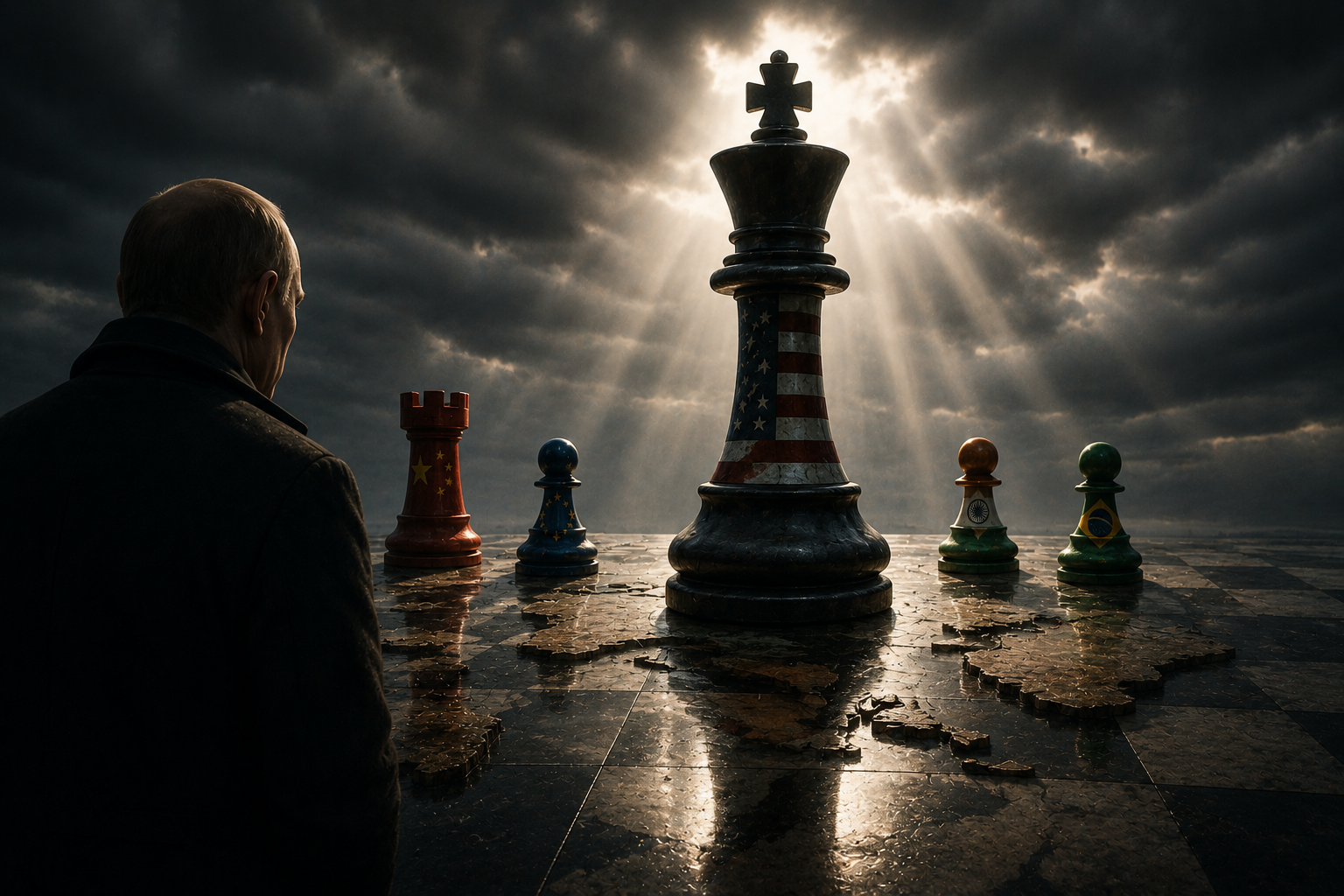



For years, the Kremlin has championed the concept of a “multipolar world,” a vision where Western hegemony is dismantled and Russia regains its status as a top-tier power. However, according to Hanna Notte, Director of the Eurasia Program at the James Martin Center for Nonproliferation Studies, Vladimir Putin’s strategy is hitting a devastating wall. In her analysis for Foreign Affairs, Notte argues that the United States is effectively disrupting Putin’s strategy by adopting a more aggressive and unpredictable posture—one that sidelines Moscow entirely.
The Strategy of Rule Breaking
Russia’s approach to global influence was built on a specific paradox: Moscow sought to increase its power by systematically breaking international rules while relying on the United States and the West to continue following them. This asymmetry gave Putin a distinct advantage. Russia could invade neighbors, weaponize energy, and interfere in elections, all while hiding behind the legalistic protections of international institutions when the West tried to push back.
The invasion of Ukraine was meant to be the culmination of this journey—a final rejection of Western constraints. Putin calculated that he could shatter the old order and emerge as a free agent in a world where “might makes right.” However, this strategy only worked as long as Washington attempted to uphold the framework of international law. When the U.S. began to act outside those traditional boundaries, Moscow’s advantage began to evaporate.
The Devaluation of the Russian Veto
Russia has long used international bodies like the United Nations, the IAEA, and various nuclear treaties to project power far beyond its actual economic weight. By holding a permanent seat on the UN Security Council, Russia can paralyze global action and force the world to negotiate on its terms.
The shift under the current U.S. administration, characterized by a blatant disregard for these very institutions, has undermined Russia’s primary leverage. When Washington ignores the UN or devalues international treaties, Russia’s “right to veto” becomes meaningless. If the United States no longer seeks the approval of the Security Council to act, Russia is stripped of its ability to obstruct American interests. Instead of being a necessary partner in global governance, Moscow is becoming a frustrated observer of American unilateralism.
Russia as a Bystander in Its Own “Zones of Interest”
A key pillar of Putin’s foreign policy was the demand that the U.S. consult with him as an equal. He wanted the West to recognize Russia’s “exclusive sphere of influence” and negotiate the fate of third countries over their heads.
However, recent U.S. actions toward Iran, Venezuela, and potentially Cuba have turned Russia into a bystander. By methodically “strangling” the Kremlin’s key partners through sanctions and direct military or political pressure, the U.S. is demonstrating that it does not feel the need to ask for Moscow’s permission. Instead of a seat at the table, Putin is watching from the sidelines as his global network of allies is dismantled.
A World Without Rules Is Not a World of Parity
Putin hoped that the collapse of the old liberal order would free Russia from the “shackles” of Western rules. But the reality is far harsher. Instead of a balanced “multipolarity,” Putin has helped create a world without rules—a world where the United States can leverage its colossal military and economic superiority without restraint.
In a world governed by law, a middle-tier power like Russia can use diplomacy and international bodies to punch above its weight. In a world governed purely by raw power, Russia finds itself at a massive disadvantage compared to the United States. This is not the “multipolarity” the Kremlin dreamed of; it is an chaotic landscape where Russia is finding itself increasingly isolated and vulnerable.