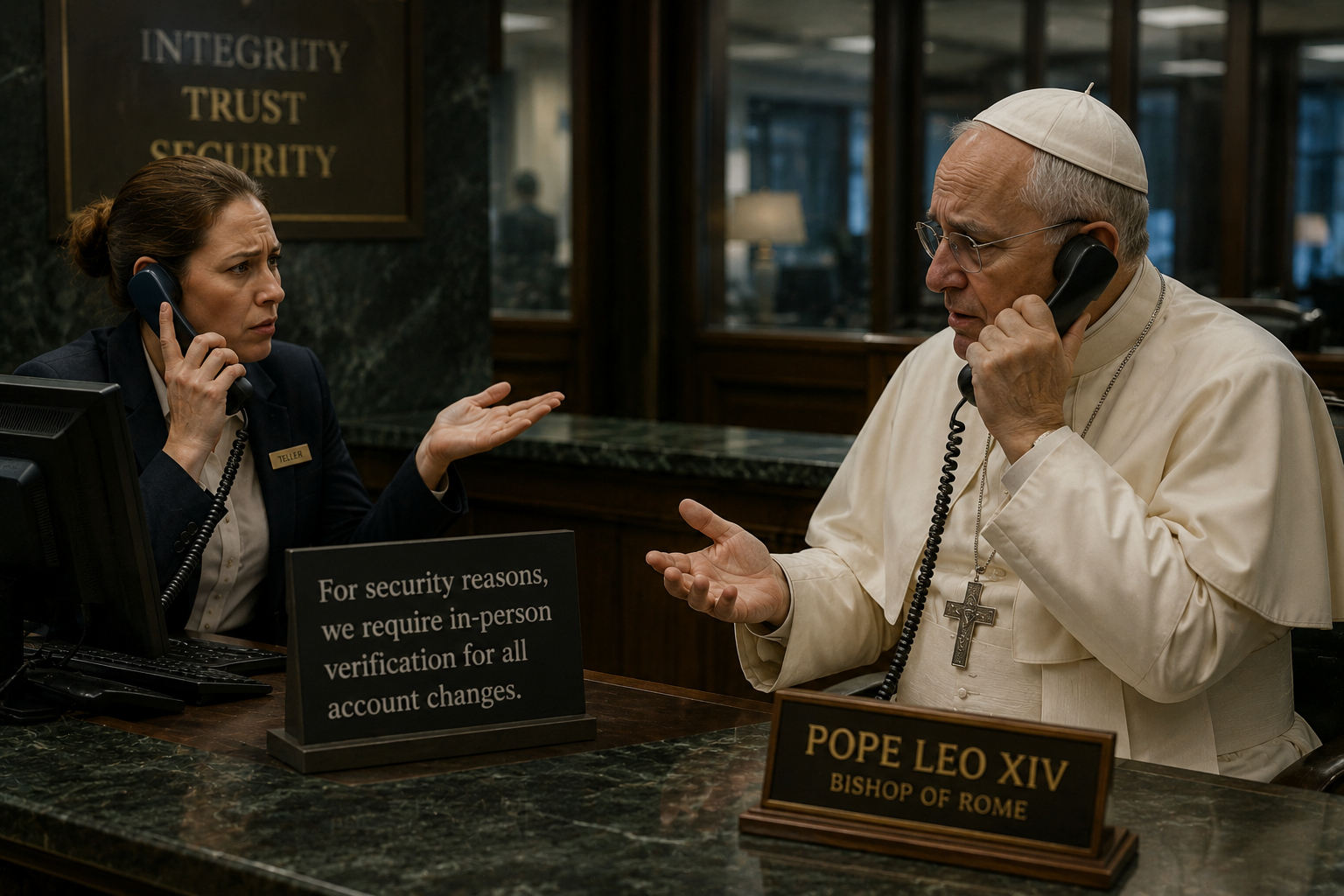




In a bizarre intersection of divine authority and earthly bureaucracy, a story has emerged involving Pope Leo XIV and the rigid security protocols of an American financial institution. The incident occurred when the Pontiff personally called his bank in the United States to update his contact information, including his phone number and address.
Despite successfully passing the standard security questions, the bank teller remained skeptical. Following strict internal protocols designed to prevent identity theft, the employee insisted that the caller must visit a physical branch in person to verify his identity. When the Pontiff explained that such a visit would be “somewhat difficult” because he is, in fact, the Pope, the employee reportedly hung up, convinced she was being pranked by a suspicious caller.
The logistical deadlock was eventually broken only after a high-ranking priest with personal connections to the Chairman of the Bank intervened, securing a rare exception for the Bishop of Rome.
The Theology of Global Finance
This incident has sparked a heated debate among historians and social critics regarding the relationship between spiritual leadership and material wealth in the 21st century. The discovery of a personal American bank account held by the “Representative of the Almighty” raises several uncomfortable questions for the faithful and skeptics alike.
Why Does the Pope Need an American Bank Account?
Critics wonder why a figure whose needs are entirely provided for by the sovereign state of the Vatican requires a private account in a foreign jurisdiction. From a historical perspective, the Church has long transitioned from the communal poverty of its origins to a complex global administrative entity. However, the optics of a Pontiff managing personal assets in a capitalist hub like the United States contrast sharply with the image of a servant of the poor.
The Mystery of Divine Funding
A recurring question for critics of organized religion is the necessity of money for spiritual work. If the mission is metaphysical, the reliance on modern financial instruments—especially those protected by “influential connections” with bank chairmen—suggests a deep entanglement with the very world the Church often critiques.
The Needle’s Eye Problem: Historians frequently point to the Gospel passage stating it is easier for a camel to pass through the eye of a needle than for a rich man to enter the Kingdom of God. This ancient warning seems increasingly at odds with a clergy that navigates the highest echelons of international finance.
Scripture vs. Modern Reality
When examining the foundational texts of Christianity, there is a notable absence of bank accounts, luxury transport, or elite security details. The followers of Yeshua (Jesus) were famously instructed to carry neither purse nor script.
The modern reality of the papacy—involving private banking, high-level connections with financial titans, and armored motorcades—represents a radical departure from the “primitive Church” described in historical records. This gap between the biblical “initial source” and the 21st-century institution remains one of the most significant points of friction between the Vatican and its critics.
The Power of Connections
Perhaps the most telling part of the story is not the bank’s refusal, but how the problem was solved. The fact that a “friend of the Pope” had the direct line of a bank chairman to bypass standard rules highlights a system of elite networking that exists far above the reach of the average believer. It suggests that while the gates of Heaven may be open to all, the doors of American banks are much easier to open if you have the right connections in the hierarchy.
How do you reconcile the necessity of modern administrative tools for the Church with the spiritual call to poverty and detachment from worldly wealth?