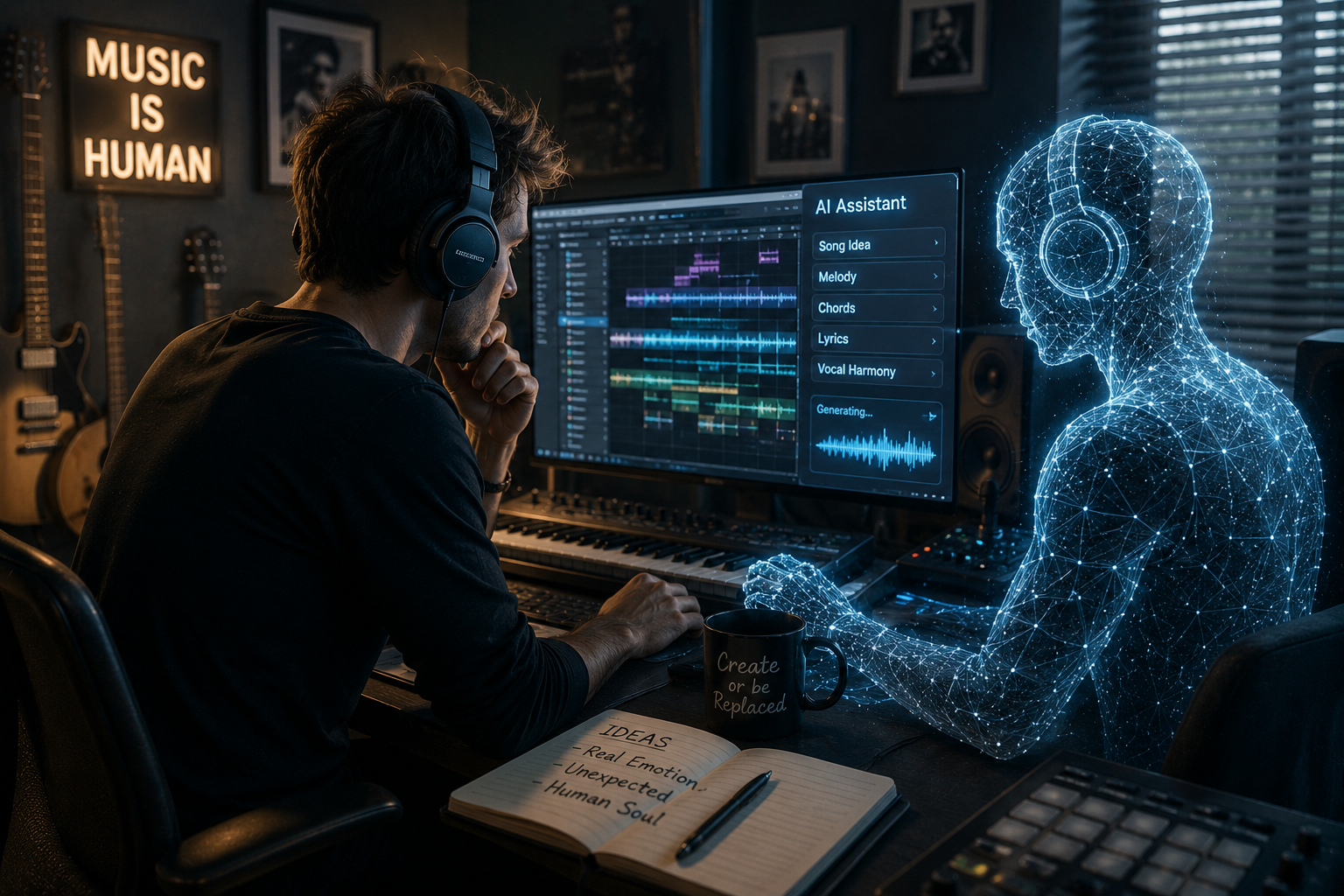

The music industry is currently undergoing a quiet revolution that has many purists and fans deeply unsettled. A growing number of professional songwriters and producers are publicly admitting that Artificial Intelligence is no longer just a futuristic concept but a primary tool in their creative process. While efficiency is up, many argue that the emotional “soul” of music—the very thing that connects a listener to an artist—is at risk of being permanently erased.
The Public Adoption of AI in the Studio
It is no longer a secret that some of the biggest names in music are experimenting with AI to generate lyrics, melodies, and even vocal textures. This transparency is refreshing to some, but alarming to those who view songwriting as a sacred human experience. The following table highlights several prominent artists and songwriters who have publicly discussed their use of AI in their creative workflows.
| Artist or Songwriter | Nature of AI Use | Public Context |
| Grimes | Vocal Synthesis | Created a platform for AI voice cloning and royalty sharing. |
| David Guetta | Vocal Mimicry | Used AI to replicate Eminem’s voice for a live performance. |
| Paul McCartney | Audio Restoration | Utilized AI to extract John Lennon’s voice for a final Beatles track. |
| will.i.am | Creative Co-pilot | Uses AI for lyrical brainstorming and concept development. |
| Jacob Collier | Harmonic Exploration | Uses AI tools to process and explore complex vocal harmonies. |
From Sampling to Synthetic Creation
The influence of AI extends far beyond lyrics. In modern music production, especially in genres like Pop, Hip-Hop, and EDM, the use of AI-generated samples and audio stems has become ubiquitous. AI tools can now generate perfectly mixed 808 bass lines, “catchy” synth loops, and drum patterns that are mathematically optimized to trigger a dopaminergic response in the listener.
Music has historically been a “surge of the soul,” a medium through which we receive an inverted emotion from the singer or author. We listen to feel their pain, their joy, or their rebellion. The realization that a heartbreaking lyric was generated by a Large Language Model (LLM) rather than a broken heart often suppresses this perception, leaving the listener feeling deceived by a digital illusion.
The Hollywood Precedent and the Mass Market Trap
The music industry’s current tension mirrors the recent Hollywood writers’ strikes. In 2023, screenwriters protested against the use of AI, fearing that studios would use algorithms to replace human creativity. However, a harsh reality exists: the industry itself paved the way for this automation.
For years, we have seen the rise of mass-market products—from formulaic Marvel movies to pop songs built on predictable 808 bass lines and “hooky” but hollow sounds. When creative output becomes a template, it becomes programmable. If a song is built on a standard four-chord progression and generic lyrics about “the club,” an AI can replicate it perfectly because the human creator stopped innovating long ago.
A Call to Creative Rebellion
The threat of AI is not just an external invasion; it is a mirror reflecting the stagnation of modern creativity. If artists want to remain relevant and irreplaceable, they must move away from the template. Human soul is found in the cracks—the slight off-key note, the irregular rhythm, and the lyrics that do not always rhyme but hit a raw nerve.
If you write what is “safe,” you are competing with a machine that can do “safe” better and faster. To survive, creators must explore harmonies and narratives that an AI, trained on past data, could never predict. The message to the creative community is clear: do not be outraged that the machines can do your job if your job has become mechanical. Create something new, create with a soul, and give the audience a reason to choose a human over a script.