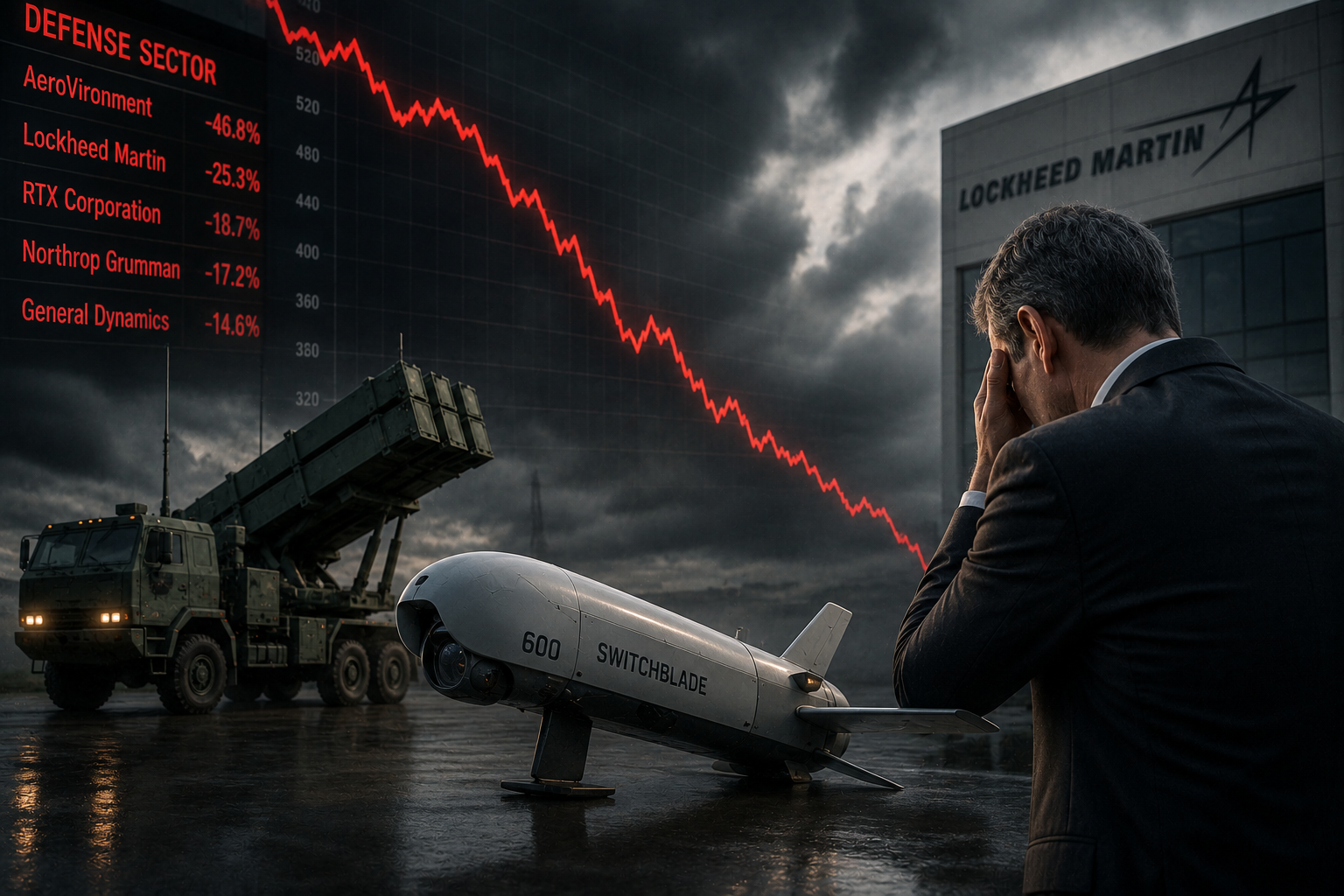





For over two years, the global defense sector has been the undisputed darling of Wall Street. However, as of May 2026, the tide has turned abruptly. Major defense contractors are seeing their share prices tumble as investors react to a cocktail of diplomatic shifts, market exhaustion, and rumors of a “frozen” conflict in Ukraine.
While the “merchants of death” saw record profits following the full-scale invasion of Ukraine, the market is now pricing in a much quieter—and less profitable—geopolitical landscape.
Defense Sector Stock Performance 2024-2026
The following table highlights the dramatic shift in market capitalization for the industry’s most prominent players. The “Peak Price” reflects the highs reached during the period of maximum escalation, while the “Current Price” accounts for the recent sell-off triggered by reports of a potential conflict freeze.
| Company Name | Primary Hardware | Peak Price (2024-25) | Current Price (May 2026) | Total Decline (%) |
| AeroVironment (AVAV) | Switchblade Drones | ~$240 | ~$115 | -52% |
| Lockheed Martin (LMT) | HIMARS / F-35 | ~$610 | ~$458 | -25% |
| RTX (Raytheon) | Patriot / NASAMS | ~$125 | ~$94 | -24.8% |
| Northrop Grumman (NOC) | B-21 / Ammunition | ~$550 | ~$425 | -22.7% |
| Rheinmetall AG | Leopard Tanks / Shells | €570 | €410 | -28% |
| General Dynamics (GD) | Abrams Tanks | ~$315 | ~$255 |
The Anatomy of the Sell-off
The data reveals a clear trend: the “Darlings of the Frontline”—companies like AeroVironment whose products are directly consumed in high volumes on the battlefield—have suffered the most. While diversified giants like General Dynamics or Northrop Grumman have broader portfolios (including nuclear submarines and space tech) that provide a “floor” for their stock price, the pure-play combat tech firms are highly sensitive to any rumors of peace or a “frozen” status quo.
Investors should note that while these numbers look grim, the current “crash” brings many of these stocks back to their historical valuation means. However, if the pivot to the Baltic Sea occurs as predicted, these “Post-Correction” prices might represent the most significant buying opportunity of the decade before the next cycle of escalation begins.
The Drone Crash: AeroVironment and the Hardware Sell-off
The most dramatic casualty of this correction has been the drone manufacturing sector. Shares of AeroVironment (AVAV), the producer of the famous Switchblade “kamikaze” drones, have seen a staggering decline. After peaking during the height of the drone-warfare revolution in Ukraine, the stock has plummeted, losing nearly half its value in recent months.
This collapse is driven by a realization that the initial “gold rush” for tactical drones is stabilizing. Analysts suggest that the market is now over-saturated, and with rumors of a potential ceasefire or “frozen” front line circulating in Washington and European capitals, the urgent, high-volume replenishment contracts that drove the stock to record highs are beginning to dry up.
The Big Players: Lockheed Martin and the HIMARS Hangover
It isn’t just the niche drone makers feeling the heat. Industrial titans like Lockheed Martin (LMT), the manufacturer of the HIMARS systems that became a household name in 2022-2023, have also seen significant corrections. Lockheed’s stock has retreated roughly 25% from its 2024 highs.
The logic among institutional investors is simple: de-escalation is bad for business. As the rhetoric shifts from “supporting Ukraine for as long as it takes” to “finding a path to a freeze,” the massive backlogs for heavy artillery, missile systems, and long-range rockets are being re-evaluated. If the conflict enters a “cold” phase, the immediate demand for high-cost munitions—the primary profit driver for LMT—will inevitably decrease.
The Trump Factor and the “Baltic Pivot”
However, seasoned market analysts warn that selling defense assets now might be premature. The market remains hyper-sensitive to every quote from Donald Trump and his administration. While Trump has often signaled a desire to “freeze” the Ukraine conflict, his broader foreign policy remains unpredictable, often leaning toward massive increases in defense spending to “rebuild the military.”
Furthermore, as one door closes, another often opens. We previously analyzed the high probability of a strategic strike on Estonian islands this year. A freeze in the Ukrainian theater could very well be a tactical pause for the Kremlin to pivot its resources toward the Baltic Sea.
Why the Market Might Be Wrong
- The Rotation of Conflict: Historically, a “freeze” in one region often precedes an escalation in another. If NATO is forced to shift its defensive posture to the Baltics, the demand for Lockheed Martin’s systems and AeroVironment’s surveillance tech will not disappear; it will simply relocate.
- The “Trump Budget” Catalyst: Trump has already floated the idea of a $1.5 trillion defense budget by 2027. If this passes, the current stock “crash” will look less like a collapse and more like a massive “buy the dip” opportunity.
- Technological Evolution: Even in a frozen conflict, the demand for electronic warfare (EW) and AI-integrated systems remains at an all-time high. Companies that pivot from “dumb” hardware to “smart” tech will likely lead the next rally.
Conclusion
The current sell-off in defense stocks reflects a market that is tired of the status quo and eager to lock in profits. However, in a world of “inverted order” and rising tensions in the Baltics, the demand for arms is unlikely to fade away permanently. Investors dumping their shares on rumors of a “freeze” may find themselves on the wrong side of the next headline—especially if the Baltic Sea becomes the new front line of global confrontation.