
DNA replication is one of the most fundamental processes in all of biology, ensuring that genetic information is faithfully passed down from a mother cell to its daughter cells. At the absolute heart of this intricate molecular dance is DNA polymerase—a highly specialized family of enzymes responsible for synthesizing new DNA strands.
Without DNA polymerase, life as we know it could not exist, grow, or replicate. Beyond its natural role in cellular survival, this enzyme has also become the backbone of modern biotechnology, driving everything from forensic science to advanced genetic sequencing techniques.
The Molecular Architect: How DNA Polymerase Works
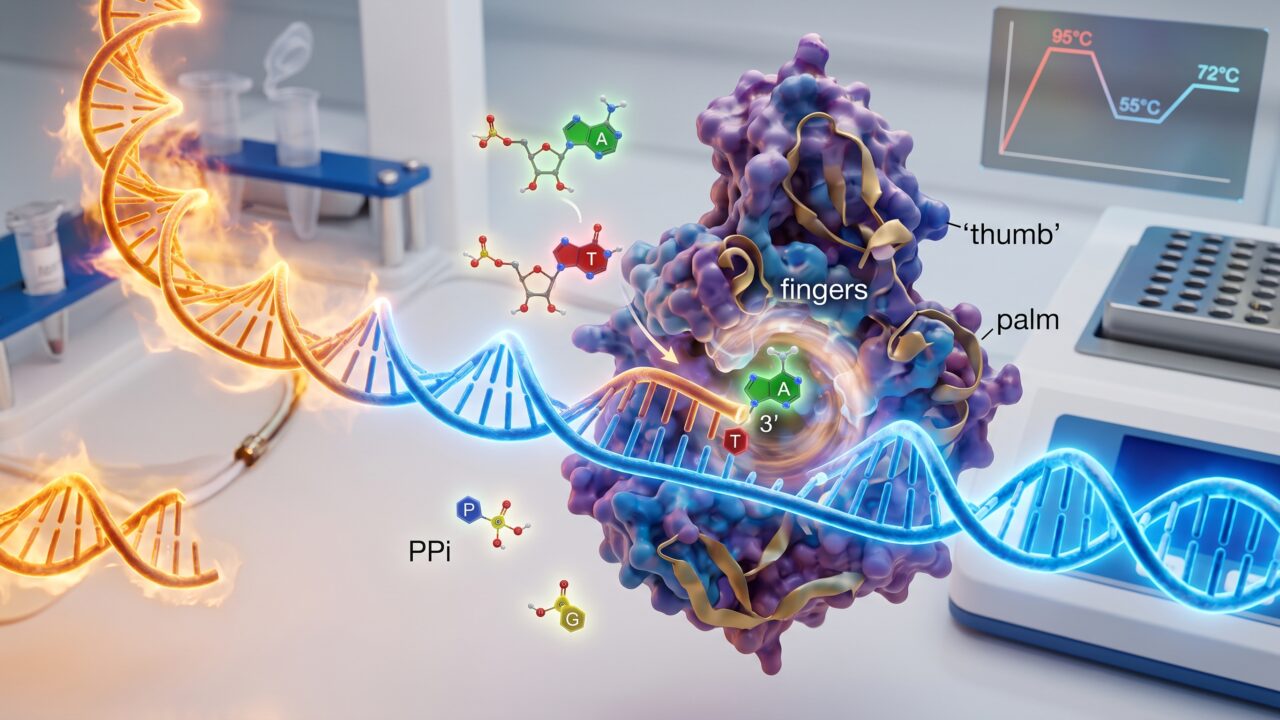
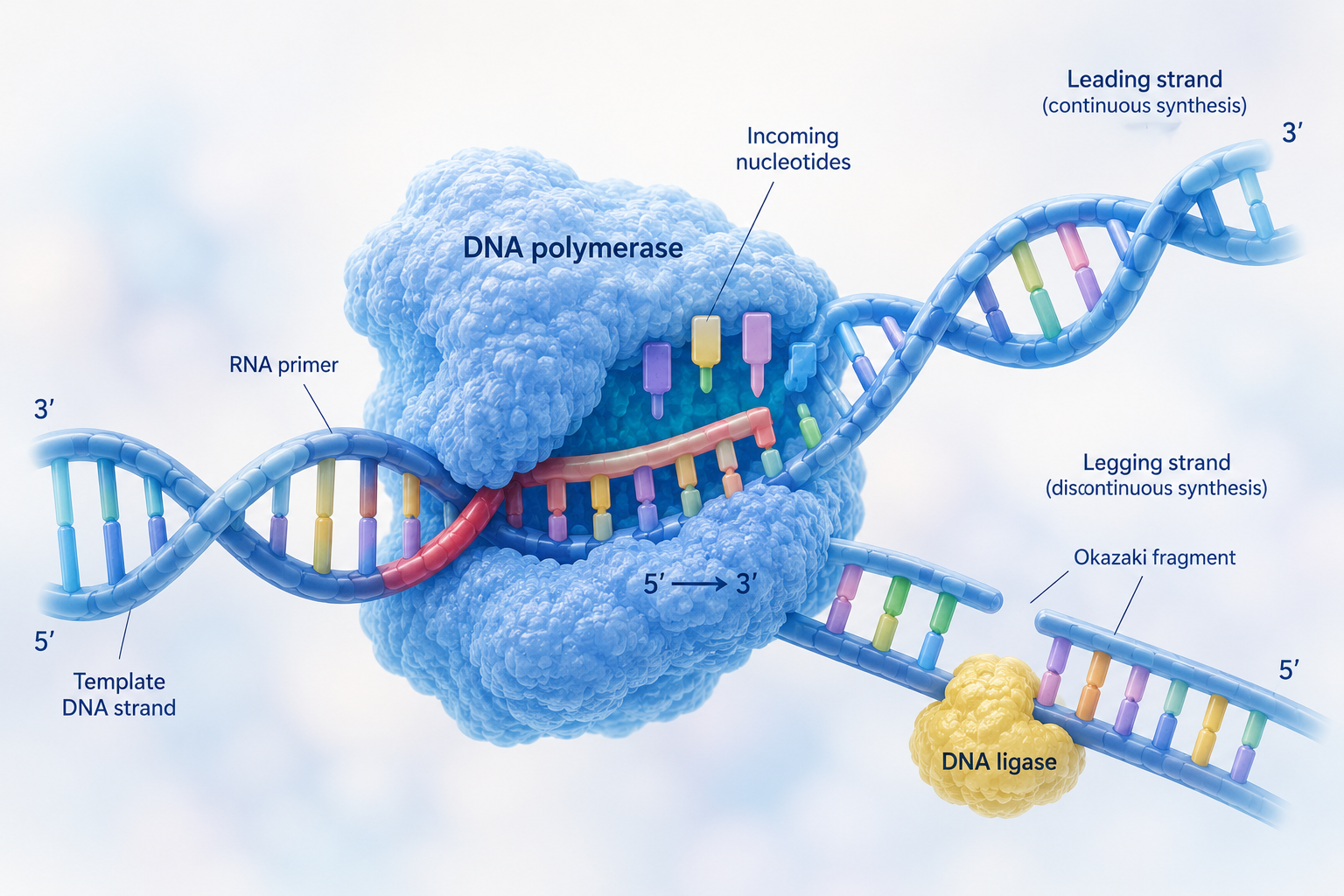
DNA polymerase works by adding individual nucleotides to a growing DNA strand. The enzyme reads an existing “template” strand and matches complementary bases: Adenine (A) pairs with Thymine (T), and Cytosine (C) pairs with Guanine (G).
However, DNA polymerase cannot simply build a new strand out of thin air. It operates under two strict biological constraints:
- It requires a primer: The enzyme can only attach a new nucleotide to an existing free 3′-hydroxyl (-OH) group. Therefore, another enzyme called RNA primase must first lay down a short sequence of RNA nucleotides to give DNA polymerase a starting point.
- Directional synthesis: DNA polymerase can only synthesize DNA in one direction: from the 5′ end to the 3′ end.
Because the two strands of a DNA double helix run in opposite directions (antiparallel), replication must occur differently on each side. On the leading strand, DNA polymerase moves smoothly and continuously in the direction of the replication fork. On the lagging strand, synthesis is disjointed, forcing the enzyme to build backward in short segments known as Okazaki fragments, which are later glued together by DNA ligase.
Proofreading and Fidelity: Preventing Mutations
The human genome contains over 3 billion base pairs, and copying it perfectly every time a cell divides is a monumental task. Left unchecked, ordinary replication would introduce devastating mutations. Fortunately, DNA polymerase is equipped with an exceptional “proofreading” capability.
Many types of DNA polymerase possess a 3′ to 5′ exonuclease activity. If the enzyme accidentally incorporates an incorrect nucleotide (such as mismatching a G with a T), it senses the structural distortion in the double helix. The enzyme then stops, shifts backward, removes the incorrect base, and replaces it with the correct one. This self-correcting feature brings the error rate down to less than one mistake for every billion base pairs added.
Types of DNA Polymerase: Prokaryotes vs. Eukaryotes
Different organisms rely on specialized versions of this enzyme to handle replication, proofreading, and DNA repair.
Prokaryotic DNA Polymerases (e.g., E. coli)
- DNA Polymerase I: Primarily handles clean-up. It removes the temporary RNA primers from the lagging strand and fills in the remaining gaps with DNA.
- DNA Polymerase II: Acts as a specialized emergency repair enzyme when the primary replication machinery stalls.
- DNA Polymerase III: The primary workhorse of bacterial replication, responsible for rapid, continuous synthesis of both the leading and lagging strands.
Eukaryotic DNA Polymerases (Humans and Animals)
Eukaryotes possess a more complex array of polymerases, designated by Greek letters:
- Polymerase (Alpha): Works closely with primase to initiate synthesis on both strands.
- Polymerase (Delta): The main enzyme responsible for synthesizing the lagging strand and executing high-fidelity proofreading.
- Polymerase (Epsilon): Primarily synthesizes the leading strand during active cell division.
- Polymerase (Gamma): Uniquely located inside the mitochondria, responsible exclusively for replicating mitochondrial DNA.
Revolutionizing Biotechnology: Modern Frontiers in 2026
Humanity has successfully harnessed DNA polymerase to revolutionize medicine and science. The most famous application is the Polymerase Chain Reaction (PCR). By utilizing Taq polymerase—a heat-resistant DNA polymerase extracted from extreme thermal hot springs—scientists can amplify a single microscopic fragment of DNA into millions of copies in a matter of hours.
Entering 2026, next-generation engineering has taken DNA polymerase even further. Artificial intelligence and directed evolution models have allowed scientists to synthesize custom, engineered polymerases. These modern variants are highly resistant to chemical inhibitors and can sequence hyper-complex regions of the human genome with unprecedented speed. Furthermore, these synthetic enzymes are accelerating the development of liquid biopsies, allowing doctors to detect early-stage cancer mutations from a simple blood draw.
Frequently Asked Questions (FAQ)
Q: What is the main function of DNA polymerase?
A: The primary function of DNA polymerase is to synthesize a new, complementary strand of DNA by matching loose nucleotides to an existing template strand during cell division and DNA repair.
Q: Why does DNA polymerase require a primer?
A: DNA polymerase cannot start a new DNA chain from scratch; it can only append a nucleotide to an existing 3′-OH group. An enzyme called primase must first create a small RNA primer to provide this necessary chemical hook.
Q: What is the difference between DNA polymerase and RNA polymerase?
A: DNA polymerase synthesizes a double-stranded DNA molecule during cell replication to ensure the genetic code is copied for a new cell. RNA polymerase reads a DNA template to create a single-stranded RNA molecule during transcription, which is used to build proteins.
Q: Can DNA polymerase fix its own mistakes?
A: Yes. Many forms of DNA polymerase feature built-in proofreading capabilities through 3′ to 5′ exonuclease activity, which allows them to detect, remove, and correct mismatched base pairs instantly.
[…] a deeper analysis of cellular DNA replication, exploring dna polymerase function provides important foundational context. While standard cellular enzymes denature at high […]