



Celebrated across the globe by hundreds of millions of believers, the solemnity of Pentecost stands as one of the most pivotal and sacred moments in the Christian liturgical calendar. Often hailed as the official birthday of the Church, this holy day bridges ancient Old Testament covenant theology with the dramatic outpouring of the Holy Spirit described in the New Testament.
As communities prepare for liturgical observances, questions frequently arise regarding what does pentecost sunday mean, the historical evolution of the feast, its sacramental significance, and the precise calendar placement for pentecost 2026. This comprehensive guide explores the deep pentecost history, theological typology, liturgical traditions, and global customs surrounding this holy day.
Exploring Pentecost History and Biblical Typology
To fully understand meaning of pentecost in the bible, one must examine how New Testament events fulfill ancient Old Testament shadows. The word itself originates from the Greek term Pentekoste, which translates directly to “fiftieth.”
In the Jewish tradition, the feast was originally known as Shavuot (the Feast of Weeks) or the Feast of Harvest. Celebrated precisely fifty days after Passover, it served a dual purpose: expressing gratitude for the grain harvest and commemorating the giving of the Torah to Moses at Mount Sinai.
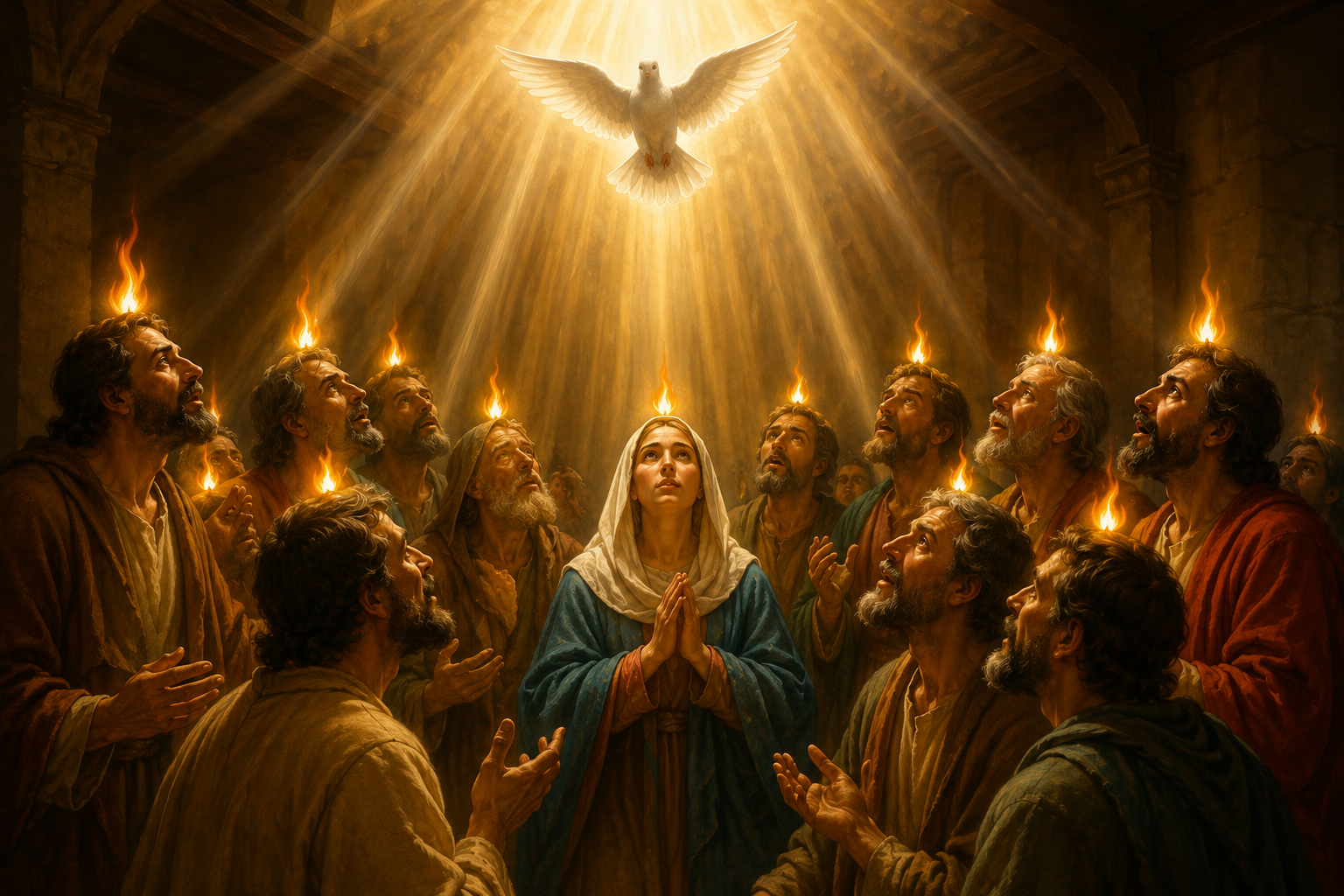
In Christian theology, the day of pentecost marks the moment in the Book of Acts (Chapter 2) when the Holy Spirit descended upon the Virgin Mary, the Apostles, and early disciples gathered in the Upper Room (Cenacle) in Jerusalem.
A profound biblical parallel exists between Mount Sinai and the Upper Room:
- The Old Covenant at Sinai: God revealed His presence through thunder, fire, and a loud trumpet blast, writing the Law on tablets of stone fifty days after the physical liberation from Egypt during Passover.
- The New Covenant at Jerusalem: The Holy Spirit descended with the sound of a driving wind and tongues of fire fifty days after Christ’s Resurrection at Passover, inscribing the divine law directly onto human hearts.
The miraculous gift of tongues enabled the Apostles to preach the Gospel immediately to Jewish pilgrims visiting Jerusalem from diverse nations, converting three thousand souls in a single day and establishing the foundation for pentecostal holidays.
The Seven Gifts of the Holy Spirit and Sacramental Connection
In Catholic and traditional liturgical theology, Pentecost is not merely a historical commemoration; it is the sacramental blueprint for the grace imparted through the Sacrament of Confirmation. Just as the Apostles received the fullness of the Holy Spirit to transform them from fearful disciples into bold witnesses, believers receive a special outpouring of divine grace to live out their baptismal calling.
The descent of the Holy Spirit brings seven distinct spiritual gifts designed to strengthen human wisdom and moral fortitude:
- Wisdom: The capacity to judge and order all things according to divine purpose.
- Understanding: Deep insight into revealed truths and spiritual realities.
- Counsel: Supernatural prudence to make morally sound decisions in challenging situations.
- Fortitude: Spiritual strength and courage to endure hardship and defend the faith.
- Knowledge: The ability to discover the spiritual meaning underlying creation.
- Piety: Filial affection for God as a loving Father and reverence for sacred things.
- Fear of the Lord: A holy awe and reverence that inspires a person to avoid sin out of love for God.
Key Dates and Calendar Calculation for Pentecost 2026
Because Pentecost is a moveable feast tied directly to the variable date of Easter, its exact placement on the calendar changes every year. Believers planning their liturgical schedules frequently ask when is pentecost 2026 or search for the official pentecost 2026 date.
Because Easter Sunday is calculated as the first Sunday following the full moon after the vernal equinox, Pentecost always occurs on the seventh Sunday after Easter (inclusive of Easter Sunday).
For Western Christian traditions (including Roman Catholic, Protestant, and Anglican churches), pentecost sunday 2026 falls on May 24, 2026.
When determining when does pentecost start and end 2026, the liturgical celebration begins on the evening of Pentecost Eve (Saturday, May 23) with a solemn Vigil Mass and continues through pentecost day 2026 on Sunday. In the Roman Rite, Pentecost marks the conclusion of the 50-day Easter Season, after which Ordinary Time resumes.
For Eastern Catholic and Eastern Orthodox churches following the Julian calendar, the day of pentecost 2026 is observed on May 31, 2026.
| Liturgical Milestone | Western Church Calendar 2026 | Eastern Orthodox Calendar 2026 |
| Easter Sunday | April 5, 2026 | April 12, 2026 |
| Feast of the Ascension | May 14, 2026 | May 21, 2026 |
| Pentecost Sunday | May 24, 2026 | May 31, 2026 |
| Whit Monday | May 25, 2026 | June 1, 2026 |
(Note: Search trends and regional terminology often include variations like when is pentecost, pentecostal sunday 2026, when is pentacost, when is penticost, pentecostes 2026, and traditional Germanic expressions such as pfingst).
Liturgical Practices and Global Cultural Traditions
Throughout centuries of Christian history, distinct liturgical customs and cultural celebrations have developed around pentecostal sunday to honor the presence of the Holy Spirit:
The Symbolism of Red Vestments and Rose Petals
Red is the official liturgical color assigned to the feast, symbolizing the divine fire of charity and the zeal of the Apostles. In Rome, an ancient tradition known as the Rain of Roses takes place at the Pantheon. Following the Pentecost Mass, firefighters drop thousands of red rose petals through the oculus in the dome, creating a breathtaking visual representation of the descending tongues of fire.
Whit Monday and European Public Holidays
In many European nations—including France, Germany, Belgium, Switzerland, and the Netherlands—the day following Pentecost (known as Whitsun or Whit Monday) is celebrated as a public holiday. Historically, this week was favored for solemn baptisms, where candidates wore white garments, giving rise to the term “White Sunday” or “Whitsunday.”
Green Pentecost and Botanical Blessings
In Central and Eastern European traditions, churches and homes are decorated with fresh green branches, sweetgrass, and birch foliage. Known as “Green Sunday” or “Green Holy Days,” this custom symbolizes the renewal of creation, spiritual growth, and the life-giving energy of the Spirit.
Frequently Asked Questions
What does Pentecost Sunday mean in Christian theology?
Pentecost Sunday commemorates the descent of the Holy Spirit upon the Virgin Mary and the Apostles fifty days after Christ’s Resurrection. It marks the fulfillment of Christ’s promise to send the Paraclete (Advocate) and represents the public inauguration of the Christian Church to all nations.
When is Pentecost Sunday 2026?
For Western Christian churches, pentecost sunday 2026 takes place on May 24, 2026. For Eastern Orthodox communities, it is celebrated on May 31, 2026.
Why is Pentecost called the birthday of the Church?
Before Pentecost, the disciples remained hidden in fear behind locked doors. When the Holy Spirit descended upon them, they were empowered with divine grace, courage, and the gift of tongues, driving them out into the streets to preach the Gospel publicly and baptize believers for the first time.
What is the connection between Pentecost and the Sacrament of Confirmation?
Confirmation is considered a personal Pentecost for every Christian. Through the laying on of hands and anointing with holy chrism, the confirmed believer receives the seal of the Holy Spirit and the fullness of His seven gifts, equipping them to act as mature witnesses for Christ in the world.