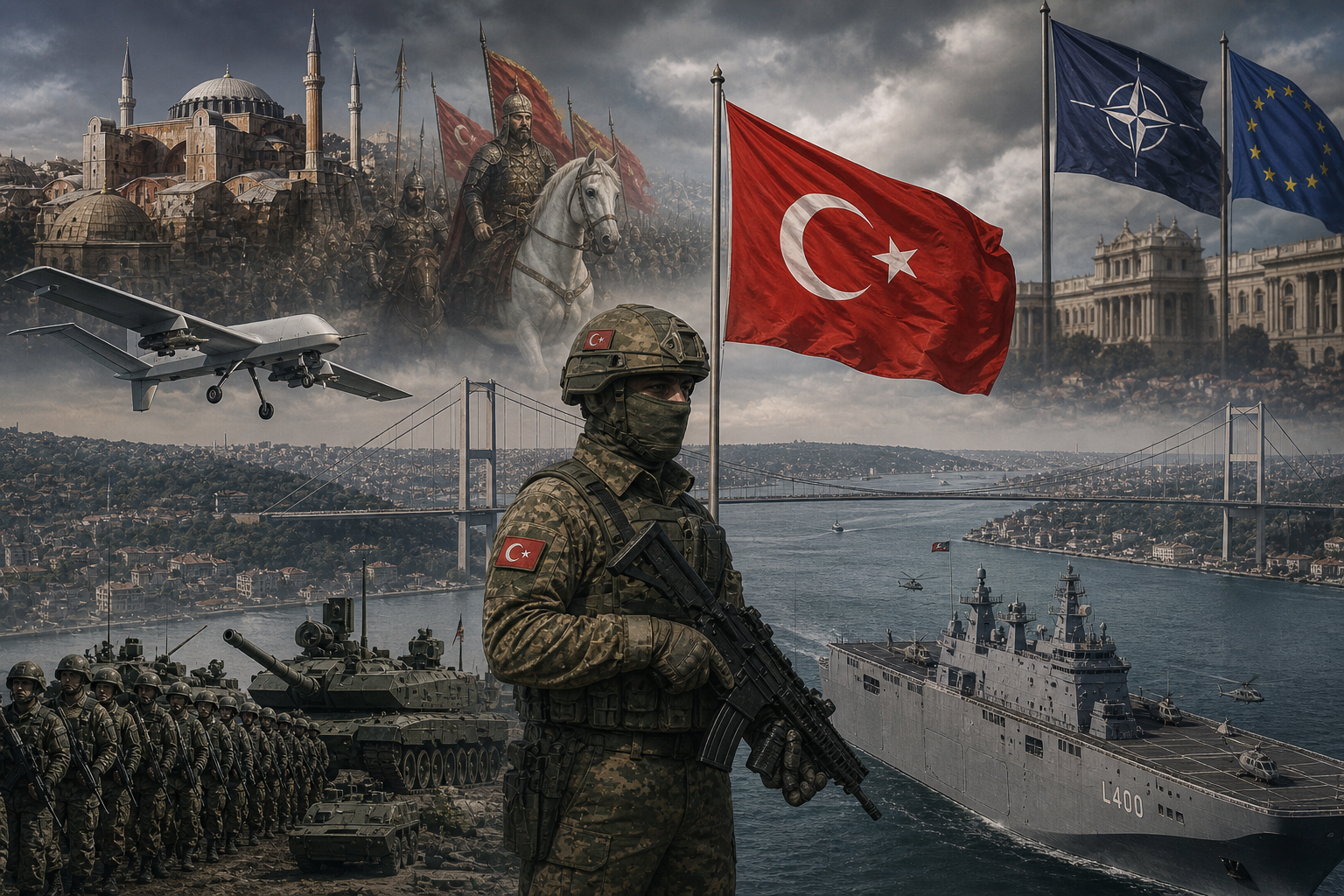




For nearly a century, the security of Europe has rested on a single, unwavering pillar: the American military guarantee. However, as the 2026 NATO Summit in Ankara approaches and President Donald Trump’s rhetoric regarding a total U.S. withdrawal from the alliance intensifies, the European Union finds itself at a historical crossroads. With the American “umbrella” folding, Brussels is turning its eyes toward the only regional power capable of filling the void.
Turkey—once viewed as a problematic candidate on the periphery—is now being repositioned as the central alternative for European defense. To understand this shift, one must look back at a millennium of history that transformed a group of Anatolian principalities into a geopolitical indispensable.
From Manzikert to Constantinople – The Foundation of Regional Hegemony
The path of Turkey as a dominant power did not begin with modern diplomacy, but with the shattering of the old Roman order. The Battle of Manzikert in 1071 serves as the definitive starting point. By defeating the Byzantine Emperor Romanus IV, the Seljuk Turks opened the gates of Anatolia, shifting the center of gravity from the Greek-speaking West to the Turkish-speaking East.
This was not merely a military victory; it was the birth of a new administrative model. The Turks did not just conquer; they integrated. While the Byzantine Empire slowly withered under internal decay and Crusader betrayals, the Ottoman dynasty (founded by Osman I in 1299) began a systematic expansion that was as much about state-building as it was about warfare.
The Turning Point of 1453
When Mehmed the Conqueror took Constantinople in 1453, he did more than end the Middle Ages. He claimed the mantle of the “Kayser-i Rûm” (Caesar of Rome), positioning the Turkish Sultan as the legitimate successor to the Roman emperors. For the next 400 years, the Ottoman Empire acted as the “Third Pillar” of Europe, a superpower that European monarchs either feared or sought as an ally to balance the power of the Habsburgs or the French.
The Modern Metamorphosis: From “Sick Man” to Strategic Core
The 20th century saw the fall of the Empire, but the Republic of Turkey, founded by Mustafa Kemal Atatürk in 1923, preserved the core of Ottoman geopolitical instinct. During the Cold War, Turkey served as NATO’s “Southern Flank,” the frontline against Soviet expansion.
However, in the 2020s, a profound shift occurred. No longer content to be a mere outpost for Washington, Ankara pursued Strategic Autonomy. Through massive investment in its indigenous defense industry—symbolized by the global dominance of Bayraktar drones and the TCG Anadolu carrier—Turkey transformed from a consumer of security into a producer of it.
2026: The “Trump Factor” and the Brussels-Ankara Pivot
The current crisis stems from a simple mathematical reality. If the U.S. removes its 100,000 troops and nuclear deterrence from the continent, Europe lacks the conventional “boots on the ground” to secure its borders. Turkey, however, possesses the second-largest standing army in NATO and a battle-hardened military infrastructure that spans the Mediterranean, the Black Sea, and the Caucasus.
The New Architecture of Necessity
Brussels is no longer looking at Turkey through the lens of human rights or EU membership values; it is looking at it through the lens of survival.
- Conventional Deterrence: With Russia’s continued aggression, Turkey’s control over the Bosphorus (via the Montreux Convention) and its massive armored divisions are the only credible land barrier protecting the EU’s southeastern flank.
- The “Drone Gap”: While European defense firms struggle with bureaucracy, Turkish defense tech provides the high-tech, low-cost solutions (UAVs, electronic warfare) that have defined the modern battlefield.
- Energy Security: Turkey has successfully positioned itself as the “Energy Hub” for Europe, controlling the flow of gas from Azerbaijan and Central Asia, effectively replacing the dependency on Russian Nord Stream pipelines.
A Return to the Historical Norm
The idea of Turkey as Europe’s protector may seem radical to modern eyes, but historically, it is a return to form. For centuries, the stability of Eastern and Southern Europe was managed by the authorities in Istanbul.
As we move toward the July 2026 NATO Summit, the “Special Relationship” between Washington and London is being eclipsed by a “Relationship of Necessity” between Brussels and Ankara. In an era where the U.S. is increasingly focused on internal populist shifts, the EU has realized that its security is unthinkable without the military might of Turkey. The heirs of the Ottomans are no longer knocking at Europe’s gates; they are now the ones holding the keys to the gate’s lock.