




The world of perfumery is often presented as an art of mystery and romance, but beneath the glass flacons and marketing campaigns lies a rigorous, fascinating science. Our reaction to scent—ranging from deep desire to visceral disgust—is not arbitrary; it is the result of a complex evolutionary and neurological interplay between chemistry and the brain.
The Architecture of Smell and the Neural Pathways
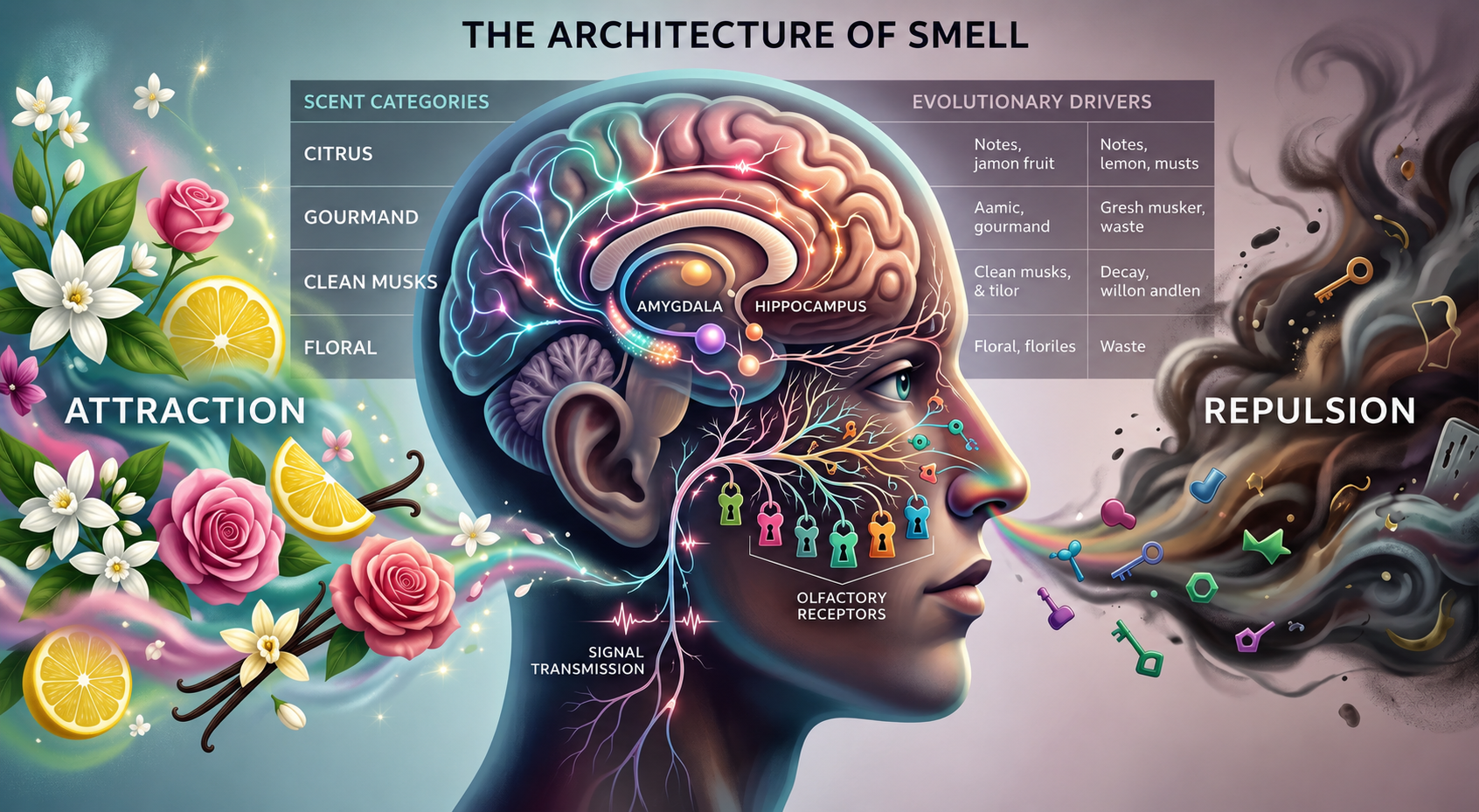
At the core of olfaction lies the olfactory epithelium, a specialized tissue at the roof of the nasal cavity. This area is packed with millions of sensory neurons, each equipped with receptors that serve as “locks” for specific “keys”—the odorant molecules.
When an odorant molecule enters the nose, it binds to a specific G-protein-coupled receptor (GPCR). This binding triggers a chemical cascade within the neuron, converting the chemical signal into an electrical impulse. These impulses travel through the olfactory bulb directly to the limbic system, specifically the amygdala for emotional processing and the hippocampus for memory storage. Unlike sight or sound, scent has a “fast track” to the parts of our brain that govern survival and emotion, which is why scents can trigger memories with such sudden intensity.
The Paradox of Concentration and the Case of Skatole
One of the most intriguing aspects of olfactory science is how concentration dictates perception. A prime example is skatole, an organic compound found in feces.
At high concentrations, skatole is undeniably repulsive, signaling decay and waste—an evolutionary warning to avoid pathogens. However, at trace concentrations, it is remarkably perceived as floral, creamy, and even honey-like. This happens because the human receptor response is not linear. When a concentration is low, our receptors may only identify a fragment of the molecule’s chemical profile, masking the “fecal” note and allowing the sweet undertone to dominate. This phenomenon explains why many master perfumers use “dirty” or animalic notes like civet or musk to add depth and sensuality to a fragrance.
Individual Receptor Variation and Why We Differ
Why does one person find a perfume intoxicating while another finds it choking? The answer lies in genomic variation. Each individual possesses a slightly different set of olfactory receptor genes.
Just as some people are “super-tasters” who find certain vegetables bitter due to specific gene expressions, our olfactory palette is uniquely coded. Your perception of a specific molecule, such as the woody Iso E Super or the musky Galaxolide, depends on the sensitivity threshold of your specific receptor proteins. Furthermore, past experiences—associative learning—can rewire how we interpret these signals. If a scent reminds you of a traumatic event, your amygdala will flag that molecule as unpleasant, regardless of its chemical beauty.
Universal Scents and the Search for Consensus
While there is no single “universal” perfume that appeals to every human due to our biological and cultural differences, certain profiles have historically demonstrated broad appeal due to their associations with cleanliness, safety, or energy-dense nutrition.
| Scent Category | Typical Notes | Evolutionary or Cultural Driver |
| Citrus | Lemon, Bergamot, Grapefruit | Association with freshness, hygiene, and vitality. |
| Gourmand | Vanilla, Tonka Bean, Cocoa | Triggers primal associations with energy-dense food. |
| Clean Musks | Galaxolide, White Musk | Mimics the “clean skin” scent, signaling health and safety. |
| Floral | Jasmine, Rose, Lavender | Associated with lush environments and biodiversity. |
Heritage brands like Chanel or Guerlain have attempted to create “master formulas,” such as the iconic Chanel No. 5. These are not universal in the biological sense, but they are successes in cultural engineering—creating a formula so balanced in its chemical projection that it appeals to a broad cross-section of the population, bridging the gap between individual preference and social trend.
Conclusion and the Future of Fragrance
The scents we choose are a dialogue between our evolutionary past and our individual neurobiology. Perfumery is effectively the art of manipulating the nervous system. By understanding the threshold between the repulsive and the sublime—as seen in the delicate manipulation of concentrations—perfumers can create experiences that resonate deep within our limbic system, bypassing logic to reach the raw, emotional core of the human experience.