





The white sands of a Mexican beach recently became the site of a chilling discovery. A massive, ribbon-like creature, known in folklore as the “Doomsday Fish,” was found washed ashore. For centuries, the appearance of this rare deep-sea dweller has sent ripples of fear through coastal communities. To many, it is not just a biological anomaly but a prophetic warning of earthquakes, tsunamis, and global upheaval.
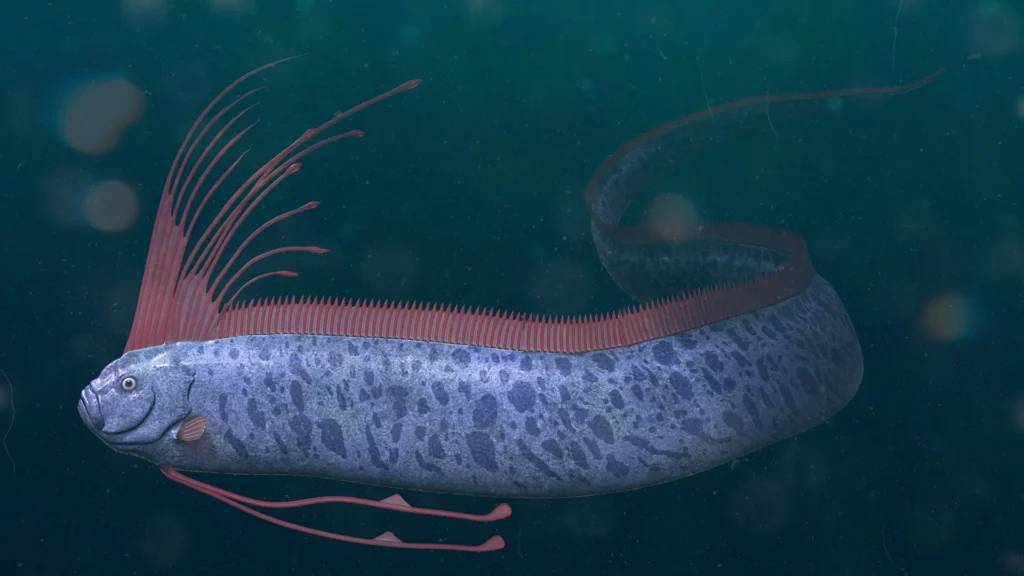
The Sentinel of the Abyss — What is the Oarfish?
The creature in question is the Oarfish (Regalecus glesne). Holding the title of the longest bony fish in existence, it can reach lengths of up to 11 meters (36 feet). Its physical appearance is as striking as its reputation: a silver, scale-less body topped with a vibrant red dorsal fin that resembles a crown.
The “Doomsday” moniker stems from its habitat. Oarfish typically live in the mesopelagic zone, approximately 1,000 meters (3,300 feet) below the ocean surface. They are rarely seen by human eyes; they do not surface to hunt or mate. Historically, when an oarfish is found in shallow waters or on a beach, a natural disaster—usually a massive earthquake—has followed shortly after.
Legend vs. Science — Why Does It Sense Disaster?
In Japanese mythology, the oarfish is known as Ryugu no Tsukai, or the “Messenger from the Palace of the Sea God.” Legend says that dozens of these fish washed ashore in Japan months before the devastating 2011 Fukushima earthquake and tsunami.
While skeptics dismiss this as superstition, some seismologists and biologists offer a scientific hypothesis. Living at extreme depths, oarfish are uniquely attuned to the Earth’s tectonic movements:
- Electromagnetic Sensitivity: Deep-sea creatures may be able to sense the electromagnetic changes that occur when tectonic plates begin to grind or fracture before an earthquake.
- Chemical Changes: The release of gases (such as carbon monoxide) or changes in water chemistry caused by deep-crustal stress can disrupt the oarfish’s habitat, forcing it to flee toward the surface in a state of distress.
- Hydrostatic Pressure: Subtle shifts in deep-sea pressure currents, invisible to surface-dwellers, may act as a biological trigger for these sensitive giants.
The Global Context — A World on Edge
The timing of the Mexican discovery coincides with a period of heightened geological and environmental anxiety. With the “Ring of Fire” showing increased activity and climate shifts altering ocean currents, the appearance of the “Messenger” feels particularly ominous. Whether it is a biological reaction to shifting crusts or a rare ecological accident, the sight of a creature from the abyss serves as a reminder of how little we truly know about the forces beneath us.
What Can Humanity Do in Times of Uncertainty?
When faced with the prospect of “Doomsday” or natural catastrophes, the human response often fluctuates between panic and denial. However, the most effective path lies in adaptation and vigilance:
- Respect the Warning: Whether you believe in the omen or the science, such sightings should encourage local governments to review disaster preparedness and early-warning systems.
- Environmental Consciousness: Understanding that the deep ocean is a sensitive barometer for the planet’s health. Changes in deep-sea behavior often reflect broader environmental instabilities.
- Community Resilience: In the face of global shifts, the survival of a “bio-social” species depends on group cohesion. Strengthening local ties and disaster education is the only shield against the unpredictable.
- Stoicism and Common Sense: Nature has its cycles—some spanning minutes, others millions of years. Maintaining a grounded perspective and focusing on what we can control—our readiness and our empathy—is essential.
Thankfulness to my father who told me on the topic of this
website, this blog is really amazing.
It’s fantastic that you are getting ideas from
this post as well as from our dialogue made here.
I know this if off topic but I’m looking into starting my own blog and was curious what all is required to get
setup? I’m assuming having a blog like yours would cost a pretty penny?
I’m not very internet savvy so I’m not 100% sure.
Any tips or advice would be greatly appreciated.
Many thanks