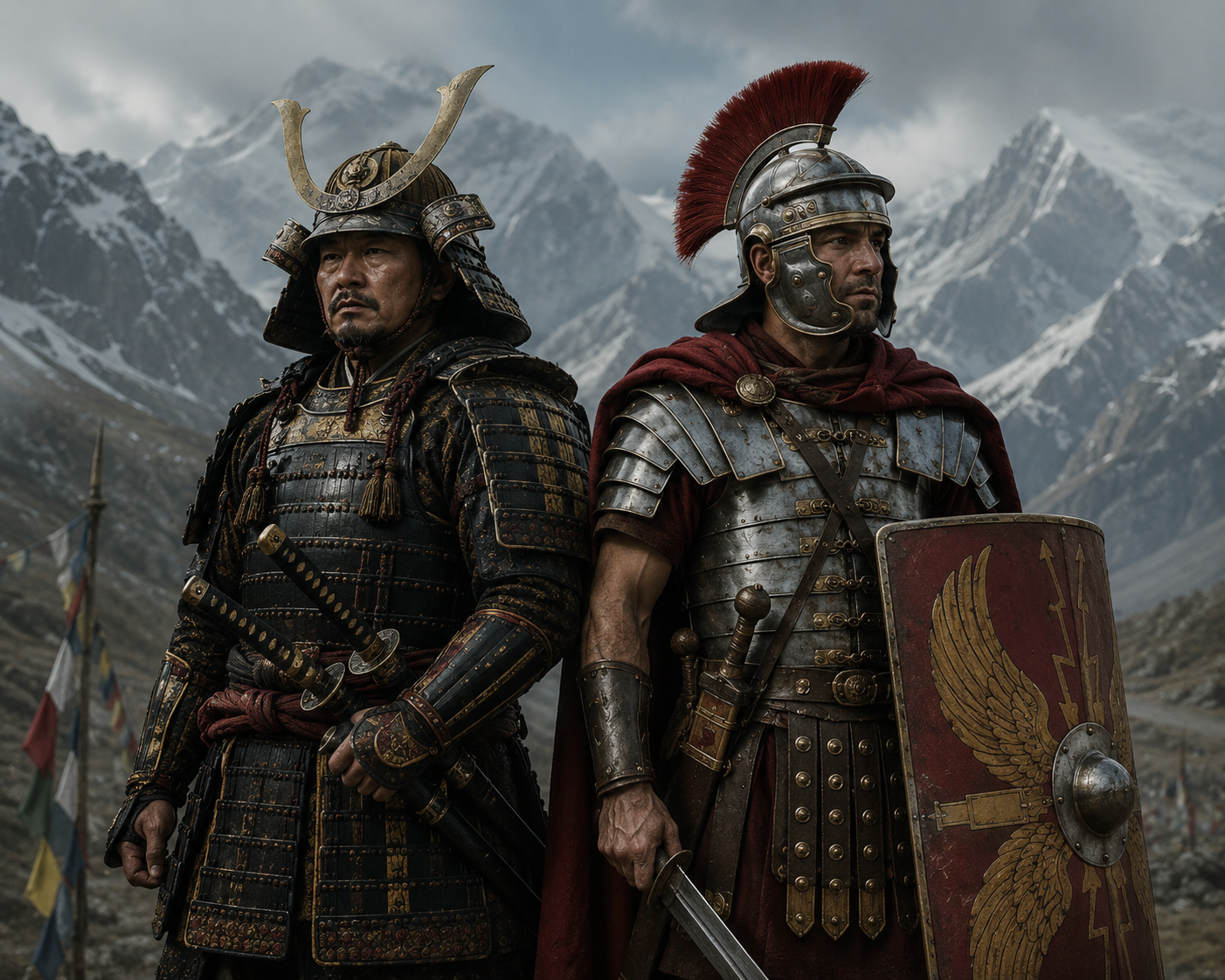




The historical context for such an encounter is purely speculative, yet it provides a fascinating laboratory for military analysis. Imagine a “Lost Legion” pushing beyond Bactria, ascending the Karakoram passes, only to encounter an expeditionary force of a Shogunate seeking to expand its influence over the mountain trade routes.
Composition and Capabilities
The Roman Legion (Legio Rapax)
The Romans bring a disciplined, heavy-infantry-centric force. Their strength lies in the Maniple system and the Scutum (large rectangular shield).
- Armament: The Gladius (short sword), Pilum (heavy javelin), and Lorica Segmentata (iron plate armor).
- Tactics: Tight formations, shield walls, and systematic advancement.
- Artillery: Portable Ballistae and Onagers, which are difficult to transport in mountains but devastating if deployed.
The Shogunate Forces (Bushi/Samurai)
The army of the Shogun is a mix of elite mounted archers and disciplined infantry (Ashigaru).
- Armament: The Yumi (asymmetrical longbow), Naginata (polearm), and the early Tachi (curved sword).
- Tactics: High-mobility skirmishing, expert archery from horseback, and individual duels of honor.
- Armor: Lamellar (small scales) of iron and leather, designed for flexibility.
The Himalayan High Plateau
The Himalayas are the “Great Leveler.” At 4,000 meters, the thin air and jagged terrain dictate the rules of engagement.
| Factor | Impact on Romans | Impact on Shogunate |
| Altitude (Oxygen) | Severe. Heavy iron armor makes breathing nearly impossible during a charge. | Moderate. Japanese armor is lighter, but horses will suffer from altitude sickness. |
| Rugged Slopes | Disrupts the Testudo and shield wall. Gaps appear in the formation. | Advantageous for Yumi archers who can fire from high ridges. |
| Temperature | Iron armor becomes a “refrigerator,” drawing heat away from the body. | Silk and leather layers provide better insulation. |
Strengths and Weaknesses
Roman Empire
- Strength: Engineering. Romans can build a fortified camp (Castra) in a single night even on rock, creating a “portable fortress” that the Shogun cannot easily storm.
- Weakness: Predictability. Roman tactics rely on a flat, steady frontline. In the mountains, they are vulnerable to ambushes from above.
Shogunate
- Strength: Skirmishing. The Yumi bow has a longer effective range than the Roman Pilum. Samurai can harass the Roman column from the slopes without ever engaging in close combat.
- Weakness: Discipline. While elite, Samurai often sought individual glory, which could lead to a lack of cohesion against a locked Roman shield wall.
The Reconstruction: The Battle of the High Pass
The battle begins as the Romans attempt to hold a narrow valley. The Shogun’s archers occupy the surrounding ridges.
- Phase 1: The Rain of Arrows. The Samurai rain arrows down. The Romans form the Testudo (turtle). However, the Yumi arrows fired from high elevation have immense kinetic energy, occasionally piercing the wooden shields.
- Phase 2: The Roman Counter-Push. Realizing they cannot stay still, the Roman commander orders an uphill charge. The heavy Lorica Segmentata becomes a curse; the soldiers tire quickly in the thin air.
- Phase 3: The Naginata Charge. As the Roman line thins and gaps appear due to the uneven rocks, the Shogun’s infantry charges with Naginatas. These polearms can outreach the Roman Gladius, striking at the legs and necks of the legionaries.
Potential Victor
In this specific Himalayan setting, the Shogunate Forces hold the advantage.
The Roman military machine was designed for the plains of Europe and the deserts of the Middle East. Its heavy infantry and rigid formations are “brittle” in extreme mountain terrain. The Shogunate’s flexibility, lighter armor, and superior long-range archery allow them to bleed the Legion dry through attrition without ever meeting them in a full-scale “fair” fight on a flat field.
The Verdict: The Roman Eagle would likely fall in the snow. The Legion’s strength is its mass, but in the mountains, mass is a liability. The Shogun’s blade, favored by agility and height, would prevail.