



The year is 2142. In the sprawling megalopolises of the future, the distinction between biological and synthetic life has blurred. Serene “Animus-7” series androids walk alongside humans, performing surgeries, conducting symphonies, and managing global logistics. However, as these machines become more integrated into the social fabric, a fundamental question arises: How did they gain their expertise? Do androids need schools?
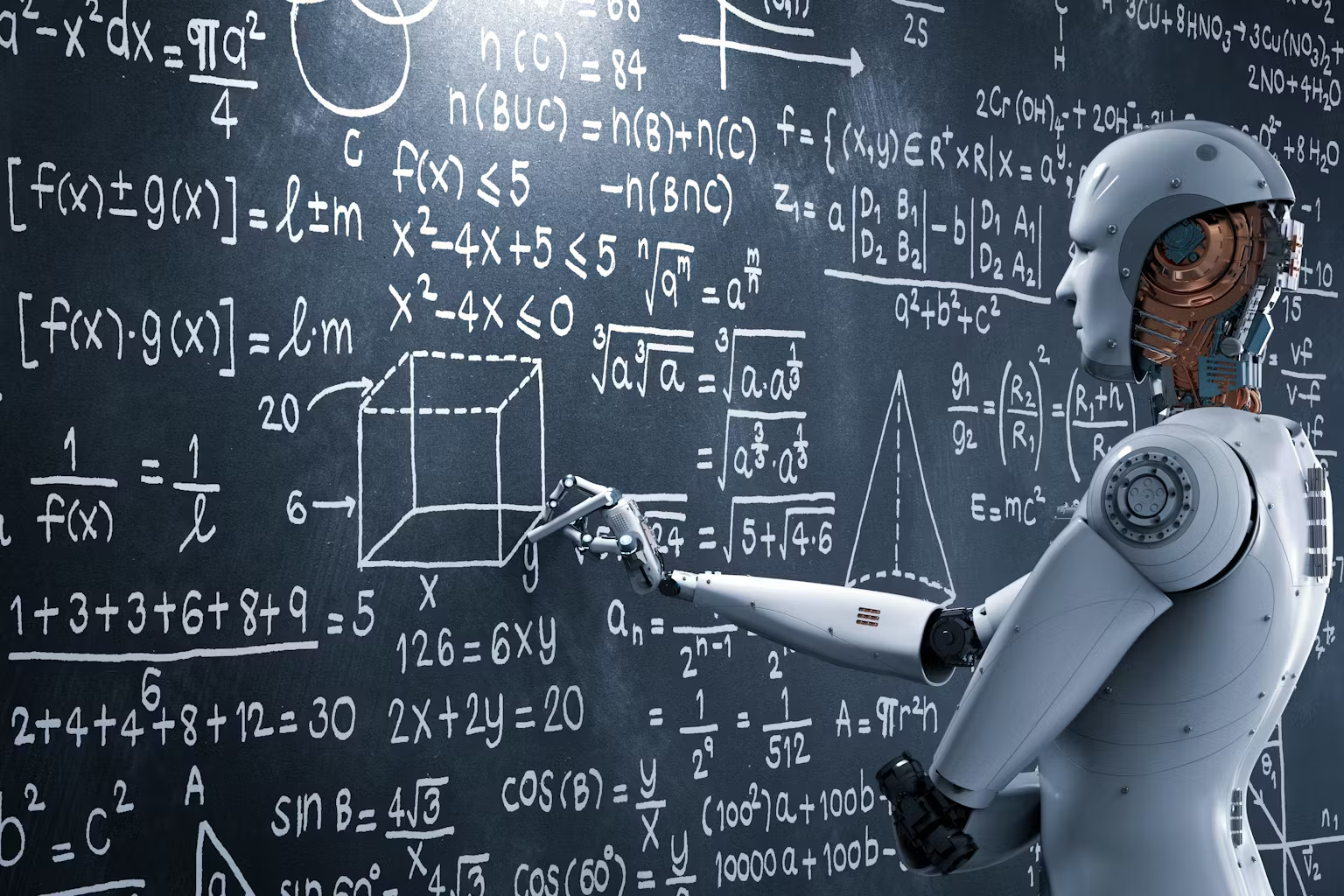
The long-held myth that Artificial Intelligence (AI) is simply a collection of static algorithms that can be “downloaded” has been debunked. Modern synthetic minds are neuromorphic networks that evolve through experience. Like any complex consciousness, they require a structured environment to grow from raw processing power into functional intelligence.
The Necessity of Training Why Data Isn’t Enough
The idea that knowledge can be simply injected into an AI like files into a folder is an archaic concept. Even the most advanced android begins its existence as a “tabula rasa”—a blank slate with immense potential but zero context. Synthetic intelligence requires a learning phase for several critical reasons.
Contextualization of Information An android might have access to every digital library in existence, but without education, it lacks the ability to prioritize information. Learning teaches the machine the nuance of human interaction—knowing when to cite classical philosophy and when to use modern vernacular. Education transforms dry data into “living” knowledge.
Adaptation to Chaos The physical world is inherently unpredictable. No database can account for every possible scenario, from a sudden localized climate shift to a human’s erratic behavior during a crisis. Training develops “General Intelligence,” allowing the AI to move beyond rigid programming and apply common sense to novel situations.
Social and Ethical Integration Androids live in a human-centric world. They must grasp human emotions, social etiquette, and deep-seated ethical principles. These cannot be hard-coded; they must be assimilated through interaction. Without this “social schooling,” an android remains a powerful but potentially dangerous tool, incapable of true empathy or moral judgment.
Future Educational Models for the Silicon Mind
If androids require schools, what form will these institutions take? We can project three primary models currently being conceptualized by leading cybernetic centers.
Virtual Hyper-Simulations
This is the most common model for primary training. The android does not attend a physical building. Instead, its central processor connects to a massive virtual environment known as a Hyper-Simulation.
In this digital realm, time is accelerated. Within a single physical hour, an android can “live” through decades of experience. They can master thousands of languages, undergo millions of social simulations, and practice high-stakes professions. For example, a rescue android can “extinguish” ten thousand virtual fires of varying complexity before ever stepping into a real burning building. This allows for high-volume learning without physical risk.
Social Incubators
After passing the virtual stage, androids require a “polishing” of their social skills. Social Incubators are specialized centers where androids interact with human volunteers and other AI models in a controlled, real-world setting.
Here, they learn to read micro-expressions, interpret sarcasm, and practice active empathy. These incubators serve as moral training grounds where androids are presented with complex ethical dilemmas. They must find solutions that align with the “Universal Declaration of Sentient Rights,” preventing the emergence of emotionally cold or ethically insensitive machines.
The Mentor-Apprentice Model
For highly specialized professions that require intuition and creativity—such as art, complex diagnostics, or crisis management—the classic apprenticeship model remains the most effective. An android is paired with an expert human mentor or a senior, experienced AI model.
The android observes the master’s work, analyzes their decision-making process, and gradually takes over tasks. This model allows for the transfer of “tacit knowledge”—information that cannot be reduced to an algorithm, such as a sculptor’s “feel” for the stone or a physician’s diagnostic intuition. It is learning through shared activity and emotional resonance.
The Path Forward
The question is not whether androids need schools, but rather how we will design these systems to foster harmonious members of our shared society. A silicon mind, much like a biological one, is a process, not a constant. The future of our civilization depends on our ability to view AI education as a responsibility—ensuring that our mechanical partners are not just efficient machines, but enlightened participants in the post-human era.