




In an era defined by instantaneous communication and digital dependence, the phrase “the world is at our fingertips” has never been more true. But this seamless connectivity is not achieved through magic; it is made possible by a vast, intricate, and surprisingly fragile network of fiber-optic cables resting on the floor of the world’s oceans. This invisible infrastructure is the backbone of the global internet, carrying over 95% of all international data and voice traffic. It is the silent engine of the modern world, powering everything from financial markets and government communications to scientific research and social media. This very indispensability, however, makes the subsea cable network a prime target in an age of shifting geopolitics and asymmetrical warfare. For nations that reject international norms and seek to disrupt the “civilized” world, these underwater arteries represent a unique and potent vulnerability.
The Great Connector: How the Internet is Built Underwater
To understand the risk, one must first grasp the scale and structure of this subsea network. Forget the mental image of satellites beaming internet to our devices. While satellite internet (like Starlink) exists, it handles only a tiny fraction of global traffic due to latency and capacity limitations. The real heavy lifting is done by standard fiber-optic cables, some no thicker than a soda can, stretching for thousands of miles across abyssal plains and continental shelves.
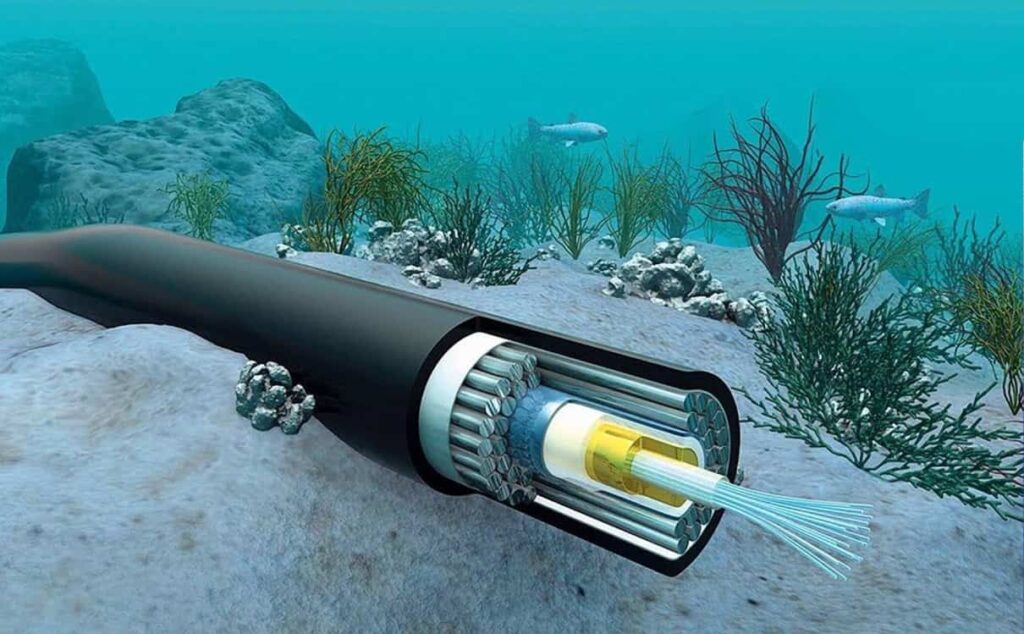
The architecture of the global internet is a marvel of engineering. Major data centers in North America, Europe, and Asia are connected by a web of these cables, which terminate at specific “landing stations” on the coast. These landing stations, in turn, connect to the terrestrial fiber-optic networks that distribute the signal inland. The key to the system’s resilience—historically—has been its redundancy. If one cable is damaged, traffic is automatically rerouted through others. A cable cut off the coast of New York might slow down traffic to London, but it rarely cuts it off entirely.
However, this redundancy is not evenly distributed across the globe. Certain geographical chokepoints compress multiple cables into narrow, high-risk lanes. This is the structural flaw that hostile state actors and terrorist organizations are increasingly looking to exploit.
The Chokepoint Peril: The Strait of Hormuz Scenario
Perhaps no single location better illustrates this concentration of risk than the Strait of Hormuz. This narrow passageway, situated between Iran and Oman, is famous for its role in global oil transit. Less known, but equally critical, is its role as a key internet corridor.
A significant number of subsea cables connecting Europe to Asia run directly through the Strait of Hormuz. These cables are the primary digital pathway between major European internet hubs (like Frankfurt, London, and Amsterdam) and the booming markets and data centers of the Middle East, India, and East Asia.
The damage, even if localized, would be catastrophic. Imagine a coordinated attack in the Strait of Hormuz that successfully severs just one of these high-capacity cables.
- Europe’s Immediate Blindness: Suddenly, the direct, low-latency pathway to Asian data would be cut. European businesses dependent on real-time data from Asian markets (finance, logistics, manufacturing supply chains) would face severe disruption. Communication with subsidiaries and partners in Asia would become laggy, unreliable, or impossible.
- The Overload Effect: The massive amount of data that was flowing through the Strait of Hormuz would be immediately rerouted. This traffic would have to find an alternative path—likely through much longer, already-congested routes (such as across the Pacific and United States, or around the southern tip of Africa). This new, rerouted traffic would inevitably create extreme congestion on these alternative paths, slowing down all internet traffic between Europe and Asia and increasing latency for users worldwide.
- Regional Isolation: For countries like the UAE, Oman, and Qatar, which are directly serviced by these cables, the impact would be even more severe. Some could face near-total digital isolation from the Western world.
This isn’t a hypothetical problem. The Strait of Hormuz is situated adjacent to Iran, a state that has demonstrated a repeated willingness to use its geography to project power and disrupt international systems. Any malicious actor—state-sponsored or a well-equipped terrorist group—could view a coordinated cable-cutting operation in the Strait as a cheap and highly effective way to hold the global economy hostage.
The Asymmetrical Threat: Digital Warfare on a Budget
The vulnerability of subsea cables is an asymmetrical threat par excellence. It costs millions to lay a single transoceanic cable, but relatively little to destroy it. Hostile countries, unable to compete with the civilized world militarily or economically, see this infrastructure as a prime target. By damaging these cables, they can inflict billions of dollars in economic damage, cause widespread societal chaos, and compromise the communication networks of their rivals—all while maintaining a degree of deniability that is difficult with traditional military actions.
The risks extend beyond simple sabotage. Hostile nations have been accused of using specialized “spy ships” to loiter over cable routes, potentially for the purpose of tapping into the data they carry or mapping the network for future attacks. This persistent surveillance is a clear indication that the subsea environment is becoming the new frontline in cyber and intelligence warfare.
Securing the Deep: The Path Forward
The defense of the global internet cannot be left to private telecommunications companies alone. It is a shared responsibility that requires a multifaceted approach:
- Enhanced Monitoring and Protection: Naval forces, particularly those of NATO and other democratic alliances, must increase their presence and surveillance in known cable corridors and chokepoints. Advanced technology, such as autonomous underwater vehicles (AUVs), should be deployed to monitor cable routes for signs of tampering.
- Rapid Repair Capabilities: The global fleet of cable-laying and repair ships must be expanded and strategically stationed to minimize response times in the event of a cut. Hostile nations will target the system, not just individual cables, so the ability to rapidly restore connectivity is as important as the ability to prevent an attack.
- Diplomacy and Law: The international community must establish clear, binding norms and legal frameworks that define attacks on subsea infrastructure as a severe violation of international law, carrying significant consequences.
- Investment in Redundancy: Governments must encourage and incentivize the development of alternative cable routes that bypass traditional chokepoints. This could include new routes through the Arctic Ocean or increased investment in terrestrial networks that offer diverse pathways.
The global internet is a magnificent achievement, but it is not invulnerable. The fiber-optic cables that connect us are silent, deep-sea targets for those who wish to unravel the fabric of civilization. Recognizing this reality is the first step toward building the robust, redundant, and secure infrastructure that the 21st century demands.ows us to live freely and connected remains at the mercy of those who wish to see that freedom disappear.