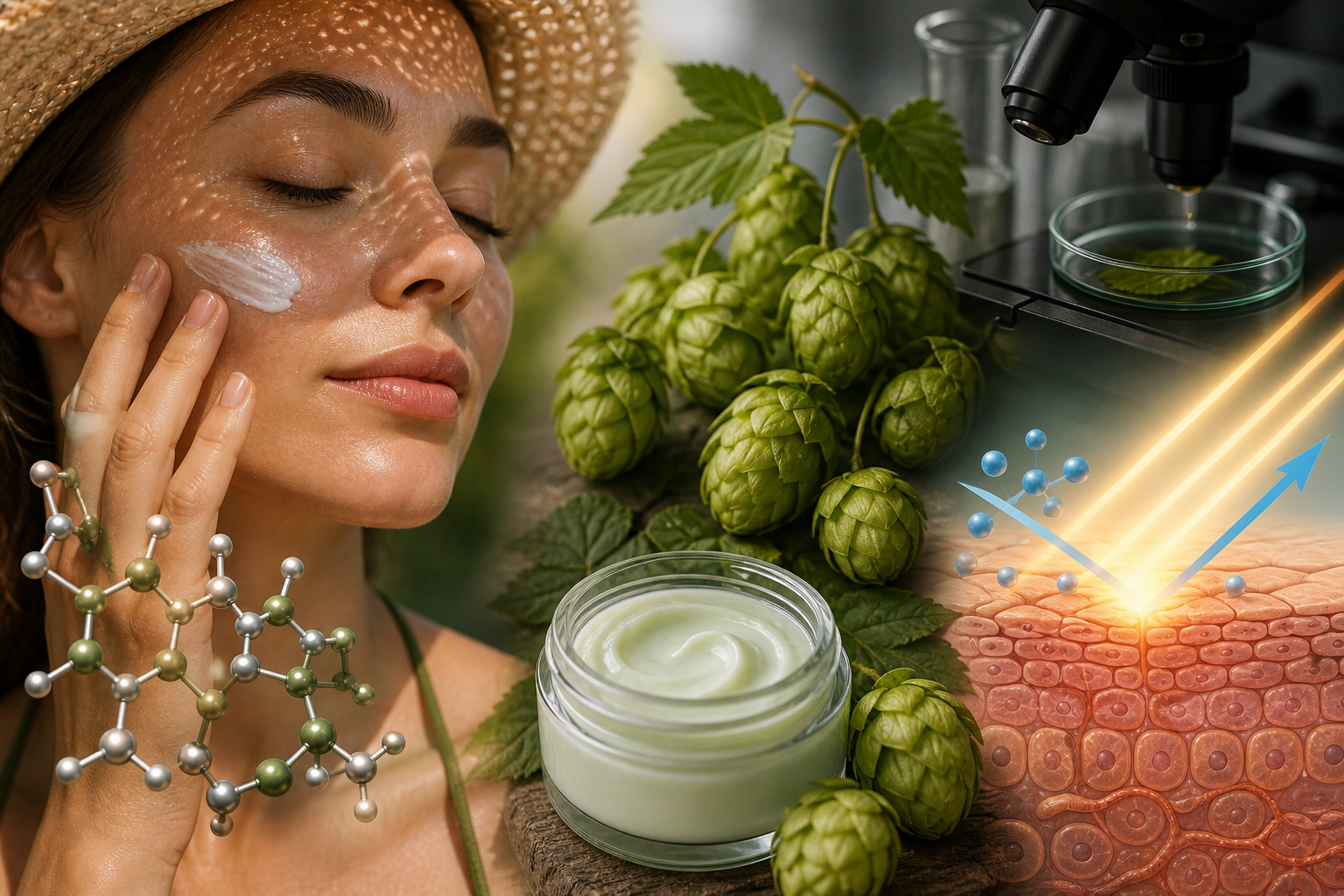




Can your favorite pint actually protect you from the sun? While it sounds like a catchy headline, recent research from the University of São Paulo (published in Applied Sciences) has grounded this idea in serious molecular biology.
Scientists have discovered that brewing by-products — specifically hops (Humulus lupulus) — contain a complex biochemical toolkit that can shield human cells from the destructive energy of the sun.
The Molecular Battlefield: How UVB Destroys Skin
To understand how hops help, we first need to look at the enemy. UVB radiation (280–315 nm) acts as a high-energy “bullet.” When these rays hit your skin, they trigger two devastating biochemical pathways:
- Direct DNA Damage: UVB photons are absorbed directly by DNA bases, causing them to fuse incorrectly (forming pyrimidine dimers), which leads to mutations.
- The Oxidative Storm: Radiation splits water and oxygen molecules in the skin to create Reactive Oxygen Species (ROS). These unstable molecules attack cell membranes (lipid peroxidation) and destroy structural proteins like collagen.
The Biochemistry of Hops: Nature’s Radical Scavengers
The study reveals that hops aren’t just a physical barrier; they are a sophisticated biochemical defense system. The protection comes from a class of compounds called prenylated flavonoids and bitter acids.
1. Xanthohumol: The “Master” Antioxidant
Xanthohumol is a unique prenylflavonoid found almost exclusively in hops. At a molecular level, it acts as a high-capacity electron donor. It “quenches” free radicals by donating an electron to stabilize them before they can damage cellular structures. Furthermore, Xanthohumol activates the Nrf2 pathway — a master switch in human cells that turns on the production of our body’s own internal protective enzymes (like glutathione).
2. Alpha and Beta Acids (Humulones and Lupulones)
These are the compounds that give beer its bitterness, but on the skin, they function as potent anti-inflammatories. They work by inhibiting the COX-2 enzyme, the same molecular target that aspirin or ibuprofen hits. By blocking this enzyme, hop extracts prevent the biochemical cascade that leads to redness, swelling, and “sunburn” pain.
3. Polyphenolic Shielding
The polyphenols in hops contain aromatic rings that are perfectly tuned to absorb energy in the UV spectrum. When a UVB photon hits these molecules, the energy is absorbed and dissipated as harmless heat through a process called internal conversion, preventing the photon from ever reaching your DNA.
From the Brewery to the Beauty Counter
During the experiment at the University of São Paulo, researchers developed a topical formulation enriched with these concentrated extracts. They monitored biochemical markers of stress in skin cells and found that the hop-enriched cream significantly lowered levels of malondialdehyde (MDA) — a key biological marker of cellular fat “rancidity” caused by the sun.
Crucial Distinction: This does not mean you should apply beer to your skin. Beer contains ethanol, which can disrupt the skin’s lipid barrier and potentially increase penetration of harmful substances. The scientists used purified, concentrated extracts of the hops themselves to achieve these results.
Why This Matters for the Future
This discovery is a major win for sustainable “green” chemistry. By upcycling brewing waste, the cosmetic industry can move away from purely synthetic filters toward “biological filters.”
We are likely looking at a future where your sunscreen isn’t just a chemical block, but a plant-based repair kit. The University of São Paulo has demonstrated that Humulus lupulus can effectively “neutralize” the sun’s energy before it turns into a medical emergency.